

Archive position — measured, not model output
1 like on Devpost
505 of the 7,850 archived projects have more likes, and 1,758 share exactly 1 — so this project's #1,110 place in the like-ranked listing is a tie-break inside that group, not a ranking.
Projects (log scale)
Likes on Devpost. ▲ marks this project's group.
Show the figures
| Likes | Projects | Share of archive |
|---|---|---|
| 0 | 5,587 | 71.2% |
| 1 | 1,758 | 22.4% |
| 2 | 284 | 3.6% |
| 3–4 | 132 | 1.7% |
| 5–9 | 75 | 1.0% |
| 10+ | 14 | 0.2% |
 User Stories BotA demo video on every pull request
Get a demo video on every new feature
GitHub App that watches your pull requests and records a narrated, captioned demo.
Save time on demo prep and make informed decisions faster with a video walkthrough of every new feature.
Executive Summary
What the company appears to be
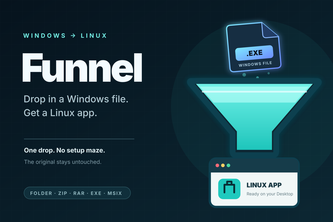
Funnel is a self-reported local desktop application for Linux that converts offline Windows game files (folders, archives, EXEs) into Linux desktop launchers using tools like Wine, Proton, UMU, and GTK3. It is built by one person, Ethan Stigter, and was submitted as a project to the OpenAI 2026 hackathon.
What changed
The author states that this is a new tool developed during Build Week using Codex and GPT-5.6 for development assistance, but no prior version or evolution is described.
The single most important open question
Is there any evidence of product-market fit, customer traction, or commercial viability beyond the author’s own use case?
Note: This analysis is based entirely on the self-reported description provided by the author. No independent verification, revenue data, customer names, or adoption metrics are available.
What The Product Actually Is
The description states that Funnel is a local Python and GTK application designed to convert offline Windows game files into Linux desktop launchers. It supports various formats including folders, ZIP, RAR, 7z archives, EXE, and installers.
It extracts games safely, identifies the correct executable among potentially multiple candidates, creates isolated Wine or Proton environments, and places a launcher on the Desktop and in the application menu.
The original game files remain untouched. Steam is optional and no Steam account is required.
Claim: Funnel turns an offline Windows game into a Linux desktop app.
Evidence: Author's own write-up.
Inference: The tool operates locally without cloud or AI models inside it.
Evidence: Author states that conversion is local and deterministic, and there is no AI model inside Funnel.
Positioning & Claim Evolution
The author positions Funnel as a solution for Linux users who want to run older or independent Windows games without the complexity of manual setup. The tagline “Drop in a Windows game. Get a Linux launcher.” reflects this intent.
There is no indication that Funnel has evolved from an earlier version or that its positioning has shifted over time. It appears to be a one-time project submitted for a hackathon.
Claim: Drop in a Windows game. Get a Linux launcher.
Evidence: Tagline and author's own write-up.
Inference: The tool is aimed at users who want simple access to older or DRM-free games.
Evidence: Author states that the goal was to simplify setup for offline, DRM-free games.
Target Customer & ICP
The description suggests that Funnel targets Linux users who play older or independent Windows games and wish to avoid complex Wine/Proton setup. It is not described as targeting gamers with online services, kernel anti-cheat systems, or proprietary launchers.
Claim: The tool is for Linux users wanting to run offline, DRM-free Windows games.
Evidence: Author's own write-up.
Inference: The ICP likely includes Linux enthusiasts and retro gaming fans who prefer local tools over online services.
Evidence: Author’s stated intent and the tool’s design for offline use.
Business Model & Pricing Evidence
There is no evidence of a business model or pricing structure. The project is described as a personal hackathon submission with no indication of monetization, licensing, or distribution plans.
Claim: No commercial model or pricing information.
Evidence: Author’s own write-up and project description.
Technical & Delivery Signals
Funnel is built using Python, GTK3, and integrates with tools like 7-zip, freedesktop, UMU, Wine, and Proton. It uses Codex and GPT-5.6 for development assistance but does not embed AI models into the final product.
It handles safe extraction, executable selection, and launcher creation. The author notes challenges in identifying correct executables and improving detection logic over time.
Claim: Funnel is a local Python/GTK application using Wine/Proton/UMU.
Evidence: Author's own write-up and technology tags.
Inference: The tool is deterministic, not cloud-based, and designed for offline use.
Evidence: Author states conversion is local and deterministic.
Traction & Maturity Signals
There is no evidence of traction, customers, or adoption beyond the author’s own testing. No metrics, usage data, or feedback from users are provided. The project is described as a hackathon submission with no indication of further development or market entry.
Claim: No traction or maturity signals.
Evidence: Author's own write-up and lack of any external validation.
Competitive Context
The description does not mention competitors or similar tools in the space. It is unclear whether there are existing solutions for converting Windows games to Linux launchers, nor if Funnel fills a gap or overlaps with others.
Claim: No competitive context provided.
Evidence: Author's own write-up and project description.
Open Questions & Risks
- The tool is described as a single-person hackathon project with no commercial traction.
- It targets only offline, DRM-free games — limiting its market scope.
- No evidence of scalability or distribution strategy.
- No indication of long-term maintenance or updates beyond the author’s testing.
Inference: Lack of commercial viability or product-market fit.
Evidence: Author's own write-up and absence of any traction or business model.
Questions the description leaves open
- What is your plan for distribution and adoption beyond personal use?
- Have you tested Funnel with a wide range of games, and how does it handle edge cases?
- Are there plans to support online games or those with anti-cheat systems?
- Is there any intention to monetize or scale this tool beyond the current scope?
- What are your long-term goals for Funnel — is it intended as a side project or a product?
Overall Assessment
There is no evidence of commercial traction, revenue, or customer adoption. The project is described as a single-person hackathon submission with no indication of market readiness or scalability.
Claim: No investment or partnership potential.
Evidence: Author's own write-up and lack of any business or product traction data.
Inference: This appears to be a proof-of-concept tool, not a scalable or commercial product.
Evidence: Author’s description of it as a hackathon project with no further development plans.
User Stories BotA demo video on every pull request
Get a demo video on every new feature
GitHub App that watches your pull requests and records a narrated, captioned demo.
Save time on demo prep and make informed decisions faster with a video walkthrough of every new feature.
Source
Submitted to the OpenAI 2026 hackathon on Devpost. Project home on Devpost. Back to the full gallery on Devpost.
This competitive analysis was produced by top-founders.com (opens in a new tab)
Generated by a language model from this project's public Devpost page — its tagline, the author's own write-up and any built-with tags listed there — as captured in August 2026. Short quotations are the author's words. It is an opinion on the idea as a business, not on the people behind it, and it reflects the description as published then. If the project has moved on, request a correction below. The analysis is not independent research and contains no verified traction, revenue or customer data.
An independent guide by KFG International LLC — not affiliated with, endorsed by, or connected to Devpost or OpenAI.