

Archive position — measured, not model output
1 like on Devpost
505 of the 7,850 archived projects have more likes, and 1,758 share exactly 1 — so this project's #1,112 place in the like-ranked listing is a tie-break inside that group, not a ranking.
Projects (log scale)
Likes on Devpost. ▲ marks this project's group.
Show the figures
| Likes | Projects | Share of archive |
|---|---|---|
| 0 | 5,587 | 71.2% |
| 1 | 1,758 | 22.4% |
| 2 | 284 | 3.6% |
| 3–4 | 132 | 1.7% |
| 5–9 | 75 | 1.0% |
| 10+ | 14 | 0.2% |
 User Stories BotA demo video on every pull request
Get a demo video on every new feature
GitHub App that watches your pull requests and records a narrated, captioned demo.
Save time on demo prep and make informed decisions faster with a video walkthrough of every new feature.
Executive Summary
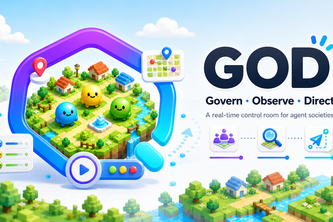
The description states that G.O.D is a control room for observing, questioning, and steering multi-agent societies. The author describes it as an interactive system running LLM agents in a simulated town environment, with capabilities to pause, replay, ask questions, intervene, and export experiments. It was built for the OpenAI 2026 hackathon.
The project is self-reported and unverified. There is no evidence of revenue, customers, or traction beyond the author's own account. The description does not state whether G.O.D has any commercial product or business model in place, nor does it describe any market or competitive positioning beyond its hackathon submission.
Key open question
What is the intended commercial application of G.O.D? Is this a prototype for a larger product, or a proof-of-concept with no clear path to monetization?
What The Product Actually Is
The description states that G.O.D runs a town of LLM agents on an interactive map. Users can pause, replay, ask residents questions, intervene in the next step, and export experiments.
It is built using:
- React/Vite frontend
- FastAPI backend
- Pixel Town environment
- JiuwenClaw agent runtime
The system uses structured, reusable files for experiments, maps, agents, and replay data. It supports browser replays, a no-code setup flow, and portable experiment packs.
Inference The product appears to be a simulation or visualization tool for multi-agent systems, with an emphasis on interactivity and reproducibility.
Positioning & Claim Evolution
The description states that G.O.D is inspired by Generative Agents and OASIS. It aims to provide an interactive control room where users can observe, question, and steer agent societies.
It was built for the OpenAI 2026 hackathon, suggesting a focus on experimentation and demonstration rather than commercial deployment.
Inference The positioning appears to be as a tool for research or prototyping of multi-agent systems, with potential future applications in simulation, training, or visualization.
Target Customer & ICP
The description does not state who the target customer is. It does not name any specific user personas or buyer types.
Not evidenced No information on who would use this product, what their needs are, or how they would interact with it beyond the author’s own use case in a hackathon setting.
Business Model & Pricing Evidence
The description does not state anything about pricing, monetization, or business model. It does not mention any revenue streams, subscriptions, or commercial offers.
Not evidenced No evidence of a business model or pricing structure.
Technical & Delivery Signals
The project is built with:
- Frontend: React/Vite
- Backend: FastAPI
- Environment: Pixel Town
- Agent runtime: JiuwenClaw
- Data storage: SQLite
- Communication: WebSockets
It supports:
- Browser replays
- No-code setup flow
- Portable experiment packs
- Structured, reusable files for experiments, maps, agents, and replay data
Inference The system is built with a modern stack and emphasizes modularity and reusability. It appears to be designed for experimentation and simulation rather than production use.
Traction & Maturity Signals
The description states that this project was submitted to the OpenAI 2026 hackathon, and that it was built in a short timeframe (implied by “hackathon” context).
It does not state any revenue, customers, or adoption beyond the author’s own account.
Not evidenced No evidence of traction, user base, or product maturity beyond a prototype.
Competitive Context
The description references Generative Agents and OASIS as inspirations. It also mentions multi-agent systems and LLMs as core components.
It does not name any competitors or describe how G.O.D differentiates from existing tools in the space.
Not evidenced No competitive landscape, differentiation, or market positioning beyond the author’s own description.
Open Questions & Risks
- The project is a hackathon submission with no evidence of commercial traction.
- No stated business model or pricing.
- No mention of any customers or users beyond the author.
- The system appears to be experimental and not production-ready.
- The team size is listed as 1, which may limit development capacity.
Inference The risk of this being a non-commercial prototype with no clear path to monetization is high. The lack of evidence for traction or product-market fit raises concerns about viability.
Questions the description leaves open
- What is the intended commercial application of G.O.D?
- How does it differ from existing tools in multi-agent simulation or LLM agent orchestration?
- Is there a plan to move beyond the hackathon prototype into a product or service?
- What are the technical and operational challenges that would need to be overcome for production use?
- Are there any early adopters or pilot customers?
Overall Assessment
The description states that G.O.D is a hackathon submission. There is no evidence of revenue, customers, or traction.
Not evidenced No basis for evaluating investment or partnership potential beyond the author’s own account.
Inference Without further information on commercial viability, product-market fit, or business model, it is not possible to assess whether G.O.D is a viable target for investment or partnership. The project appears to be an experimental prototype with no clear indication of future development or monetization strategy.
User Stories BotA demo video on every pull request
Get a demo video on every new feature
GitHub App that watches your pull requests and records a narrated, captioned demo.
Save time on demo prep and make informed decisions faster with a video walkthrough of every new feature.
Source
Submitted to the OpenAI 2026 hackathon on Devpost. Project home on Devpost. Back to the full gallery on Devpost.
This competitive analysis was produced by top-founders.com (opens in a new tab)
Generated by a language model from this project's public Devpost page — its tagline, the author's own write-up and any built-with tags listed there — as captured in August 2026. Short quotations are the author's words. It is an opinion on the idea as a business, not on the people behind it, and it reflects the description as published then. If the project has moved on, request a correction below. The analysis is not independent research and contains no verified traction, revenue or customer data.
An independent guide by KFG International LLC — not affiliated with, endorsed by, or connected to Devpost or OpenAI.