

Archive position — measured, not model output
0 likes on Devpost
2,263 of the 7,850 archived projects have more likes, and 5,587 share exactly 0 — so this project's #5,038 place in the like-ranked listing is a tie-break inside that group, not a ranking.
Projects (log scale)
Likes on Devpost. ▲ marks this project's group.
Show the figures
| Likes | Projects | Share of archive |
|---|---|---|
| 0 | 5,587 | 71.2% |
| 1 | 1,758 | 22.4% |
| 2 | 284 | 3.6% |
| 3–4 | 132 | 1.7% |
| 5–9 | 75 | 1.0% |
| 10+ | 14 | 0.2% |
 User Stories BotA demo video on every pull request
Get a demo video on every new feature
GitHub App that watches your pull requests and records a narrated, captioned demo.
Save time on demo prep and make informed decisions faster with a video walkthrough of every new feature.
Executive Summary
Company: Lmpool
Self-reported basis: The entire analysis is based on a single author-supplied description from Devpost, submitted as part of the OpenAI 2026 hackathon. No external verification or archived evidence exists for this project.
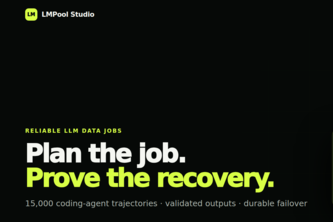
What it appears to be: A tool for managing large-scale LLM workloads through durable, declarative workflows, with a visual Studio interface and capacity-aware execution.
What changed: The author reports redesigning the tool during Build Week around declarative jobs and durable runs, adding a visual control plane (Studio), and improving reliability, cost estimation, and monitoring.
Most important open question: Is there evidence of real-world usage or traction beyond the solo builder's own experiments?
What The Product Actually Is
The description states that Lmpool:
- Turns large LLM workloads (e.g., completions, annotations, judgements over datasets) into typed, declarative execution plans.
- Validates workloads, estimates cost, plans concurrency, and executes them durably.
- Includes a visual Studio workspace for designing jobs, uploading datasets, previewing plans, launching immutable revisions, and monitoring progress, retries, model assignments, lineage, and cost.
Inference: The tool appears to be a workflow engine for LLM tasks, with an emphasis on reliability, observability, and capacity management. It is built around Python and uses Codex and GPT-5.6 Sol for development.
Positioning & Claim Evolution
The author states:
- Lmpool was originally built to study thousands of conversations with coding agents over a year.
- The tool aims to manage context limits, rate limits, cost, concurrency, invalid outputs, and multiple model deployments.
- It is positioned as a way to turn fragile LLM API loops into planned, durable, observable workflows.
Inference: The positioning evolved from a personal research tool to a general-purpose workflow engine for managing LLM workloads. The author emphasizes durability, observability, and planning over ad-hoc execution.
Target Customer & ICP
The description states:
- The tool is built for developers who want to manage large-scale LLM tasks.
- It supports researchers and practitioners working with datasets, annotations, and multimodal inputs (audio, images, video).
- It enables users to ask questions that are too large for a single prompt or model call.
Inference: The primary customer is likely a developer or researcher who needs to scale LLM-based workflows. The ICP may include those doing large-scale annotation, multimodal analysis, or research involving human-agent interactions.
Business Model & Pricing Evidence
Not evidenced.
The description does not mention any pricing model, monetization strategy, or business model. It is entirely self-reported and unverified.
Technical & Delivery Signals
The description states:
- Built with Codex, GPT-5.6 Sol, FastAPI, OpenAI SDK, Playwright, Python, Remotion, SQLite, UV.
- The core was a capacity-aware Python execution library.
- Studio is a thin visual control plane over the same APIs.
- Uses Codex for architecture analysis, implementation, testing, debugging, and reviewing boundaries.
- The author retained final judgment over every change.
Inference: The tool is built with modern Python and AI-assisted development tools. It has a modular architecture (core + Studio), and the author used AI collaboration extensively but maintained control.
Traction & Maturity Signals
Not evidenced.
There is no mention of customers, revenue, usage metrics, or adoption beyond the solo builder’s own use case. The project is described as a hackathon submission with no evidence of traction or product-market fit.
Competitive Context
Not evidenced.
The description does not reference any competitors or market positioning relative to existing tools for LLM workflow management or orchestration.
Open Questions & Risks
- Solo builder: Only one team member is mentioned (Hosam Shahin). This raises questions about scalability, support, and long-term maintenance.
- No traction: No evidence of customers, usage, or revenue. The tool is described as a personal project with no external validation.
- Unverified claims: All descriptions are self-reported and unverified; there is no independent corroboration of features or performance.
- Limited scope: The tool is currently focused on text-based LLM workflows and is described as evolving toward multimodal support, but this has not yet been implemented.
Questions the description leaves open
- What specific use cases have you validated with the tool beyond your own experiments?
- How do you plan to scale beyond a solo builder?
- Have you identified any real-world customers or partners who are using Lmpool?
- What is the current roadmap for multimodal support, and how does it differ from existing tools?
- How do you intend to monetize or commercialize this tool?
Overall Assessment
Not evidenced.
There is no evidence of revenue, customers, traction, or a clear path to market adoption. The project is described as a hackathon submission with no external validation or business model. It is unclear whether it has moved beyond the prototype stage or if there is any commercial intent or demand.
User Stories BotA demo video on every pull request
Get a demo video on every new feature
GitHub App that watches your pull requests and records a narrated, captioned demo.
Save time on demo prep and make informed decisions faster with a video walkthrough of every new feature.
Source
Submitted to the OpenAI 2026 hackathon on Devpost. Project home on Devpost. Back to the full gallery on Devpost.
This competitive analysis was produced by top-founders.com (opens in a new tab)
Generated by a language model from this project's public Devpost page — its tagline, the author's own write-up and any built-with tags listed there — as captured in August 2026. Short quotations are the author's words. It is an opinion on the idea as a business, not on the people behind it, and it reflects the description as published then. If the project has moved on, request a correction below. The analysis is not independent research and contains no verified traction, revenue or customer data.
An independent guide by KFG International LLC — not affiliated with, endorsed by, or connected to Devpost or OpenAI.