

Archive position — measured, not model output
1 like on Devpost
505 of the 7,850 archived projects have more likes, and 1,758 share exactly 1 — so this project's #1,111 place in the like-ranked listing is a tie-break inside that group, not a ranking.
Projects (log scale)
Likes on Devpost. ▲ marks this project's group.
Show the figures
| Likes | Projects | Share of archive |
|---|---|---|
| 0 | 5,587 | 71.2% |
| 1 | 1,758 | 22.4% |
| 2 | 284 | 3.6% |
| 3–4 | 132 | 1.7% |
| 5–9 | 75 | 1.0% |
| 10+ | 14 | 0.2% |
 User Stories BotA demo video on every pull request
Get a demo video on every new feature
GitHub App that watches your pull requests and records a narrated, captioned demo.
Save time on demo prep and make informed decisions faster with a video walkthrough of every new feature.
Executive Summary
What the company appears to be
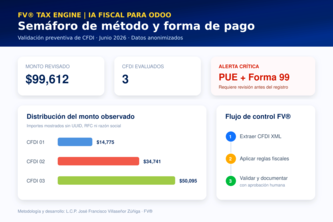
FV® Tax Engine | IA Fiscal para Odoo is a self-reported project by one individual (José Francisco Villaseñor Zúñiga) that uses AI to automate parts of Mexican fiscal and accounting workflows, particularly for integration with Odoo ERP. It aims to convert CFDI data and financial information into validated outputs such as fiscal semaphores, layouts for Odoo import, and audit trails.
What changed
The project started as a prototype addressing manual processes in Mexican tax and accounting workflows, evolving into a two-module system including a CFDI validation engine and a digital platform margin dashboard. It is presented as a tool that combines AI with human judgment to reduce error and increase traceability.
Single most important open question
Is there evidence of actual use or traction beyond the author’s own development and demonstration?
Note: This analysis is based entirely on the self-reported, unverified description provided by the project author. No external data, revenue figures, customer names, or third-party validation are available.
What The Product Actually Is
The description states that FV® Tax Engine is a system that uses AI to process CFDI and financial data, generating fiscal validations, semaphores, and structured layouts for Odoo ERP. It also includes a second module: a dashboard for calculating platform marginality indicators (commission, shipping cost, net margin) based on digital platform transactions.
- The system integrates with Odoo via XML, CSV, and Excel formats.
- It uses OpenAI tools like GPT and Codex to interpret data and apply fiscal rules.
- It includes human approval steps before modifying external systems.
- The author claims the AI acts as a copilot, not a replacement for professional judgment.
Inference: The system appears to be built around a hybrid model of AI + human validation, with an emphasis on traceability and auditability. However, no evidence is provided about actual deployment or usage in real-world environments.
Positioning & Claim Evolution
The project positions itself as a solution for Mexican businesses dealing with large volumes of CFDI and financial data, where manual processing leads to errors and poor traceability.
- The author claims the system was developed from real-world accounting and fiscalization practices.
- It is positioned as a way to reduce repetitive work while maintaining compliance and accountability.
- The evolution from a single prototype to two functional modules (CFDI engine + margin dashboard) shows iterative development but no evidence of commercial traction or scalability.
Claim: "La inteligencia artificial aporta mayor valor cuando complementa el juicio profesional."
Inference: This reflects an intent to position the tool as a hybrid solution, not purely automated.
Target Customer & ICP
The description implies that the target customer is Mexican businesses or accounting firms using Odoo ERP and processing large volumes of CFDI and financial data.
- The system targets companies that need to validate fiscal data and prepare it for ERP integration.
- It also addresses platforms or digital marketplaces where marginality analysis is needed.
- The author identifies a specific use case: "despachos y empresas" (firms and companies), suggesting a B2B focus.
Not evidenced: No explicit customer list, buyer personas, or segmentation strategy is provided. The ICP remains inferred from the stated problem space.
Business Model & Pricing Evidence
The author mentions a future business model involving subscription and implementation services:
- Future plans include offering the platform as a scalable service.
- A model of "suscripción y servicios de implementación" (subscription and implementation services) is described.
Not evidenced: No pricing structure, revenue streams, or monetization details are provided. The business model remains conceptual.
Technical & Delivery Signals
The project was built using:
- Python
- OpenAI tools (GPT, Codex)
- Odoo integration (XML, CSV, Excel)
- GitHub for version control
- Tools like Microsoft, PDF, and ChatGPT
It includes:
- A prototype for CFDI validation
- A dashboard for digital platform margin analysis
- Demo data and scripts in Python and Excel
Inference: The technical stack suggests a developer-focused approach with AI integration. However, no evidence of production-grade delivery or scalability is given.
Traction & Maturity Signals
The project is described as:
- A prototype built from real-world cases
- A two-module system (CFDI engine + margin dashboard)
- Submitted to the OpenAI 2026 hackathon
Not evidenced: No evidence of actual users, customers, or revenue. No data on adoption rate, usage metrics, or product maturity beyond prototype stage.
Competitive Context
The author does not reference competitors directly. However, the problem space (fiscal validation and ERP integration in Mexico) suggests overlap with:
- Odoo modules for fiscal compliance
- AI-based accounting tools
- Mexican tax automation platforms
Inference: The competitive landscape is implied but not detailed. No differentiation or positioning against existing tools is stated.
Open Questions & Risks
- No traction or revenue evidence – The project remains a prototype with no verified users.
- Single-person team – Limited capacity for scaling or development.
- Unverified claims – All descriptions are self-reported without external validation.
- Unclear monetization path – No pricing, subscriptions, or commercial strategy described.
- Limited deployment scope – Only demo data and internal use cases are mentioned.
Inference: The lack of real-world application and business model clarity raises concerns about viability and scalability.
Questions the description leaves open
- What specific real-world workflows were used to build the prototype?
- Have any companies or accounting firms tested this system in practice?
- How is human oversight implemented in the validation process?
- What are the actual technical limitations of the current prototype?
- Are there plans for integration with other ERP systems beyond Odoo?
- What is the timeline and roadmap to commercialization?
Overall Assessment
Not evidenced: No data on financial performance, customer traction, or market validation exists.
Assessment (inference): The project appears to be a proof-of-concept with strong alignment to a real problem in Mexican fiscal and accounting workflows. However, without evidence of adoption, revenue, or scalability, it is not ready for investment or partnership consideration at this stage. It may represent an early-stage idea with potential but requires further development and validation before any strategic move.
User Stories BotA demo video on every pull request
Get a demo video on every new feature
GitHub App that watches your pull requests and records a narrated, captioned demo.
Save time on demo prep and make informed decisions faster with a video walkthrough of every new feature.
Source
Submitted to the OpenAI 2026 hackathon on Devpost. Project home on Devpost. Back to the full gallery on Devpost.
This competitive analysis was produced by top-founders.com (opens in a new tab)
Generated by a language model from this project's public Devpost page — its tagline, the author's own write-up and any built-with tags listed there — as captured in August 2026. Short quotations are the author's words. It is an opinion on the idea as a business, not on the people behind it, and it reflects the description as published then. If the project has moved on, request a correction below. The analysis is not independent research and contains no verified traction, revenue or customer data.
An independent guide by KFG International LLC — not affiliated with, endorsed by, or connected to Devpost or OpenAI.