

Archive position — measured, not model output
0 likes on Devpost
2,263 of the 7,850 archived projects have more likes, and 5,587 share exactly 0 — so this project's #5,037 place in the like-ranked listing is a tie-break inside that group, not a ranking.
Projects (log scale)
Likes on Devpost. ▲ marks this project's group.
Show the figures
| Likes | Projects | Share of archive |
|---|---|---|
| 0 | 5,587 | 71.2% |
| 1 | 1,758 | 22.4% |
| 2 | 284 | 3.6% |
| 3–4 | 132 | 1.7% |
| 5–9 | 75 | 1.0% |
| 10+ | 14 | 0.2% |
 User Stories BotA demo video on every pull request
Get a demo video on every new feature
GitHub App that watches your pull requests and records a narrated, captioned demo.
Save time on demo prep and make informed decisions faster with a video walkthrough of every new feature.
Executive Summary
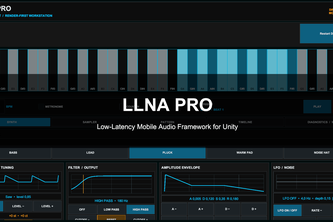
LLNA PRO – Low-Latency Mobile Audio Framework for Unity is a self-reported Unity asset that aims to improve mobile audio performance for rhythm games, virtual instruments, and music production apps by integrating native Android and iOS audio systems. The author, Barış Biltekin, describes it as a cross-platform audio toolkit built with C#, Unity, and native audio technologies such as Oboe, AAudio, AudioUnit, and RemoteIO.
The framework includes components like a synthesizer, sampler, sequencer, offline renderer, WAV export, and timeline. It is positioned to help developers avoid Unity’s standard audio pipeline for low-latency applications on mobile platforms.
What Changed
The project evolved from solving a single audio latency issue into a full toolkit with multiple audio capabilities. It was submitted to the OpenAI 2026 hackathon.
Single Most Important Open Question
Is there evidence of developer adoption or usage beyond the author’s own development context?
What The Product Actually Is
The description states that LLNA PRO is a Unity Asset Store package that brings native low-latency audio to Android and iOS. It includes:
- Native playback for Android and iOS
- A playable synthesizer, sampler, sequencer, audio timeline
- Offline audio rendering and WAV export
- Integration with Unity through C# components
It was built using Unity, C#, Oboe, AAudio, AudioUnit, RemoteIO, and supported by Codex for architecture and debugging.
Inference The framework is described as a toolkit that allows developers to build audio-based mobile apps without needing to implement native audio engines from scratch. It targets Unity developers working on rhythm games or music apps.
Positioning & Claim Evolution
The author states that LLNA PRO was initially built to solve a single audio latency problem (around 150 ms) in rhythm games and virtual instruments. Over time, it evolved into a complete cross-platform audio toolkit.
It is positioned as a solution for developers who want to avoid Unity’s standard audio pipeline and instead use native audio systems for better performance on mobile platforms.
Claim
The framework makes complex native audio technology accessible through Unity components.
Inference It is not a standalone app but a developer tool or asset, likely intended for sale or distribution in the Unity Asset Store.
Target Customer & ICP
The description states that the author develops mobile rhythm games, audio-based games, and music production apps with Unity. The framework is intended for developers working on:
- Rhythm games
- Virtual instruments
- Drum machines
- Music production apps
It is described as a mobile-first solution.
Inference The ICP (Ideal Customer Profile) likely includes indie or professional Unity developers building audio-intensive mobile applications, particularly those in the music or gaming space.
Business Model & Pricing Evidence
The description does not provide evidence of pricing, monetization, or distribution strategy. It only states that LLNA PRO is a Unity Asset Store package, implying it may be sold through that platform.
Not evidenced No information on revenue model, pricing tiers, or whether it’s free, paid, or open-source.
Technical & Delivery Signals
The framework is built with:
- Unity
- C#
- Native Android audio (Oboe, AAudio)
- iOS audio (AudioUnit, RemoteIO)
- Codex for architecture and debugging
It supports:
- Touch input responsiveness
- Glissando keyboard interaction
- Preset reusability
- Native playback
- Rendered audio output
Inference The framework is designed to be cross-platform, integrating with both Android and iOS native audio systems, and is intended to be easily integrated into Unity projects.
Traction & Maturity Signals
The project was submitted to the OpenAI 2026 hackathon, suggesting it’s a prototype or early-stage product. There is no evidence of:
- Revenue
- Customers
- User adoption
- Product usage beyond the author's own development context
Not evidenced No data on downloads, user feedback, or market traction.
Competitive Context
The description does not mention competitors or similar tools in the market. It implies that Unity’s standard audio pipeline is suboptimal for low-latency use cases, but no comparison to existing solutions is made.
Inference The framework likely competes with other Unity-based audio tools or native audio implementations, but there is no evidence of direct competition or market positioning.
Open Questions & Risks
- No revenue or customer data: The project appears to be a prototype or personal tool without commercial traction.
- Single developer team: Only one member (Barış Biltekin) is listed, which may limit scalability or long-term maintenance.
- Unverified claims: All statements are self-reported and unverified.
- Hackathon submission: Suggests early-stage development with limited testing or market validation.
Questions the description leaves open
- What is the current stage of development, and how far along is it from a production-ready product?
- Are there any existing users or developers using LLNA PRO in commercial projects?
- How does the framework compare to Unity’s built-in audio system in terms of performance and ease of use?
- Is the framework available for purchase or distribution through Unity Asset Store, and what is the pricing model?
- What are the specific technical limitations or compatibility issues with different mobile devices or OS versions?
Overall Assessment
Not evidenced: No data on revenue, customer base, or market traction to assess investment or partnership viability.
Inference The project appears to be a developer tool in early development, likely targeting indie developers or small teams. It has not yet demonstrated commercial adoption or scalability.
Given the self-reported nature of the description and lack of evidence for traction or monetization, this is a highly speculative opportunity with limited due-diligence support at this stage.
User Stories BotA demo video on every pull request
Get a demo video on every new feature
GitHub App that watches your pull requests and records a narrated, captioned demo.
Save time on demo prep and make informed decisions faster with a video walkthrough of every new feature.
Source
Submitted to the OpenAI 2026 hackathon on Devpost. Project home on Devpost. Back to the full gallery on Devpost.
This competitive analysis was produced by top-founders.com (opens in a new tab)
Generated by a language model from this project's public Devpost page — its tagline, the author's own write-up and any built-with tags listed there — as captured in August 2026. Short quotations are the author's words. It is an opinion on the idea as a business, not on the people behind it, and it reflects the description as published then. If the project has moved on, request a correction below. The analysis is not independent research and contains no verified traction, revenue or customer data.
An independent guide by KFG International LLC — not affiliated with, endorsed by, or connected to Devpost or OpenAI.