

Archive position — measured, not model output
1 like on Devpost
505 of the 7,850 archived projects have more likes, and 1,758 share exactly 1 — so this project's #1,107 place in the like-ranked listing is a tie-break inside that group, not a ranking.
Projects (log scale)
Likes on Devpost. ▲ marks this project's group.
Show the figures
| Likes | Projects | Share of archive |
|---|---|---|
| 0 | 5,587 | 71.2% |
| 1 | 1,758 | 22.4% |
| 2 | 284 | 3.6% |
| 3–4 | 132 | 1.7% |
| 5–9 | 75 | 1.0% |
| 10+ | 14 | 0.2% |
 User Stories BotA demo video on every pull request
Get a demo video on every new feature
GitHub App that watches your pull requests and records a narrated, captioned demo.
Save time on demo prep and make informed decisions faster with a video walkthrough of every new feature.
Executive Summary
What the company appears to be
Fridge Pal is a self-reported personal productivity tool for home cooks, built as a full-stack web application by one developer (Evan Kim). It claims to help users track ingredients in their fridge, freezer and pantry; identify items nearing expiration; and use AI to suggest meals that utilize those ingredients before they go bad.
What changed
The project was submitted as part of the OpenAI 2026 hackathon. The author describes it as a personal solution to a daily problem — managing food inventory and reducing waste — with an emphasis on user experience, simplicity, and AI integration.
Single most important open question
Is there evidence that Fridge Pal has moved beyond a prototype or hackathon demo into actual usage by users? The description states no revenue, customers, or traction data are available. There is no indication of whether the app is being used outside of its creator's personal environment.
What The Product Actually Is
The description states:
- Fridge Pal is an app that tracks food in fridges, freezers and pantries.
- It shows which ingredients are about to expire.
- Users can select ingredients and receive AI-generated meal suggestions.
- After cooking, users record what they used to update inventory.
- The frontend uses Vue 3, TypeScript, Vite; the backend uses FastAPI, MySQL, Docker.
- AI is integrated via Codex and DeepSeek APIs.
Inference The app appears to be a personal prototype built for one user’s daily needs. It includes features like expiration tracking, inventory management, and AI-powered recipe suggestions — but it is not described as having any marketplace or community elements beyond sharing recipes in the future.
Positioning & Claim Evolution
The author states:
- The product was built to solve a personal problem: forgetting what ingredients are in the fridge and letting food go to waste.
- It aims to make cooking easier and reduce food waste.
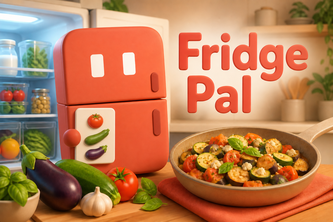
- The app has a “cute” personality, with playful animations and a logo designed as a fridge companion.
Inference Positioning is centered on personal utility for solo cooks who want to reduce waste. It does not appear to have evolved into a broader commercial or market-facing strategy. No claims are made about scalability, audience expansion, or monetization beyond the creator’s own use case.
Target Customer & ICP
The description states:
- The target user is someone who lives alone and enjoys cooking.
- They often buy different ingredients and keep them in their fridge.
- The app helps users avoid wasting food by suggesting meals based on what they already have.
Inference The initial ICP seems to be a single-user, self-employed or independent cook. No segmentation beyond this is described. There is no evidence of targeting families, restaurants, or institutional kitchens.
Business Model & Pricing Evidence
Not evidenced.
The description does not mention:
- Any pricing model
- Revenue streams
- Monetization strategy
- Subscription plans or in-app purchases
Inference There is no indication that Fridge Pal has a business model beyond personal use. No commercial structure or monetization is described.
Technical & Delivery Signals
The description states:
- Built with Vue 3, TypeScript, FastAPI, MySQL, Docker.
- Uses Codex and DeepSeek APIs for AI functionality.
- Includes responsive UI design, semantic color tokens, reusable components.
- Database uses SQLAlchemy, Alembic, Pydantic.
- Local development uses SQLite; production uses MySQL.
Inference The app is technically complete enough to be deployed as a full-stack system. It includes containerization and database abstraction. However, no evidence of performance metrics, scalability, or production deployment is provided.
Traction & Maturity Signals
Not evidenced.
The description does not mention:
- Number of users
- Active usage patterns
- Customer feedback or retention
- Product adoption beyond the creator’s own use
Inference There are no signs of traction or maturity. The project is described as a personal hackathon submission, not a product in active market use.
Competitive Context
Not evidenced.
The description does not mention:
- Competitors
- Market analysis
- Product differentiation
- Industry trends
Inference No competitive positioning or awareness is evident. The author does not reference similar tools or platforms in the food waste or meal-planning space.
Open Questions & Risks
- No commercial traction or user base: The app is described as a personal tool, with no evidence of adoption beyond its creator.
- Unverified AI claims: While AI is used for recipe generation, there is no data on accuracy or reliability of outputs.
- Single-person team: With only one developer, scalability and long-term maintenance are concerns.
- No monetization strategy: No indication of how the product would generate revenue if expanded.
- Limited scope: The app appears to be a personal solution without community or marketplace features.
Questions the description leaves open
- Has Fridge Pal been used by anyone other than yourself?
- Are you planning to monetize this tool, and how?
- What is your long-term vision for the product beyond personal use?
- How do you plan to scale the AI recipe generation or improve its accuracy?
- Have you considered integrating with smart fridge or grocery delivery services?
Overall Assessment
Not evidenced.
The description does not provide any information about:
- Valuation
- Funding status
- Strategic partnerships
- Investor interest
Inference This is a self-reported personal project, not a commercial venture. There is no basis for assessing investment or partnership potential at this stage. The lack of traction, revenue, or market engagement makes it difficult to evaluate its viability as an investment target or strategic partner.
User Stories BotA demo video on every pull request
Get a demo video on every new feature
GitHub App that watches your pull requests and records a narrated, captioned demo.
Save time on demo prep and make informed decisions faster with a video walkthrough of every new feature.
Source
Submitted to the OpenAI 2026 hackathon on Devpost. Project home on Devpost. Back to the full gallery on Devpost.
This competitive analysis was produced by top-founders.com (opens in a new tab)
Generated by a language model from this project's public Devpost page — its tagline, the author's own write-up and any built-with tags listed there — as captured in August 2026. Short quotations are the author's words. It is an opinion on the idea as a business, not on the people behind it, and it reflects the description as published then. If the project has moved on, request a correction below. The analysis is not independent research and contains no verified traction, revenue or customer data.
An independent guide by KFG International LLC — not affiliated with, endorsed by, or connected to Devpost or OpenAI.