

Archive position — measured, not model output
0 likes on Devpost
2,263 of the 7,850 archived projects have more likes, and 5,587 share exactly 0 — so this project's #5,033 place in the like-ranked listing is a tie-break inside that group, not a ranking.
Projects (log scale)
Likes on Devpost. ▲ marks this project's group.
Show the figures
| Likes | Projects | Share of archive |
|---|---|---|
| 0 | 5,587 | 71.2% |
| 1 | 1,758 | 22.4% |
| 2 | 284 | 3.6% |
| 3–4 | 132 | 1.7% |
| 5–9 | 75 | 1.0% |
| 10+ | 14 | 0.2% |
 User Stories BotA demo video on every pull request
Get a demo video on every new feature
GitHub App that watches your pull requests and records a narrated, captioned demo.
Save time on demo prep and make informed decisions faster with a video walkthrough of every new feature.
Executive Summary
The description states that LLM Gateway is an AI middleware platform designed to act as a unified control plane for routing, caching, and protecting LLM requests. The author describes it as a provider-agnostic gateway that centralizes infrastructure concerns such as authentication, rate limiting, resilience, and observability. It supports semantic caching, OpenAI-compatible API integration, and modular architecture with dependency injection and policy management.
The project is self-reported as a hackathon submission by one individual (Vaibhav Tandon), built using FastAPI and various open-source tools like Redis, Qdrant, Prometheus, and OpenTelemetry. It includes simulated local development environments and claims to have validated thousands of requests under load.
Key commercial due-diligence question: What is the actual market demand for this type of infrastructure abstraction, and how does it differ from existing solutions or patterns in the LLM middleware space?
There is no evidence of revenue, customers, traction, or adoption beyond the author’s own description. The project appears to be a proof-of-concept or prototype with no demonstrated commercial viability.
What The Product Actually Is
The description states that LLM Gateway is an “AI middleware platform” that acts as a single entry point for LLM requests. It provides:
- Provider-agnostic request routing
- Semantic caching
- Team-based authentication and access control
- Rate limiting and token budget enforcement
- Automatic retries, fallback routing, and circuit breaker protection
- Real-time metrics and telemetry
- Runtime policy updates through admin APIs
- OpenAI-compatible Chat Completions API
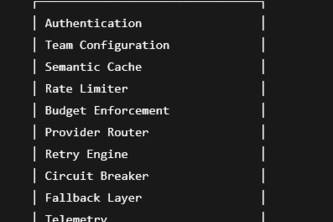
The author describes its architecture as modular middleware with components for each responsibility (routing, caching, resilience, etc.), built using FastAPI and supporting dependency injection.
Inferred: The system is intended to sit between AI applications and LLM providers, abstracting infrastructure concerns from application developers.
Not evidenced: No details on actual implementation, performance benchmarks, or production usage.
Positioning & Claim Evolution
The author positions LLM Gateway as a “smart AI control plane” that centralizes common LLM integration challenges such as authentication, rate limiting, caching, and observability. The claim is that it reduces complexity for developers by offering a unified interface instead of requiring each team to solve these problems independently.
It also claims to offer a “unified AI middleware platform” rather than a single AI application, suggesting a shift toward infrastructure-as-a-service or platform-as-a-service in the LLM space.
Inferred: The positioning reflects an attempt to address developer pain points around LLM integration complexity and lack of standardization across providers.
Not evidenced: No evidence of prior positioning, competitor comparisons, or market feedback on this approach.
Target Customer & ICP
The description implies that the target customer is AI application developers or teams building AI-powered products, who are currently solving infrastructure concerns like routing, caching, and rate limiting manually.
It also suggests a need for “team-based authentication” and “budget enforcement,” indicating potential use cases in enterprise or multi-team environments where cost control and access management matter.
Inferred: The ICP likely includes early-stage startups or engineering teams working with multiple LLM providers who want to reduce operational overhead.
Not evidenced: No evidence of specific customer segments, personas, or actual user interviews.
Business Model & Pricing Evidence
The description does not mention any pricing model, licensing terms, or monetization strategy. It is framed purely as a technical solution without commercial framing.
Inferred: If this becomes a product, it might be offered as SaaS or open-source with enterprise support options, but no such claims are made.
Not evidenced: No indication of revenue streams, pricing tiers, or business model assumptions.
Technical & Delivery Signals
The author states that the gateway was built using:
- FastAPI
- Docker
- Redis
- Qdrant
- Prometheus
- Grafana
- OpenTelemetry
- YAML-based configuration
- Dependency injection
- Middleware architecture
It supports semantic caching via vector similarity search and includes embedded infrastructure for local development.
Inferred: The technical stack suggests a modern, scalable, and observability-focused approach to middleware design.
Not evidenced: No evidence of scalability testing, production deployment details, or performance metrics beyond simulated load.
Traction & Maturity Signals
The project is described as a hackathon submission (submitted to the OpenAI 2026 hackathon). The author mentions:
- Thousands of simulated gateway requests validated
- Local development runtime mirroring production behavior
- Modular architecture with clean separation of concerns
Inferred: This indicates early-stage prototyping and validation, not yet proven market traction.
Not evidenced: No evidence of actual users, real-world deployments, or adoption metrics.
Competitive Context
The description does not reference competitors or similar tools in the LLM gateway or middleware space. It implies that there is a gap in the market for a unified control plane but doesn’t name or describe existing alternatives.
Inferred: There may be overlap with existing LLM infrastructure tools, API gateways, or observability platforms, but no explicit comparison is made.
Not evidenced: No competitive analysis, benchmarking, or differentiation from other solutions.
Open Questions & Risks
- Unproven market demand: The project is a hackathon submission with no evidence of customer traction or commercial interest.
- Single-person development: With only one team member, scalability and long-term maintenance are uncertain.
- Lack of commercial clarity: No pricing, monetization strategy, or business model described.
- No production data: Simulated load testing is not equivalent to real-world usage.
- Ambiguity in positioning: The claim that it’s a “smart AI control plane” lacks specificity about what makes it unique or valuable beyond general middleware patterns.
Not evidenced: No evidence of risk mitigation strategies, team experience, or prior commercial success.
Questions the description leaves open
- What specific problems are you solving for developers or teams that existing tools don’t address?
- How do you plan to monetize this platform if it becomes a product?
- Have you validated the need for this abstraction with any real users or customers?
- What is your roadmap beyond the current prototype, and how does it align with market demand?
- Are there any known competitors or similar tools in this space that you are aware of?
- How do you intend to scale from a single developer to a full team or enterprise deployment?
Overall Assessment
The description states that LLM Gateway is a hackathon project built by one person, with no evidence of revenue, customers, traction, or commercial viability.
Inferred: This appears to be an early-stage prototype or proof-of-concept, not yet ready for investment or partnership discussions.
Not evidenced: No data on market size, TAM, unit economics, or team capability beyond the single developer. The project lacks any indication of product-market fit or scalable business model.
User Stories BotA demo video on every pull request
Get a demo video on every new feature
GitHub App that watches your pull requests and records a narrated, captioned demo.
Save time on demo prep and make informed decisions faster with a video walkthrough of every new feature.
Source
Submitted to the OpenAI 2026 hackathon on Devpost. Project home on Devpost. Back to the full gallery on Devpost.
This competitive analysis was produced by top-founders.com (opens in a new tab)
Generated by a language model from this project's public Devpost page — its tagline, the author's own write-up and any built-with tags listed there — as captured in August 2026. Short quotations are the author's words. It is an opinion on the idea as a business, not on the people behind it, and it reflects the description as published then. If the project has moved on, request a correction below. The analysis is not independent research and contains no verified traction, revenue or customer data.
An independent guide by KFG International LLC — not affiliated with, endorsed by, or connected to Devpost or OpenAI.