

Archive position — measured, not model output
1 like on Devpost
505 of the 7,850 archived projects have more likes, and 1,758 share exactly 1 — so this project's #2,107 place in the like-ranked listing is a tie-break inside that group, not a ranking.
Projects (log scale)
Likes on Devpost. ▲ marks this project's group.
Show the figures
| Likes | Projects | Share of archive |
|---|---|---|
| 0 | 5,587 | 71.2% |
| 1 | 1,758 | 22.4% |
| 2 | 284 | 3.6% |
| 3–4 | 132 | 1.7% |
| 5–9 | 75 | 1.0% |
| 10+ | 14 | 0.2% |
 User Stories BotA demo video on every pull request
Get a demo video on every new feature
GitHub App that watches your pull requests and records a narrated, captioned demo.
Save time on demo prep and make informed decisions faster with a video walkthrough of every new feature.
Executive Summary
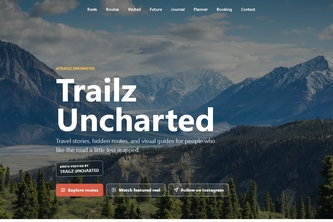
The company appears to be a solo-built, AI-assisted travel platform focused on cultural and historical storytelling for offbeat destinations in South and Southeast Asia. The author states that the product was built using OpenAI Codex and deployed via Netlify. No revenue, customers or traction data are evidenced.
What changed
The project is presented as a functional, live product built in a hackathon setting, using AI tools to accelerate development. It is not clear if this represents an initial prototype or a more mature offering.
The single most important open question
Is there any evidence of user adoption, revenue generation, or customer feedback that would indicate traction beyond the author’s own claims?
What The Product Actually Is
- The description states that Trailz Uncharted is a travel platform.
- It helps users discover hidden routes and offbeat destinations across India, Bhutan, Nepal, Malaysia, Singapore, and Oman.
- It integrates Instagram reels for curated travel stories.
- It includes a trip planner that builds personalized plans in seconds.
- It offers real-time travel guidance and booking support via WhatsApp integration.
- It features a built-in travel assistant for quick questions on routes, reels, and bookings.
- The platform was built using OpenAI Codex, with deployment on Netlify.
Inference The product is described as a web-based travel tool that combines AI-assisted planning, storytelling, and booking capabilities. It is not clear whether it is a marketplace, a content platform, or an assistant tool.
Positioning & Claim Evolution
- The tagline states: “Discover the story behind every destination — an AI travel guide that blends smart planning with rich cultural and historical context.”
- The author claims to have built something that goes beyond basic travel checklists and adds real depth and personality to journeys.
- The inspiration comes from personal travel experiences, particularly in India and neighboring countries.
- The platform is described as being built using AI tools, emphasizing speed and efficiency.
Inference The positioning is centered on storytelling and cultural immersion, with a focus on offbeat destinations. It positions itself as an alternative to generic travel apps by integrating AI for planning and content delivery.
Target Customer & ICP
- The description states that the platform targets users interested in discovering hidden routes and offbeat destinations.
- It is focused on travelers in India, Bhutan, Nepal, Malaysia, Singapore, and Oman.
- The platform integrates WhatsApp for booking and guidance, suggesting a mobile-first or mobile-oriented user base.
Inference The target customer appears to be culturally curious, digitally native travelers who are looking for authentic experiences beyond typical tourist routes. However, no explicit segmentation or persona data is provided.
Business Model & Pricing Evidence
- No pricing information, subscription tiers, or monetization strategy is evidenced.
- The description does not mention any revenue streams or business model components.
- The platform integrates WhatsApp for booking support, but it is unclear if this is a paid service or part of a freemium offering.
Inference There is no evidence of a defined business model. It is unclear how the platform intends to generate revenue or whether it is a free tool with potential monetization in the future.
Technical & Delivery Signals
- The platform was built using OpenAI Codex, HTML5, CSS3, JavaScript, Instagram API, WhatsApp API, and Netlify.
- It is hosted on Netlify.
- The author built the entire platform solo during a hackathon.
- Features include trip planning, Instagram integration, WhatsApp booking, and a chat assistant.
Inference The technical stack suggests a lightweight, web-based application built with AI-assisted development. The solo build implies limited scalability or team support, but also rapid prototyping capabilities.
Traction & Maturity Signals
- The platform is described as a live, working product.
- It was submitted to the OpenAI 2026 hackathon.
- The author states that it was built in a short timeframe (a hackathon).
- No evidence of user engagement, customer feedback, or usage metrics is provided.
Inference There is no evidence of traction beyond the author’s own claims. It is unclear whether the platform has been used by others or if it is still in an experimental phase.
Competitive Context
- The description does not mention any direct competitors.
- No market analysis or competitive positioning is provided.
- The focus on cultural storytelling and offbeat destinations suggests a niche within the broader travel tech space.
Inference The competitive landscape is unknown. It appears to be positioned in a niche segment of travel tech, but no evidence of existing players or market dynamics is available.
Open Questions & Risks
- The platform is solo-built, which raises concerns about scalability and long-term maintenance.
- No revenue or monetization strategy is evident.
- The product is described as a hackathon submission, suggesting it may not be fully mature or tested in the real world.
- Lack of user data or feedback makes it difficult to assess real-world utility.
Inference Key risks include lack of traction, unclear business model, and limited team capacity. The platform may be an early-stage idea rather than a developed product.
Questions the description leaves open
- What is the current user engagement or feedback on the platform?
- How does the platform plan to monetize its services?
- Are there any partnerships with local guides or travel agencies in the target regions?
- What are the plans for scaling beyond a solo-built prototype?
- Is there any data on how users interact with the trip planner, Instagram integration, and WhatsApp features?
Overall Assessment
- The description states that this is a solo-built, hackathon submission.
- No evidence of revenue, customers, or traction is provided.
- The platform appears to be in an early stage of development.
Inference There is insufficient evidence to support investment or partnership interest at this time. The project is described as a functional prototype but lacks any demonstration of real-world adoption or business viability.
User Stories BotA demo video on every pull request
Get a demo video on every new feature
GitHub App that watches your pull requests and records a narrated, captioned demo.
Save time on demo prep and make informed decisions faster with a video walkthrough of every new feature.
Source
Submitted to the OpenAI 2026 hackathon on Devpost. Project home on Devpost. Back to the full gallery on Devpost.
This competitive analysis was produced by top-founders.com (opens in a new tab)
Generated by a language model from this project's public Devpost page — its tagline, the author's own write-up and any built-with tags listed there — as captured in August 2026. Short quotations are the author's words. It is an opinion on the idea as a business, not on the people behind it, and it reflects the description as published then. If the project has moved on, request a correction below. The analysis is not independent research and contains no verified traction, revenue or customer data.
An independent guide by KFG International LLC — not affiliated with, endorsed by, or connected to Devpost or OpenAI.