

Archive position — measured, not model output
0 likes on Devpost
2,263 of the 7,850 archived projects have more likes, and 5,587 share exactly 0 — so this project's #4,070 place in the like-ranked listing is a tie-break inside that group, not a ranking.
Projects (log scale)
Likes on Devpost. ▲ marks this project's group.
Show the figures
| Likes | Projects | Share of archive |
|---|---|---|
| 0 | 5,587 | 71.2% |
| 1 | 1,758 | 22.4% |
| 2 | 284 | 3.6% |
| 3–4 | 132 | 1.7% |
| 5–9 | 75 | 1.0% |
| 10+ | 14 | 0.2% |
 User Stories BotA demo video on every pull request
Get a demo video on every new feature
GitHub App that watches your pull requests and records a narrated, captioned demo.
Save time on demo prep and make informed decisions faster with a video walkthrough of every new feature.
Executive Summary
What the company appears to be
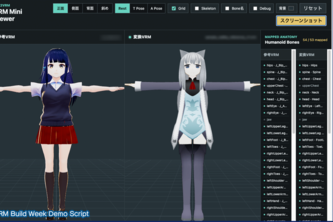
Fbx2VRM is a self-reported proof of concept for converting humanoid FBX character models into VRM format using Blender, Python, and OpenAI Codex. It was built during OpenAI Build Week 2026 as part of a hackathon submission.
What changed
The project evolved from an exploratory effort to understand FBX-to-VRM conversion challenges into a documented workflow that addresses specific technical issues such as rigging preservation, material handling, and expression fidelity. It leverages OpenAI Codex for code generation and technical investigation.
Single most important open question
Is there evidence of commercial traction or product-market fit beyond this single developer-focused proof of concept?
What The Product Actually Is
The description states that Fbx2VRM is a functional proof of concept for converting humanoid FBX character models into VRM format using Blender and the VRM Add-on for Blender. It includes:
- Preservation of rigging, materials, facial expressions, and eye highlights.
- Command-line utilities for inspection, conversion, reporting, and comparison.
- Use of OpenAI Codex to analyze structures, generate diagnostic scripts, and support workflow improvements.
It is not described as a finished product or tool available for general use. The author notes that the public repository represents only the documented scope of the Build Week effort, with additional internal tools excluded.
Evidence
- “Fbx2VRM is a functional proof of concept for converting humanoid FBX character models into VRM format using Blender and the VRM Add-on for Blender.”
- “The project also includes command-line utilities for inspecting models, running the conversion workflow, generating reports, and performing simplified structural comparisons.”
Inference This is a developer-oriented tool built to solve specific technical problems in 3D asset conversion, not a commercial offering.
Positioning & Claim Evolution
The author positions Fbx2VRM as an exploratory project that uses AI-assisted engineering to improve FBX-to-VRM conversion workflows. It is framed as a solution to common issues in animation and virtual reality development, particularly around preserving character details like eye highlights and facial expressions.
There is no indication of a broader commercial positioning or branding beyond the hackathon submission. The project does not claim to be a product or service for end-users but rather a technical demonstration.
Evidence
- “Fbx2VRM began shortly before OpenAI Build Week when I needed to convert a humanoid FBX character model into VRM format for use in VTuber-related applications.”
- “The public repository represents the documented and reusable scope of the Build Week proof of concept.”
Inference It is positioned as an internal or experimental tool, not a commercial product.
Target Customer & ICP
Not evidenced. The description does not define target customers or personas beyond the author’s personal need during the hackathon. No mention of users, buyers, or end-market segments is provided.
Evidence
- No explicit customer definition.
- The project was built for VTuber-related applications, but this is not expanded into a customer segment.
Inference The target audience likely includes 3D artists, developers, or content creators working with FBX and VRM formats, but no clear ICP is stated.
Business Model & Pricing Evidence
Not evidenced. There is no mention of pricing, monetization strategy, or business model in the description.
Evidence
- No revenue model, pricing tiers, or commercial use cases are described.
- The project is presented as a proof of concept, not a product for sale.
Inference No business model is evident from the self-reported content.
Technical & Delivery Signals
The project was built using:
- Tools and technologies: Blender, Blender Python API, VRM Add-on for Blender, OpenAI Codex (GPT-5.5 and GPT-5.6), Python, macOS, JSON, GitHub.
- Workflow approach: Use of AI to analyze structures, generate scripts, and support debugging.
- Key technical fixes:
- Resolved duplicated scale correction causing arm/leg stretching.
- Fixed eye highlight material assignment.
- Improved facial expression bindings.
The author emphasizes that Codex was used not only for code generation but also for investigation and validation.
Evidence
- “OpenAI Codex was used throughout development to analyze FBX and VRM model structures.”
- “One of the most important fixes was identifying that the FBX import scale should not be applied again to the armature and mesh.”
Inference The project shows a strong technical foundation and integration of AI in engineering workflows, but no indication of production readiness or scalability.
Traction & Maturity Signals
Not evidenced. There is no mention of users, adoption, revenue, or product usage beyond the author’s own development efforts during a hackathon.
Evidence
- No customer data, user base, or market traction.
- The project is described as a “functional proof of concept,” not a deployed product.
Inference No evidence of commercial traction or maturity beyond the initial prototype stage.
Competitive Context
Not evidenced. The description does not reference competitors or existing tools in the FBX-to-VRM conversion space.
Evidence
- No mention of existing solutions, market players, or competitive landscape.
- The author focuses on technical challenges rather than market positioning.
Inference No competitive context is provided; this cannot be assessed from the self-reported description.
Open Questions & Risks
- Lack of commercial viability: The project is described as a proof of concept, not a product or service.
- Single-person team: Only one developer is listed, which may limit scalability or long-term development capacity.
- No monetization strategy: No indication of how the tool would be sold or used commercially.
- Limited scope: The public repository excludes internal tools and advanced features, suggesting incomplete functionality.
Evidence
- “Fbx2VRM is currently a functional proof of concept rather than a production-ready universal converter.”
- “The public repository represents the documented and reusable scope of the Build Week proof of concept.”
Inference This project lacks commercial readiness or strategic direction beyond its initial development phase.
Questions the description leaves open
- What is the intended path from this proof of concept to a commercial product?
- Are there any plans for monetization or user adoption beyond the developer community?
- How does the tool scale across different FBX and VRM formats, and what are the limitations?
- Is there interest in expanding beyond VTuber use cases or into broader 3D asset workflows?
- What is the long-term vision for integrating AI tools like Codex into the conversion pipeline?
Overall Assessment
Not evidenced. There is no indication of funding, investment stage, or partnership interest from the description.
Evidence
- No mention of funding rounds, investors, or strategic partners.
- The project is presented as a personal or hackathon effort.
Inference No commercial investment or partnership signals are evident. This appears to be an experimental project with no clear path to market traction or financial returns.
User Stories BotA demo video on every pull request
Get a demo video on every new feature
GitHub App that watches your pull requests and records a narrated, captioned demo.
Save time on demo prep and make informed decisions faster with a video walkthrough of every new feature.
Source
Submitted to the OpenAI 2026 hackathon on Devpost. Project home on Devpost. Back to the full gallery on Devpost.
This competitive analysis was produced by top-founders.com (opens in a new tab)
Generated by a language model from this project's public Devpost page — its tagline, the author's own write-up and any built-with tags listed there — as captured in August 2026. Short quotations are the author's words. It is an opinion on the idea as a business, not on the people behind it, and it reflects the description as published then. If the project has moved on, request a correction below. The analysis is not independent research and contains no verified traction, revenue or customer data.
An independent guide by KFG International LLC — not affiliated with, endorsed by, or connected to Devpost or OpenAI.