

Archive position — measured, not model output
0 likes on Devpost
2,263 of the 7,850 archived projects have more likes, and 5,587 share exactly 0 — so this project's #6,033 place in the like-ranked listing is a tie-break inside that group, not a ranking.
Projects (log scale)
Likes on Devpost. ▲ marks this project's group.
Show the figures
| Likes | Projects | Share of archive |
|---|---|---|
| 0 | 5,587 | 71.2% |
| 1 | 1,758 | 22.4% |
| 2 | 284 | 3.6% |
| 3–4 | 132 | 1.7% |
| 5–9 | 75 | 1.0% |
| 10+ | 14 | 0.2% |
 User Stories BotA demo video on every pull request
Get a demo video on every new feature
GitHub App that watches your pull requests and records a narrated, captioned demo.
Save time on demo prep and make informed decisions faster with a video walkthrough of every new feature.
Executive Summary
What the company appears to be
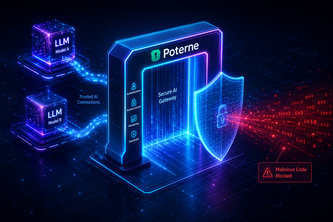
Poterne is a self-reported security gateway for LLMs, built as a prototype for OpenAI Build Week 2026. It positions itself as a provider-agnostic control plane that applies unified policies across different LLM providers (e.g., OpenAI, Claude, Gemini) through an API gateway. The product aims to block prompt injection, redact PII/secrets, scan outputs and tool calls for security threats, and convert real incidents into regression tests.
What changed
The project was submitted as a hackathon entry with no evidence of prior traction or commercial activity. It is described as a prototype built using AI-assisted development tools like Codex 5.6 and GPT-5.6.
Single most important open question — the commercial due-diligence read
Is there any evidence that Poterne has moved beyond the hackathon stage, or whether it has traction, revenue, or customers?
What The Product Actually Is
The description states that Poterne is a security gateway for LLMs, designed to sit between an application and its configured model provider (e.g., OpenAI). It functions as an OpenAI-compatible API gateway with an adapter architecture intended to apply consistent policies across providers.
Key features include:
- Blocking prompt injections and jailbreaks.
- Redacting PII and secrets while preserving context.
- Scanning outputs for system-prompt leaks or exposed credentials.
- Scanning tool calls for destructive actions like SQL injection or shell commands.
- A “Promote to Eval” feature that converts blocked incidents into Vitest regression tests and Codex-ready patch prompts.
It is described as a provider-agnostic solution, allowing the same policy layer to work across multiple LLMs without changes to policy code.
The product also includes:
- A dashboard with a Test Panel for IP-bound credential testing.
- A Replay Lab that supports live and sandbox modes for synthetic data.
- Deterministic scanners for input, output, and tool firewalls.
- Zero raw prompt storage; only safe audit metadata is retained.
Evidence Self-reported by the authors. No external validation or demonstration of actual use in production environments.
Positioning & Claim Evolution
The description states that Poterne positions itself as:
- A "quiet security gateway for every LLM."
- A "secure by default" control plane, treating incidents not as alerts but as regression tests.
- A provider-agnostic solution, applying the same policy layer across different providers.
It claims to address a fragmented security landscape where teams hard-code filtering per provider and often overlook critical failure modes such as prompt injection, system-prompt leaks, exposed API keys, PII leaks, and destructive tool calls.
The project also emphasizes:
- Turning real-world threats into permanent defenses via CI/CD-style feedback loops.
- Building enterprise-grade tools that require zero trust in storage layers.
- Using AI-assisted development (Codex 5.6, GPT-5.6) to build the entire system quickly.
Inference The positioning suggests a shift from reactive to proactive, automated LLM security, with an emphasis on developer experience and compliance.
Evidence Self-reported claims only; no third-party validation or market feedback.
Target Customer & ICP
The description implies that Poterne targets:
- Enterprise users building applications using LLMs.
- Teams managing multiple LLM integrations who want consistent, unified security policies.
- Developers and DevOps engineers looking for a secure-by-default solution that reduces risk from prompt injection, tool misuse, and data exposure.
It does not specify exact personas or segments beyond these general categories. The mention of “enterprise-grade” and “compliance” (SOC2, GDPR) suggests a focus on larger organizations with regulatory requirements.
Evidence Self-reported; no explicit customer list, usage data, or segmentation details provided.
Business Model & Pricing Evidence
There is no evidence in the description of:
- A pricing model.
- Revenue streams.
- Customer acquisition strategies.
- Monetization plans.
- Subscription tiers or licensing structures.
The project is described as a hackathon prototype, not a commercial product. The authors note that they see a path to production but do not describe how this will be monetized.
Evidence Not evidenced.
Technical & Delivery Signals
Key technical elements mentioned:
- Built using Codex 5.6 and GPT-5.6 for development.
- Uses AWS Lambda, API Gateway, DynamoDB, CloudFront, and Terraform for infrastructure.
- Frontend stack: React, Vite, TypeScript.
- Backend services: Lambda gateways, Control API, Policy Studio.
- Monorepo structure using pnpm workspaces with Node.js 22.
- Testing via Vitest.
- Adapter architecture designed to support multiple providers (DeepSeek, OpenRouter, Gemini).
- HMAC-fingerprinting used for IP quota enforcement without storing raw IPs.
The authors claim:
- The system supports provider-agnostic policies.
- Implements deterministic scanners for input/output/tool checks.
- Employs zero raw storage, storing only audit metadata.
- Designed with data privacy and observability balance in mind.
Inference The architecture shows strong engineering discipline around security, scalability, and AI-assisted development. However, the lack of production deployment or performance metrics limits confidence in real-world viability.
Evidence Self-reported; no independent verification of technical claims or delivery performance.
Traction & Maturity Signals
The project is explicitly described as a hackathon submission (OpenAI Build Week 2026). No evidence exists of:
- Revenue.
- Customers.
- Product adoption.
- Market traction.
- Post-hackathon development or funding.
It is noted that the team built the entire system using Codex and GPT, suggesting rapid prototyping but not long-term product maturity.
Evidence Not evidenced. The description explicitly states this is a prototype.
Competitive Context
The description does not mention any existing competitors directly. However, based on the stated problem—LLM security across providers—it implies a space that includes:
- LLM security gateways.
- Prompt injection detection tools.
- API security platforms for AI workloads.
- Enterprise-grade compliance solutions for AI.
No competitive analysis or differentiation from other players is provided.
Evidence Not evidenced. The authors do not reference competitors or market positioning relative to them.
Open Questions & Risks
- Prototype-only status: The entire project is described as a hackathon prototype with no evidence of commercialization or traction.
- No revenue or customer data: There is no indication that Poterne has generated any income or has real users.
- Unverified AI-assisted development claims: While the authors claim to have used Codex and GPT extensively, there is no independent confirmation of their effectiveness or accuracy in building this system.
- Limited scope for streaming firewalling: Streaming output inspection is noted as a limitation, which may impact enterprise adoption.
- No pricing or monetization strategy: No indication of how the product would be sold or priced.
- Team size and experience: Only two team members are listed, raising questions about execution capacity at scale.
Evidence These are inferences based on the lack of evidence for key commercial indicators.
Questions the description leaves open
- What is your roadmap beyond this hackathon prototype?
- Have you validated the product with any real enterprise users or pilot customers?
- How do you plan to monetize Poterne? Is there a pricing model or go-to-market strategy?
- Can you demonstrate how the system handles streaming outputs in production-like conditions?
- What are your plans for expanding support beyond the current providers (OpenAI, Claude, Mistral)?
- How do you intend to scale the security engine and maintain deterministic behavior across different environments?
- Are there any known limitations or trade-offs in terms of performance or accuracy that could affect enterprise adoption?
Overall Assessment
Assessment Not evidenced.
The project is described as a hackathon prototype, with no evidence of:
- Revenue.
- Customers.
- Product-market fit.
- Commercial traction.
- Funding or investor interest.
While the technical architecture and claims around security are compelling, there is no basis to assess whether Poterne has moved beyond the experimental stage. The lack of any commercial data, user feedback, or product maturity signals makes it difficult to evaluate its potential for investment or partnership.
Confidence Level Low — due to absence of evidence for key commercial indicators and reliance on self-reported claims only.
User Stories BotA demo video on every pull request
Get a demo video on every new feature
GitHub App that watches your pull requests and records a narrated, captioned demo.
Save time on demo prep and make informed decisions faster with a video walkthrough of every new feature.
Source
Submitted to the OpenAI 2026 hackathon on Devpost. Project home on Devpost. Back to the full gallery on Devpost.
This competitive analysis was produced by top-founders.com (opens in a new tab)
Generated by a language model from this project's public Devpost page — its tagline, the author's own write-up and any built-with tags listed there — as captured in August 2026. Short quotations are the author's words. It is an opinion on the idea as a business, not on the people behind it, and it reflects the description as published then. If the project has moved on, request a correction below. The analysis is not independent research and contains no verified traction, revenue or customer data.
An independent guide by KFG International LLC — not affiliated with, endorsed by, or connected to Devpost or OpenAI.