

Archive position — measured, not model output
0 likes on Devpost
2,263 of the 7,850 archived projects have more likes, and 5,587 share exactly 0 — so this project's #6,035 place in the like-ranked listing is a tie-break inside that group, not a ranking.
Projects (log scale)
Likes on Devpost. ▲ marks this project's group.
Show the figures
| Likes | Projects | Share of archive |
|---|---|---|
| 0 | 5,587 | 71.2% |
| 1 | 1,758 | 22.4% |
| 2 | 284 | 3.6% |
| 3–4 | 132 | 1.7% |
| 5–9 | 75 | 1.0% |
| 10+ | 14 | 0.2% |
 User Stories BotA demo video on every pull request
Get a demo video on every new feature
GitHub App that watches your pull requests and records a narrated, captioned demo.
Save time on demo prep and make informed decisions faster with a video walkthrough of every new feature.
Executive Summary
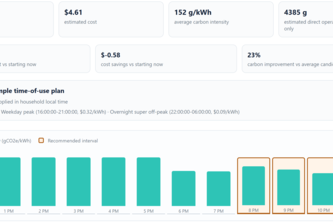
What the company appears to be: PowerPal is a self-reported personal utility optimization tool that uses AI and grid data to recommend optimal times for users to run electrical appliances in order to reduce carbon emissions and save money. The app is built using a combination of AI tools (including Codex, GPT-5.6, and OpenAI APIs) and open-source technologies.
What changed: The project was initially a hackathon submission (Devpost entry), but the author states intentions to turn it into a live web service with user sign-ups, history tracking, stats, reminders, and mobile app development.
The single most important open question: Is there any evidence of actual traction, revenue, or customer adoption beyond the author's own development work?
What The Product Actually Is
- The description states that PowerPal is an application that accesses APIs to get information about a user’s local grid data.
- It provides appliance usage recommendations based on this data, aiming to reduce carbon emissions and save money.
- The app uses the US Energy Information Administration (EIA) API and falls back to general data or inferences if an API is unavailable.
- It maps ZIP codes to relevant balancing authorities via a Department of Energy spreadsheet.
- The author built it using AI tools like Codex, GPT-5.6, and OpenAI APIs, with UI refinement through multiple passes of AI prompting.
Inference: The product appears to be a proof-of-concept or prototype built for a hackathon, not yet a commercial offering.
Positioning & Claim Evolution
- The tagline is “Saving Money and Saving the Planet,” which positions PowerPal as an environmentally conscious utility optimization tool.
- The author claims that AI can help reduce carbon footprint, aligning with public concern about AI’s environmental impact.
- The project evolved from a hackathon idea into a vision for a full web service with user accounts, history tracking, and mobile access.
Inference: The positioning is aspirational and self-described. There is no evidence of actual market positioning or branding beyond the author's own narrative.
Target Customer & ICP
- The description states that PowerPal targets U.S. adults concerned about AI’s environmental impact.
- It is designed for individuals who use electrical appliances and are interested in reducing their carbon footprint and saving money.
- The app is intended to be accessible via web and mobile platforms, suggesting a broad consumer audience.
Inference: The ICP is inferred from the author's stated goals and target demographic. No evidence of actual customer segments or personas exists.
Business Model & Pricing Evidence
- The author states that PowerPal will become a live web service where users can sign up.
- It will offer appliance usage recommendations, personalized history, stats, and reminders.
- There is no mention of pricing models, monetization strategies, or revenue streams in the description.
Inference: No evidence of business model or pricing structure exists beyond the author's stated intentions.
Technical & Delivery Signals
- The app was built using AI tools including Codex, GPT-5.6, and OpenAI APIs.
- It uses a combination of Python (FastAPI), React, TypeScript, and other open-source technologies.
- The backend integrates with EIA API and Department of Energy data to map ZIP codes to balancing authorities.
- UI was refined through multiple AI-driven checkpoints.
- Challenges included API connectivity issues and JSON format mismatches.
Inference: Technical delivery is demonstrated via the author’s own account but lacks independent verification or performance metrics.
Traction & Maturity Signals
- The project is described as a hackathon submission (Devpost entry).
- The author intends to turn it into a live web service, with mobile app development planned.
- No evidence of actual users, signups, or usage data exists beyond the author’s own work.
- There is no mention of revenue, customer acquisition, or product adoption.
Inference: No traction or maturity signals are evidenced. The project remains in an early-stage prototype phase.
Competitive Context
- The description does not mention any competitors or existing solutions in this space.
- It appears to be a novel concept within the hackathon context, but no evidence of prior art or competitive landscape is provided.
Inference: No competitive analysis or market positioning is evidenced. The author’s own claims are the only reference point.
Open Questions & Risks
- The project is entirely self-reported and unverified.
- No revenue, customers, or traction data are available.
- The app relies on APIs that may not be stable or scalable for a commercial product.
- The author is a single individual (1-person team), which raises questions about scalability and long-term development capacity.
- The use of AI tools like Codex and GPT-5.6 for development introduces uncertainty around reproducibility and control.
Inference: Risks are inferred from the lack of evidence and the self-reported nature of the project.
Questions the description leaves open
- What is the current status of the app? Is it live or still in prototype form?
- Have you conducted any user testing or gathered feedback from real users?
- How do you plan to monetize the service, and what pricing model are you considering?
- What are your plans for scaling beyond a single developer?
- Are there any legal or regulatory considerations around using EIA and DOE data in a commercial product?
- How do you intend to handle API reliability and data accuracy at scale?
Overall Assessment
- The project is described as a hackathon submission with no evidence of traction, revenue, or customer adoption.
- It is currently in an early prototype phase, with no verified business model or monetization strategy.
- There is no indication of team scalability or long-term development capacity beyond the single founder.
- The author's own account is the only source of information, and it lacks independent corroboration.
Inference: Based on the self-reported description alone, there is insufficient evidence to support a commercial due-diligence read. The project remains unproven in terms of viability, traction, or market readiness.
User Stories BotA demo video on every pull request
Get a demo video on every new feature
GitHub App that watches your pull requests and records a narrated, captioned demo.
Save time on demo prep and make informed decisions faster with a video walkthrough of every new feature.
Source
Submitted to the OpenAI 2026 hackathon on Devpost. Project home on Devpost. Back to the full gallery on Devpost.
This competitive analysis was produced by top-founders.com (opens in a new tab)
Generated by a language model from this project's public Devpost page — its tagline, the author's own write-up and any built-with tags listed there — as captured in August 2026. Short quotations are the author's words. It is an opinion on the idea as a business, not on the people behind it, and it reflects the description as published then. If the project has moved on, request a correction below. The analysis is not independent research and contains no verified traction, revenue or customer data.
An independent guide by KFG International LLC — not affiliated with, endorsed by, or connected to Devpost or OpenAI.