

Archive position — measured, not model output
0 likes on Devpost
2,263 of the 7,850 archived projects have more likes, and 5,587 share exactly 0 — so this project's #6,036 place in the like-ranked listing is a tie-break inside that group, not a ranking.
Projects (log scale)
Likes on Devpost. ▲ marks this project's group.
Show the figures
| Likes | Projects | Share of archive |
|---|---|---|
| 0 | 5,587 | 71.2% |
| 1 | 1,758 | 22.4% |
| 2 | 284 | 3.6% |
| 3–4 | 132 | 1.7% |
| 5–9 | 75 | 1.0% |
| 10+ | 14 | 0.2% |
 User Stories BotA demo video on every pull request
Get a demo video on every new feature
GitHub App that watches your pull requests and records a narrated, captioned demo.
Save time on demo prep and make informed decisions faster with a video walkthrough of every new feature.
Executive Summary
PowerTrain XR – AI-Powered Digital Twin Training is a browser-based digital twin training platform for mission-critical electrical infrastructure, built as a prototype during an OpenAI 2026 hackathon. The project is self-reported by one founder (NVIII Ward), who has a background in electrical maintenance and hospital water infrastructure. The description states that the platform aims to train technicians on dangerous or expensive failures using virtual environments, with a long-term vision of modular support across multiple industries including utilities, hospitals, manufacturing, and data centers.
The author claims the prototype demonstrates realistic operational concepts and uses AI-assisted development (GPT-5.6, Codex) to accelerate implementation. Key planned features include interactive electrical logic, AI-powered training assistant, SCADA integration, randomized fault scenarios, instructor mode, performance tracking, customer-specific twins, multi-user collaboration, VR optimization, and support for additional facilities.
The single most important open question
Is there any evidence of actual customer engagement or pilot programs beyond the hackathon prototype?
This analysis is based entirely on self-reported information from the project description. No independent verification, traction data, revenue figures, or customer names are available.
What The Product Actually Is
The description states that PowerTrain XR is a browser-based digital twin training platform for mission-critical electrical infrastructure. It demonstrates a realistic synchronous motor pumping station, where users can explore equipment, practice operational procedures, and interact with electrical systems in a safe virtual environment.
It is described as a prototype built during a hackathon, not yet a commercial product or service. The author notes that the project combines real-world industrial experience with modern web technologies (React, TypeScript, Three.js) and AI-assisted development tools (GPT-5.6, Codex).
The platform is claimed to support multiple industries, including hospitals, utilities, manufacturing facilities, electrical substations, and data centers.
Inference: The product appears to be a training simulation environment designed for industrial technicians, using virtual reality or 3D visualization techniques within a web browser.
Positioning & Claim Evolution
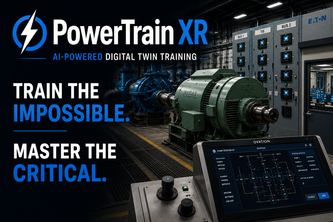
The author positions PowerTrain XR as a solution to the challenge of training technicians on failures that are too dangerous, expensive, or disruptive to replicate in real life. The tagline "Train the impossible. Master the critical" reflects this positioning.
The project's claim evolution shows:
- A hackathon prototype with a clear long-term vision.
- Emphasis on realistic operational concepts, not just graphics.
- Use of AI-assisted development to speed up implementation.
- Focus on preserving operational knowledge while improving workforce training.
There is no evidence of prior commercial positioning or market traction beyond the prototype. The description does not indicate any branding, messaging, or go-to-market strategy outside of the hackathon submission.
Inference: The company positions itself as a digital twin training platform for industrial safety, with an emphasis on AI-enhanced development and scalable architecture.
Target Customer & ICP
The author states that PowerTrain XR targets mission-critical electrical infrastructure, such as hospitals, municipal water utilities, manufacturing facilities, electrical substations, and data centers. These are described as environments where reliability is critical and technicians often encounter major failures for the first time during emergencies.
The primary users are likely technicians or trainees working in these sectors, who need safe ways to gain experience before operating on energized equipment.
There is no evidence of specific customer segments beyond general industrial settings. No named customers, use cases, or personas are provided.
Inference: The ICP appears to be industrial maintenance teams and training departments within large organizations requiring safe, repeatable, and scalable technician education.
Business Model & Pricing Evidence
The description does not contain any information about pricing models, monetization strategies, or business models. It only describes the platform’s functionality and future capabilities.
There is no mention of:
- Subscription tiers
- Licensing fees
- Per-user costs
- Enterprise contracts
- Revenue streams
Inference: No evidence exists to determine how PowerTrain XR intends to generate revenue or what its pricing structure might be.
Technical & Delivery Signals
The project was built using:
- Frontend stack: React, TypeScript, Three.js, HTML5, CSS3, Vite
- AI tools: GPT-5.6, Codex
- Deployment method: Browser-based (no native app or cloud infrastructure mentioned)
- Integration capabilities: SCADA integration, VR optimization
The author notes that the platform uses real-world industrial experience to inform design and behavior of electrical systems.
There is no evidence of:
- Production-grade infrastructure
- Scalable backend architecture
- Data persistence mechanisms
- API integrations or third-party services
Inference: The technical foundation appears to be a web-based simulation environment, built with modern frontend tools and AI-assisted development. It lacks evidence of production deployment or enterprise-grade delivery.
Traction & Maturity Signals
The project is described as a hackathon prototype, not yet a product in the market. The author mentions that they focused on creating a representative prototype during the hackathon, rather than attempting to recreate an entire utility.
There is no evidence of:
- Customers
- Revenue
- Product usage metrics
- Beta testing or pilots
- Market validation
The only maturity signal is that it was submitted to a 2026 OpenAI hackathon, which suggests early-stage development and idea exploration.
Inference: The project is in an early conceptual stage, with no demonstrated traction or commercial viability.
Competitive Context
No competitive analysis or market positioning relative to other digital twin or industrial training platforms is provided. The description does not mention:
- Competitors
- Market size estimates
- Differentiation from existing solutions
- Industry trends or adoption patterns
The author does not reference any similar tools, platforms, or vendors in the space.
Inference: No evidence exists regarding competitive landscape or positioning within the broader digital twin or industrial training market.
Open Questions & Risks
Key risks and open questions include:
- No traction or revenue: The project is described as a hackathon prototype with no commercial deployment.
- Unverified claims: All features, functionality, and future plans are self-reported without external validation.
- Single founder team: Only one member (NVIII Ward) is listed, raising questions about scalability and execution capacity.
- AI dependency: Heavy reliance on AI tools like GPT-5.6 may not be sustainable or replicable in a commercial setting.
- Lack of customer feedback: No evidence of user testing, pilot programs, or stakeholder engagement beyond the author’s experience.
Inference: The project presents high risk due to lack of validation, unproven business model, and limited team resources.
Questions the description leaves open
- What specific industrial environments have you engaged with for feedback or testing?
- How do you plan to validate the realism of operational procedures in your simulations?
- Are there any existing partnerships or pilot programs with utilities, hospitals, or manufacturers?
- What is your roadmap for transitioning from prototype to a scalable product?
- How will you monetize this platform? What pricing model are you considering?
- What are the key technical challenges in scaling beyond the current browser-based prototype?
- Can you explain how AI-assisted development impacts long-term maintainability and control?
Overall Assessment
Not evidenced.
The project is described as a hackathon prototype with no evidence of traction, revenue, or customer engagement. The author’s claims about future capabilities are unverified and lack supporting data.
There is insufficient evidence to assess whether PowerTrain XR has investment potential or strategic value for partnership. Any commercial viability remains speculative at this stage.
Confidence level: Low — based on thin self-reported evidence only.
User Stories BotA demo video on every pull request
Get a demo video on every new feature
GitHub App that watches your pull requests and records a narrated, captioned demo.
Save time on demo prep and make informed decisions faster with a video walkthrough of every new feature.
Source
Submitted to the OpenAI 2026 hackathon on Devpost. Project home on Devpost. Back to the full gallery on Devpost.
This competitive analysis was produced by top-founders.com (opens in a new tab)
Generated by a language model from this project's public Devpost page — its tagline, the author's own write-up and any built-with tags listed there — as captured in August 2026. Short quotations are the author's words. It is an opinion on the idea as a business, not on the people behind it, and it reflects the description as published then. If the project has moved on, request a correction below. The analysis is not independent research and contains no verified traction, revenue or customer data.
An independent guide by KFG International LLC — not affiliated with, endorsed by, or connected to Devpost or OpenAI.