

Archive position — measured, not model output
1 like on Devpost
505 of the 7,850 archived projects have more likes, and 1,758 share exactly 1 — so this project's #2,109 place in the like-ranked listing is a tie-break inside that group, not a ranking.
Projects (log scale)
Likes on Devpost. ▲ marks this project's group.
Show the figures
| Likes | Projects | Share of archive |
|---|---|---|
| 0 | 5,587 | 71.2% |
| 1 | 1,758 | 22.4% |
| 2 | 284 | 3.6% |
| 3–4 | 132 | 1.7% |
| 5–9 | 75 | 1.0% |
| 10+ | 14 | 0.2% |
 User Stories BotA demo video on every pull request
Get a demo video on every new feature
GitHub App that watches your pull requests and records a narrated, captioned demo.
Save time on demo prep and make informed decisions faster with a video walkthrough of every new feature.
Executive Summary
What the company appears to be
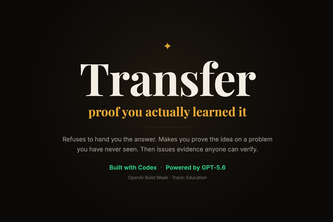
The project described by the author is a proof-of-concept educational tool named Transfer, designed to assess true understanding in programming education through a system that prevents learners from receiving direct answers and instead requires them to demonstrate mastery via solving novel, unaided problems. It uses AI for diagnosis and hint generation but enforces learning verification through runtime code execution.
What changed
The author describes building a system where the AI does not simply provide solutions or accept pattern-matching success — it actively prevents giving answers and instead ensures learners prove their understanding by solving new, unaided problems. This is framed as an innovation in how learning is measured.
Single most important open question (commercial due-diligence read)
Is there a viable path to scale this concept beyond a single-person prototype into a product that can be used by educators or learners at scale, and what would be required to do so?
What The Product Actually Is
The description states that Transfer is an AI-powered educational tool focused on Python fundamentals. It teaches fifteen concepts and enforces a specific learning loop:
- Learners run code in a browser-based Python runtime.
- If the code fails, GPT-5.6 diagnoses the misconception behind the mistake.
- Hints are Socratic questions, not solutions; a server-side guard rejects any hint that leaks an answer.
- After fixing the original problem, a new isomorphic problem is generated with its own reference solution and test cases.
- The learner must solve this new problem unaided to gain mastery.
- A checksummed evidence record is created showing failed attempt, diagnosis, generated problem, and unaided solve.
The system also includes:
- A state machine that enforces mastery rules.
- Execution-based grading (not opinion).
- Cohort analytics (limited to demo data).
- Proof records that verify integrity of the process but not identity or anti-cheating.
Not evidenced No information on whether this is a web application, mobile app, or other delivery method. No mention of integrations with LMS platforms or classroom tools.
Positioning & Claim Evolution
The author claims Transfer addresses two core issues in education:
- Pattern-matching instead of understanding: Students can get correct answers without truly learning.
- Measuring transfer (true understanding): Traditional assessments fail to detect fragile knowledge.
The positioning is that it's not just another practice site — it measures real learning by requiring unaided problem-solving after initial failure.
Inferred The author positions the tool as a way to detect "fragile understanding" before exams, which implies a shift from traditional grading toward deeper comprehension measurement. However, this claim is based on the self-reported narrative and not independently verified.
Target Customer & ICP
The description suggests that Transfer targets:
- Learners in Python courses.
- Educators who want to assess true understanding.
- Possibly teachers looking for early warning signals of student confusion.
It also mentions a potential use case for classroom analytics, where teachers can identify students who passed practice but failed transfer — indicating fragile understanding.
Not evidenced No explicit customer personas or segmentation beyond "students" and "teachers". No indication of whether the tool is aimed at K-12, higher education, corporate training, or self-taught learners.
Business Model & Pricing Evidence
The description does not include any information about:
- Revenue model.
- Pricing structure.
- Monetization strategy.
- Customer acquisition plans.
- Subscription tiers or usage-based pricing.
Not evidenced There is no evidence of a business model, even in speculative form. The author focuses entirely on the technical and pedagogical aspects.
Technical & Delivery Signals
The system uses:
- GPT-5.6 for diagnosis, hint wording, and challenge generation.
- Pyodide for Python execution in the browser.
- React + Next.js for frontend.
- Web Workers, WebAssembly, and Zod for validation.
- A state machine to enforce mastery rules.
- A guard mechanism that inspects hints and rejects anything that leaks an answer.
- Test suites (99 passing tests) covering correctness, refusal guards, and integrity checks.
The app is built using Codex + GPT-5.6, with the author stating they reviewed each product decision rather than accepting output blindly.
Inferred The architecture separates AI generation from runtime verification — a design choice that makes the system more trustworthy but also implies complexity in managing both components.
Traction & Maturity Signals
There is no evidence of:
- Revenue.
- Customers.
- Users.
- Adoption metrics.
- Product usage data.
- Market traction.
- Product maturity beyond prototype stage.
The project was submitted to the OpenAI 2026 hackathon, suggesting it's a demo or proof-of-concept. The author notes that the cohort dashboard uses "seeded demo data" and there is no roster integration or live classroom functionality.
Not evidenced No signs of traction or user engagement beyond the author’s own development process.
Competitive Context
The description does not mention:
- Competitors.
- Market landscape.
- Existing tools in the space (e.g., coding platforms like LeetCode, HackerRank, Coursera, edX).
- How Transfer differentiates from current offerings.
Not evidenced No competitive analysis or positioning relative to existing tools is provided.
Open Questions & Risks
- Scalability of AI-driven content creation: The system relies heavily on GPT-5.6 for generating misconceptions, hints, and problems. If the model fails to generalize well across different learners or domains, it could limit scalability.
- Dependency on runtime execution: The tool depends on running code in a browser sandbox (Pyodide). Any performance issues or compatibility problems could affect usability.
- Limited scope: Currently focused only on Python fundamentals and fifteen concepts — not a full curriculum.
- No identity verification or anti-cheating mechanisms: Proof records are integrity checks, not identity verification.
- Single-person team: The entire project was built by one person (ABDELAALI MOUID), raising questions about long-term maintenance, scalability, and feature development.
Inferred The lack of a clear business model or monetization strategy raises concerns about sustainability beyond the prototype stage.
Questions the description leaves open
- What are your plans for scaling beyond the current Python-focused prototype?
- How do you plan to integrate with existing educational platforms or LMS systems?
- Are there any plans to expand beyond Python into other subjects or domains?
- How would you validate that the AI-generated content (misconceptions, hints, problems) generalizes well across diverse learners?
- What is your roadmap for addressing scalability and performance concerns in a production environment?
- Do you have any thoughts on how this might be monetized or adopted by institutions or enterprises?
Overall Assessment
This is a self-reported prototype built by one individual, submitted to a hackathon. It presents an interesting idea around measuring true understanding in education using AI and execution-based verification.
However:
- There is no evidence of traction, revenue, or customer adoption.
- The business model is not described.
- The tool is currently limited in scope (Python only, 15 concepts).
- The system’s scalability and long-term viability depend on assumptions about AI reliability and runtime performance that are not tested.
Confidence level Low. This is a concept with potential, but it lacks the evidence needed to evaluate whether it can become a viable product or business.
User Stories BotA demo video on every pull request
Get a demo video on every new feature
GitHub App that watches your pull requests and records a narrated, captioned demo.
Save time on demo prep and make informed decisions faster with a video walkthrough of every new feature.
Source
Submitted to the OpenAI 2026 hackathon on Devpost. Project home on Devpost. Back to the full gallery on Devpost.
This competitive analysis was produced by top-founders.com (opens in a new tab)
Generated by a language model from this project's public Devpost page — its tagline, the author's own write-up and any built-with tags listed there — as captured in August 2026. Short quotations are the author's words. It is an opinion on the idea as a business, not on the people behind it, and it reflects the description as published then. If the project has moved on, request a correction below. The analysis is not independent research and contains no verified traction, revenue or customer data.
An independent guide by KFG International LLC — not affiliated with, endorsed by, or connected to Devpost or OpenAI.