

Archive position — measured, not model output
1 like on Devpost
505 of the 7,850 archived projects have more likes, and 1,758 share exactly 1 — so this project's #2,108 place in the like-ranked listing is a tie-break inside that group, not a ranking.
Projects (log scale)
Likes on Devpost. ▲ marks this project's group.
Show the figures
| Likes | Projects | Share of archive |
|---|---|---|
| 0 | 5,587 | 71.2% |
| 1 | 1,758 | 22.4% |
| 2 | 284 | 3.6% |
| 3–4 | 132 | 1.7% |
| 5–9 | 75 | 1.0% |
| 10+ | 14 | 0.2% |
 User Stories BotA demo video on every pull request
Get a demo video on every new feature
GitHub App that watches your pull requests and records a narrated, captioned demo.
Save time on demo prep and make informed decisions faster with a video walkthrough of every new feature.
Executive Summary
What the company appears to be
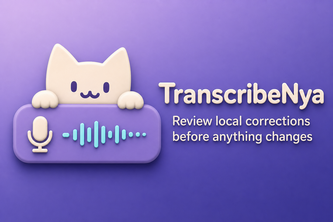
TranscribeNya is a self-reported desktop application for local audio/video transcription and correction, built using Electron, TypeScript, React, Whisper, FFmpeg, MLX, and Qwen3-1.7B-MLX-4bit. It allows users to register custom vocabulary, flag potentially incorrect segments, and review suggested corrections before applying them. The system is designed to operate entirely offline, with a focus on user control over changes.
What changed
During the OpenAI 2026 hackathon, the author added job-specific vocabulary support, Pocket Expert (a local RAG-based correction engine), a candidate-selection LoRA adapter, and a UI for human review. The tool now supports structured decision-making around corrections — keeping, replacing, or marking uncertain — with explicit user control over which text ranges are modified.
The single most important open question
Is there any evidence of real-world usage or adoption beyond the author’s own development and testing?
Note: This analysis is based solely on the self-reported project description provided by the caller. No external verification, revenue data, customer names, or traction metrics are available.
What The Product Actually Is
- The description states that TranscribeNya is an Electron-based desktop application.
- It uses Whisper for local transcription, FFmpeg for media processing, and MLX runtime.
- It includes a local RAG system to support custom vocabulary and context during review.
- A candidate-selection LoRA adapter is used to determine whether to keep, replace, or mark uncertain segments.
- The tool supports user-defined vocabulary including readings and preferred spellings.
- Corrections are presented via a UI where users can review candidates before accepting or rejecting them.
- Only the explicitly selected text range is replaced if accepted.
- The system runs entirely offline, without calling APIs like GPT-5.6 at runtime.
Inference: The product appears to be a transcription and correction tool tailored for users who want precise control over automated edits, particularly in niche or domain-specific contexts.
Positioning & Claim Evolution
- The tagline — “Find suspicious transcript segments and review safe local corrections before anything changes” — positions the tool as safe, user-controlled, and local.
- The author claims that prior to Build Week, TranscribeNya already supported local Whisper transcription, subtitle editing, and warning detection.
- During Build Week, it evolved to include:
- Job-specific vocabulary
- Pocket Expert (local RAG + candidate selection)
- Candidate-selection LoRA adapter
- Human-review UI
- Evaluation and packaging workflow
Claim: The tool was designed to avoid incorrect changes by leaving final decisions to the user.
Inference: This reflects a shift from general transcription to targeted correction with safety gates, suggesting an intent to address trust issues in automated tools.
Target Customer & ICP
- Not evidenced.
Finding: No explicit statement about target customer segments or ideal customer profiles (ICP) is present in the description. The author does not describe who would use this tool or what their needs are beyond personal experimentation.
Business Model & Pricing Evidence
- Not evidenced.
Finding: There is no mention of pricing, monetization strategy, or business model. The project is described as a hackathon submission and does not reference any sales, subscriptions, or revenue streams.
Technical & Delivery Signals
- Built with:
- Electron desktop app
- TypeScript + React frontend
- Whisper + FFmpeg for local media processing
- MLX runtime
- Qwen3-1.7B-MLX-4bit base model
- Candidate-selection LoRA adapter
- Local RAG system
- Codex and GPT-5.6 used during development, not at runtime
Claim: The tool runs entirely offline.
Inference: This is a strong technical signal that the product prioritizes privacy and performance over cloud-based processing.
Traction & Maturity Signals
- Not evidenced.
Finding: No evidence of actual users, customers, or usage metrics. The project is described as a hackathon submission with no mention of real-world deployment or adoption.
Competitive Context
- Not evidenced.
Finding: There is no discussion of competitors or market positioning beyond the author’s own claims. No comparison to existing transcription or correction tools is made.
Open Questions & Risks
- The system does not automatically correct entire subtitles — it only allows user-selected replacements.
- It uses a LoRA adapter trained on 100 cases, but this model was not adopted due to safety concerns around “keep” and “uncertain” cases.
- The current build is Ad Hoc signed, lacks notarization, and requires Apple Silicon Macs for full verification.
- The tool is described as a hackathon project, suggesting it may be in early-stage development or experimental form.
Inference: While the product has strong safety controls, its limited scope and lack of production-grade distribution raise questions about scalability and commercial viability.
Questions the description leaves open
- What is the actual use case for this tool? Who will benefit most from it?
- Are there any plans to expand beyond Mac OS or support other platforms?
- How does the system handle large-scale transcription workflows?
- Has the team considered integrating with existing transcription services or APIs?
- What are the long-term goals for product development and distribution?
Overall Assessment
- Not evidenced.
Finding: No information is provided about funding, valuation, or partnership interest. The project is described as a hackathon submission without any indication of commercial intent or investor activity.
User Stories BotA demo video on every pull request
Get a demo video on every new feature
GitHub App that watches your pull requests and records a narrated, captioned demo.
Save time on demo prep and make informed decisions faster with a video walkthrough of every new feature.
Source
Submitted to the OpenAI 2026 hackathon on Devpost. Project home on Devpost. Back to the full gallery on Devpost.
This competitive analysis was produced by top-founders.com (opens in a new tab)
Generated by a language model from this project's public Devpost page — its tagline, the author's own write-up and any built-with tags listed there — as captured in August 2026. Short quotations are the author's words. It is an opinion on the idea as a business, not on the people behind it, and it reflects the description as published then. If the project has moved on, request a correction below. The analysis is not independent research and contains no verified traction, revenue or customer data.
An independent guide by KFG International LLC — not affiliated with, endorsed by, or connected to Devpost or OpenAI.