

Archive position — measured, not model output
2 likes on Devpost
221 of the 7,850 archived projects have more likes, and 284 share exactly 2 — so this project's #324 place in the like-ranked listing is a tie-break inside that group, not a ranking.
Projects (log scale)
Likes on Devpost. ▲ marks this project's group.
Show the figures
| Likes | Projects | Share of archive |
|---|---|---|
| 0 | 5,587 | 71.2% |
| 1 | 1,758 | 22.4% |
| 2 | 284 | 3.6% |
| 3–4 | 132 | 1.7% |
| 5–9 | 75 | 1.0% |
| 10+ | 14 | 0.2% |
 User Stories BotA demo video on every pull request
Get a demo video on every new feature
GitHub App that watches your pull requests and records a narrated, captioned demo.
Save time on demo prep and make informed decisions faster with a video walkthrough of every new feature.
Executive Summary
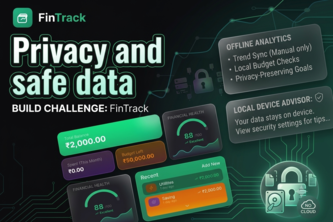
FinTrack is a self-reported offline-first personal finance tracker built as a Progressive Web App (PWA), designed to keep financial data local and prioritize user privacy over cloud dependency. The project was submitted by two developers, Rakesh Sharma and Swedha Thananzayan, for the OpenAI 2026 hackathon.
The description states that FinTrack supports expense tracking, budgeting, analytics, savings goals, and optional cloud backup via Supabase. It is built using React, TypeScript, IndexedDB with Dexie.js, and other frontend technologies. The app works completely offline unless users opt-in to cloud sync.
Key commercial due-diligence read: There is no evidence of revenue, customers, or product-market fit beyond the authors' own claims. The project is in early development, likely a prototype or proof-of-concept, with no demonstrated traction or monetization strategy.
What The Product Actually Is
The description states that FinTrack is:
- A Progressive Web App (PWA) built with React 19, TypeScript, Vite, and Tailwind CSS
- An offline-first finance tracker that stores data locally using IndexedDB and Dexie.js
- A tool for managing income/expense tracking, budgets, savings goals, recurring transactions, analytics, and financial health scoring
- Capable of exporting/importing data and optionally syncing with Supabase cloud backup
It is described as a privacy-first application, where users retain ownership of their data and can choose to enable or disable cloud synchronization.
Inference: The app appears to be a frontend-only PWA, not a full-fledged SaaS product. It does not appear to have backend infrastructure beyond optional Supabase integration.
Positioning & Claim Evolution
The description states that FinTrack was inspired by concerns about data breaches and digital privacy in personal finance apps. It positions itself as:
- A privacy-first alternative to traditional finance trackers
- An offline-first solution, allowing users to manage finances without internet or cloud dependency
- A local-first tool that gives users complete control over their financial data
The authors claim it is:
- Simple to use
- Installable via PWA
- Designed with a focus on user privacy and data ownership
- Built using modern frontend technologies (React, TypeScript, etc.)
Inference: The positioning reflects a growing trend in consumer apps toward local-first and privacy-centric design. However, the description does not indicate any market validation or differentiation from existing tools.
Target Customer & ICP
The description states that FinTrack is intended for:
- Users who are concerned about data breaches and digital privacy
- People who want to manage personal finances without uploading sensitive data to the cloud
- Individuals seeking a simple, offline-first finance tracker
It is implied that the target audience includes:
- Privacy-conscious consumers
- Users of traditional finance apps who are dissatisfied with data collection practices
Inference: The ICP appears to be early adopters or privacy advocates, but there is no evidence of customer segmentation, personas, or market research.
Business Model & Pricing Evidence
The description states that FinTrack:
- Is a free, offline-first application
- Offers optional cloud backup via Supabase
- Does not appear to have any pricing model or monetization strategy described
There is no mention of:
- Freemium tiers
- Subscription plans
- In-app purchases
- Paid features beyond cloud sync
Inference: The business model is unclear. It may be a prototype with no commercial intent, or the authors have not yet defined how it will generate revenue.
Technical & Delivery Signals
The description states that FinTrack:
- Is built using React 19, TypeScript, Vite, Tailwind CSS
- Uses IndexedDB with Dexie.js for local data persistence
- Employs Zustand for state management
- Uses Chart.js for analytics and Framer Motion for UI animations
- Implements service workers and PWA installability
- Integrates optional Supabase cloud backup
It was built using:
- Codex and GPT-5.6 for development acceleration
Inference: The tech stack suggests a modern frontend-only approach, with offline-first architecture. However, no evidence of scalability, performance metrics, or production deployment is provided.
Traction & Maturity Signals
The description states that FinTrack:
- Was submitted to the OpenAI 2026 hackathon
- Is a prototype or proof-of-concept
- Has not yet been released to the public
- Has no revenue, customer base, or adoption data
There is no evidence of:
- User engagement metrics
- Customer feedback or testimonials
- Product usage statistics
- Market traction or growth indicators
Inference: The project is in early development and lacks any maturity signals or real-world usage.
Competitive Context
The description does not mention specific competitors. However, it implies FinTrack is positioned against:
- Traditional finance apps that require cloud storage and account creation
- Apps that collect and monetize user data
It is implied that FinTrack differentiates itself through:
- Privacy-first approach
- Offline functionality
- Local data control
Inference: The competitive landscape includes mainstream personal finance tools (e.g., Mint, YNAB, PocketGuard), but no direct comparison or market positioning is provided.
Open Questions & Risks
The description states:
- FinTrack is a self-reported prototype, not a commercial product
- There is no evidence of revenue, customers, or monetization
- The app is built as a PWA, which may limit long-term scalability or monetization
- The use of GPT-5.6 for development raises questions about originality and technical depth
Open questions:
- No traction or commercial viability demonstrated
- No clear path to monetization or product-market fit
- Prototype-level features without validation
- Risk of being a one-off hackathon project with no follow-through
Questions the description leaves open
- What is the current stage of development? Is this a prototype, MVP, or early product?
- Have you validated demand for privacy-first finance tools among users?
- How do you plan to monetize FinTrack beyond optional cloud backup?
- Are there any plans to expand beyond the PWA format or add backend services?
- What is your roadmap for scaling and user acquisition?
- Do you have any partnerships or distribution channels in mind?
- What are the technical limitations of the current architecture, especially around data sync and multi-device support?
Overall Assessment
The description states that FinTrack:
- Is a self-reported hackathon project
- Has no revenue, customers, or traction
- Is built as an offline-first PWA with optional cloud backup
There is no evidence of commercial viability, product-market fit, or monetization strategy.
Assessment: Not ready for investment or partnership. This appears to be a prototype or proof-of-concept with no demonstrated traction, revenue, or clear path to market. The project lacks the maturity and commercial signals required for due-diligence consideration at this stage.
User Stories BotA demo video on every pull request
Get a demo video on every new feature
GitHub App that watches your pull requests and records a narrated, captioned demo.
Save time on demo prep and make informed decisions faster with a video walkthrough of every new feature.
Source
Submitted to the OpenAI 2026 hackathon on Devpost. Project home on Devpost. Back to the full gallery on Devpost.
This competitive analysis was produced by top-founders.com (opens in a new tab)
Generated by a language model from this project's public Devpost page — its tagline, the author's own write-up and any built-with tags listed there — as captured in August 2026. Short quotations are the author's words. It is an opinion on the idea as a business, not on the people behind it, and it reflects the description as published then. If the project has moved on, request a correction below. The analysis is not independent research and contains no verified traction, revenue or customer data.
An independent guide by KFG International LLC — not affiliated with, endorsed by, or connected to Devpost or OpenAI.