

Archive position — measured, not model output
0 likes on Devpost
2,263 of the 7,850 archived projects have more likes, and 5,587 share exactly 0 — so this project's #2,287 place in the like-ranked listing is a tie-break inside that group, not a ranking.
Projects (log scale)
Likes on Devpost. ▲ marks this project's group.
Show the figures
| Likes | Projects | Share of archive |
|---|---|---|
| 0 | 5,587 | 71.2% |
| 1 | 1,758 | 22.4% |
| 2 | 284 | 3.6% |
| 3–4 | 132 | 1.7% |
| 5–9 | 75 | 1.0% |
| 10+ | 14 | 0.2% |
 User Stories BotA demo video on every pull request
Get a demo video on every new feature
GitHub App that watches your pull requests and records a narrated, captioned demo.
Save time on demo prep and make informed decisions faster with a video walkthrough of every new feature.
Executive Summary
What the company appears to be
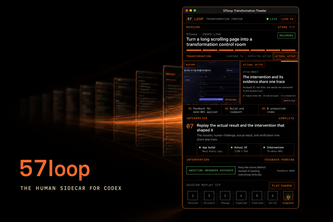
57loop — Context Translator for Codex is a self-reported local-first client application designed to help users meaningfully participate in AI-assisted coding without needing deep technical knowledge. It presents changes made by Codex in a structured way, with visible before/after states, plain-language explanations, and bounded decision points.
What changed
The author describes building a tool that shifts from a passive model output experience to an active, contextual one — where users can see what changed, why it happened, and make decisions about the next step. It introduces a "truth boundary" between conversation, pending actions, and actual file changes.
Single most important open question
Is there evidence of user adoption or engagement beyond the author’s own testing? The description lacks any data on usage, retention, or customer feedback — only self-reported development outcomes.
What The Product Actually Is
The description states that 57loop is a local-first Codex client with a Context Translator built around the conversation. It allows users to:
- Select a real project and start/resume a Codex thread inside 57loop.
- View both an immutable "Before" and latest observed "Current Actual" side-by-side.
- See completed file-change evidence become an "Actual checkpoint".
- Receive explanations from the Context Translator about what changed, why it happened now, likely effects, unverified elements, and next decisions needed.
- Approve or decline actions, interrupt threads, and steer results without leaving the product.
- Replay interventions to link them causally to future same-thread Actuals.
- Operate in English or Korean; submitted judge path is English.
The browser build is labeled as a DEMO, while the packaged macOS app represents the real runtime. The frontend uses Next.js, React, and TypeScript, and the backend integrates with Tauri/Rust for local execution and persistence.
Inference This appears to be a developer-facing tool aimed at improving transparency and control in AI-assisted coding workflows — especially where context is lost or unclear.
Positioning & Claim Evolution
The author claims that 57loop is designed for people who need to participate meaningfully in AI coding without becoming professional developers first. The core positioning centers on reducing the bottleneck of understanding context, not intelligence or vocabulary.
It positions itself as a human sidecar to Codex, aiming to improve contextual participation rather than replace it. The product evolves from an external sidecar into a client that owns the Codex conversation.
The author also notes that they made key product decisions such as:
- Replacing predicted "After" with sequential observed "Actuals"
- Keeping Before and Current Actual together
- Requiring one human decision plus causal proof
These claims suggest a shift from generic AI assistance toward structured, accountable interaction between user and AI.
Inference The positioning implies a niche in AI coding tools where trust, clarity, and agency are prioritized over raw performance or speed.
Target Customer & ICP
The description states that 57loop is intended for users who need to participate meaningfully in AI coding without becoming professional developers first. This suggests an audience of:
- Non-expert coders
- Developers working with AI tools but lacking full technical fluency
- Teams or individuals seeking clarity and control over AI-assisted changes
There is no mention of specific personas, industries, or use cases beyond general AI coding workflows.
Inference The target customer likely includes developers who are not fully comfortable with AI-generated code but want to stay involved in the process — possibly including junior developers, product managers, or technical leads.
Business Model & Pricing Evidence
There is no evidence of a business model or pricing structure in the provided description. The author does not describe monetization plans, subscriptions, licensing models, or any commercial framework.
The project is presented as a hackathon submission and includes links to a demo and repository, but no indication of paid services or revenue streams.
Inference No commercial traction or business model has been evidenced; this remains speculative.
Technical & Delivery Signals
Key technical details include:
- Built with Next.js, React, TypeScript, and Tauri/Rust
- Uses Codex and GPT-5.6 as primary implementation partners
- Implements a truth boundary: model text = conversation; approval request = pending action; only completed file-change evidence becomes Current Actual
- Runs locally with stdio JSON-RPC communication
- Supports restart-safe session recovery
- Includes 42 Rust tests, 26 web tests, and 15 CLI tests
- Has a public demo (browser-based) and a packaged macOS app
The author emphasizes that the product enforces separation of messages, turn activity, approvals, technical evidence, context packets, and actual scenes to maintain safety and clarity.
Inference This is a technically sophisticated prototype with strong engineering discipline. However, it’s unclear whether this has been scaled beyond personal or internal use.
Traction & Maturity Signals
The description mentions:
- A public demo available at https://fiftysevenloop-context-translator.zoro.chatgpt.site
- A GitHub repository: https://github.com/sundaynighttt/57loop-workspace
- A primary Codex Session ID: 019f7232-9ea2-7b12-b9f5-331fd1a441ff
- A five-user comprehension test planned after submission
- Fourteen accomplishments, including:
- Simultaneous Before and Current Actual views
- Plain-language Context Packets
- Real approval declines that prevented network commands
- Causal replay functionality
- Restart-safe recovery
However, there is no evidence of user adoption, retention metrics, or real-world usage beyond the author’s own testing.
Inference This is a mature prototype with strong functional completeness, but no evidence of traction or market validation.
Competitive Context
The description does not reference any competitors directly. However, it implies a space involving:
- AI coding assistants (e.g., Codex)
- Local-first development tools
- Tools that enhance transparency and control in AI workflows
It positions itself as an alternative to generic AI coding interfaces by focusing on contextual clarity, decision-making boundaries, and causal replay.
Inference The competitive landscape likely includes existing AI coding platforms like GitHub Copilot, Tabnine, or other local-first IDE integrations. But no direct comparison or differentiation is made in the description.
Open Questions & Risks
- No revenue or customer data: The project lacks any evidence of monetization or user engagement beyond the author’s own use.
- Single-person team: Only one member listed (조로 Cho), which may limit scalability and long-term development capacity.
- Limited market validation: No mention of early adopters, feedback loops, or usability testing beyond a planned comprehension test.
- Hackathon origin: Submitted to OpenAI 2026 hackathon — implies experimental or proof-of-concept stage.
- No cloud collaboration features mentioned: Features like billing, IDE support, and gamification are noted as future gates, suggesting current limitations.
Inference While technically impressive, the project is unproven in real-world settings and lacks commercial viability indicators.
Questions the description leaves open
- What specific problems do you see users facing when working with AI coding tools today?
- How many users have you tested this with beyond yourself? What were their reactions?
- Are there any plans to integrate with existing IDEs or platforms beyond local execution?
- What is the roadmap for moving from a demo to a production-ready product?
- Have you considered how this tool might scale in team environments or larger organizations?
- How do you plan to monetize or sustain development beyond personal effort?
Overall Assessment
The description indicates that 57loop is a technically robust, conceptually sound prototype built by one individual for a specific niche — improving transparency and control in AI-assisted coding.
However, there is no evidence of traction, revenue, or user engagement beyond the author’s own testing. The project is clearly in an early stage, likely post-hackathon, and lacks commercial readiness indicators.
Assessment Not suitable for investment or partnership at this time. A strong technical foundation exists, but no validated market need or business model has been demonstrated.
User Stories BotA demo video on every pull request
Get a demo video on every new feature
GitHub App that watches your pull requests and records a narrated, captioned demo.
Save time on demo prep and make informed decisions faster with a video walkthrough of every new feature.
Source
Submitted to the OpenAI 2026 hackathon on Devpost. Project home on Devpost. Back to the full gallery on Devpost.
This competitive analysis was produced by top-founders.com (opens in a new tab)
Generated by a language model from this project's public Devpost page — its tagline, the author's own write-up and any built-with tags listed there — as captured in August 2026. Short quotations are the author's words. It is an opinion on the idea as a business, not on the people behind it, and it reflects the description as published then. If the project has moved on, request a correction below. The analysis is not independent research and contains no verified traction, revenue or customer data.
An independent guide by KFG International LLC — not affiliated with, endorsed by, or connected to Devpost or OpenAI.