

Archive position — measured, not model output
0 likes on Devpost
2,263 of the 7,850 archived projects have more likes, and 5,587 share exactly 0 — so this project's #2,289 place in the like-ranked listing is a tie-break inside that group, not a ranking.
Projects (log scale)
Likes on Devpost. ▲ marks this project's group.
Show the figures
| Likes | Projects | Share of archive |
|---|---|---|
| 0 | 5,587 | 71.2% |
| 1 | 1,758 | 22.4% |
| 2 | 284 | 3.6% |
| 3–4 | 132 | 1.7% |
| 5–9 | 75 | 1.0% |
| 10+ | 14 | 0.2% |
 User Stories BotA demo video on every pull request
Get a demo video on every new feature
GitHub App that watches your pull requests and records a narrated, captioned demo.
Save time on demo prep and make informed decisions faster with a video walkthrough of every new feature.
Executive Summary
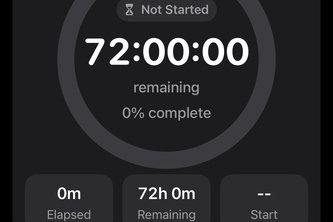
The description states that 72H Fasting Contest is a native iPhone app for tracking 72-hour fasting challenges. The author describes it as a motivation and tracking tool, not a medical device. It includes features like live timer, milestone notifications, leaderboards, private contests, and anonymous sign-in. The app uses SwiftUI, Firebase, and AI tools (Codex + GPT-5.6) in its development but does not call OpenAI APIs at runtime.
Key commercial signals:
- No evidence of revenue or customers.
- The app is self-contained and built by one person.
- It targets individuals participating in 72-hour fasts, potentially with social accountability elements.
- Pricing and business model are not described.
- Technical implementation involves Firebase and offline fallbacks.
- No traction or user growth data provided.
The single most important open question
Is there any evidence of actual usage or adoption beyond the author’s development?
What The Product Actually Is
The description states that 72H Fasting Contest is a native iPhone app designed for tracking 72-hour fasting challenges. It includes:
- A live timer and progress view
- Milestones at 12, 24, 36, 48, 60, and 72 hours
- Local reminders and milestone notifications
- History, statistics, streaks, rankings, and achievement badges
- Global and weekly leaderboards
- Private contests with invite codes
- Anonymous sign-in without email, phone, or password
The app asks users to accept a safety agreement before uploading data. It is described as a motivation and tracking tool, not a medical device.
Inference The app appears to be a personal wellness or challenge-tracking application focused on intermittent fasting.
Positioning & Claim Evolution
The description states that the app was inspired by the desire to turn an abstract 72-hour goal into a sequence of milestones, add optional social accountability, and keep safety information visible throughout the experience. The author positions it as a way to track fasts with motivation and community elements.
Inference The positioning evolved from a simple timer to a structured challenge with social features and safety considerations, suggesting an intent to make fasting more approachable and accountable.
Target Customer & ICP
The description states that the app is for individuals participating in 72-hour fasts. It includes features like leaderboards and private contests, implying a community or competitive element.
Inference The target customer likely includes people interested in intermittent fasting who want structured tracking, social motivation, and accountability. The anonymous sign-in suggests a low-friction onboarding approach for casual users.
Business Model & Pricing Evidence
The description does not state anything about pricing, monetization, or business model. It only describes the app's functionality and technical implementation.
Not evidenced.
Technical & Delivery Signals
The description states that:
- The app is built using SwiftUI and a shared AppViewModel.
- Codable models are used for profiles, fasting sessions, contests, badges, and preferences.
- Firebase Authentication and Cloud Firestore are used for backend services.
- A ContestBackend protocol separates UI from domain workflow with offline/local fallbacks.
- Realtime listeners power leaderboards.
- Firestore security rules validate ownership, permitted fields, contest membership changes, elapsed-time limits, and session state transitions.
- Server timestamps prevent early completion by changing local clock.
- Codex and GPT-5.6 were used during development but not in runtime.
Inference The app has a modern iOS architecture with backend integration and offline capabilities. AI was used for development assistance, not for product delivery or runtime functionality.
Traction & Maturity Signals
The description does not provide any evidence of traction, revenue, or user adoption beyond the author’s own development efforts. It mentions:
- A public GitHub repository
- A demo video
- Manual acceptance checklist and build instructions
Not evidenced.
Competitive Context
The description does not mention competitors or market positioning relative to other fasting or wellness apps.
Not evidenced.
Open Questions & Risks
- The app is built by a single developer, with no evidence of team or institutional support.
- No revenue, customer base, or user metrics are provided.
- The app is described as a hackathon project (submitted to OpenAI 2026 hackathon), suggesting early-stage development.
- It does not collect medical data but still requires safety consent — this may raise regulatory questions if scaled.
- Use of AI tools for development raises concerns about reproducibility or dependency on proprietary tools.
Inference The lack of traction, team size, and business model makes it difficult to assess commercial viability. The app is likely in a very early stage.
Questions the description leaves open
- What is the intended path from prototype to product?
- Are there any plans for monetization or revenue generation?
- How does the team plan to scale beyond one developer?
- Has the app been tested with real users, and what feedback has been received?
- Is there a roadmap for future features or platform expansion (e.g., Android)?
- What are the legal or regulatory considerations around safety agreements in this context?
Overall Assessment
The description states that 72H Fasting Contest is an iPhone app built by one developer as part of a hackathon submission. There is no evidence of revenue, customers, or traction.
Not evidenced.
This project appears to be an early-stage prototype with no commercial validation. It lacks any indication of product-market fit, scalability, or business model. The author’s own account does not suggest any intention to commercialize beyond personal use or hackathon submission.
Confidence: Low.
User Stories BotA demo video on every pull request
Get a demo video on every new feature
GitHub App that watches your pull requests and records a narrated, captioned demo.
Save time on demo prep and make informed decisions faster with a video walkthrough of every new feature.
Source
Submitted to the OpenAI 2026 hackathon on Devpost. Project home on Devpost. Back to the full gallery on Devpost.
This competitive analysis was produced by top-founders.com (opens in a new tab)
Generated by a language model from this project's public Devpost page — its tagline, the author's own write-up and any built-with tags listed there — as captured in August 2026. Short quotations are the author's words. It is an opinion on the idea as a business, not on the people behind it, and it reflects the description as published then. If the project has moved on, request a correction below. The analysis is not independent research and contains no verified traction, revenue or customer data.
An independent guide by KFG International LLC — not affiliated with, endorsed by, or connected to Devpost or OpenAI.