

Archive position — measured, not model output
0 likes on Devpost
2,263 of the 7,850 archived projects have more likes, and 5,587 share exactly 0 — so this project's #4,250 place in the like-ranked listing is a tie-break inside that group, not a ranking.
Projects (log scale)
Likes on Devpost. ▲ marks this project's group.
Show the figures
| Likes | Projects | Share of archive |
|---|---|---|
| 0 | 5,587 | 71.2% |
| 1 | 1,758 | 22.4% |
| 2 | 284 | 3.6% |
| 3–4 | 132 | 1.7% |
| 5–9 | 75 | 1.0% |
| 10+ | 14 | 0.2% |
 User Stories BotA demo video on every pull request
Get a demo video on every new feature
GitHub App that watches your pull requests and records a narrated, captioned demo.
Save time on demo prep and make informed decisions faster with a video walkthrough of every new feature.
Executive Summary
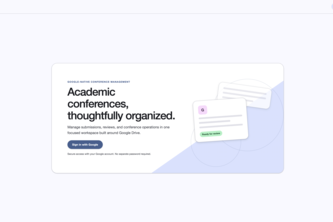
G-conf is a self-reported online conference platform built on Google infrastructure, designed to support virtual, hybrid, and in-person events. The author states it aims to reduce the effort required for organizing conferences by leveraging Google Workspace and Cloud services. It supports submission, review, and publishing workflows within Google’s ecosystem, with features like real-time chat, video conferencing via Meet APIs, and AI-powered transcription/translation.
The platform is described as being built entirely on Google Cloud Platform, using technologies such as GKE, Firebase, Vertex AI, and React/Next.js. The system is claimed to be scalable and modular, with support for large-scale events.
Key commercial due-diligence read: There is no evidence of revenue, customers, or adoption. The description contains only self-reported claims about functionality and architecture. The single most important open question is whether the author has demonstrated any traction or early user feedback — this is not evidenced.
What The Product Actually Is
The description states that G-conf is a full-featured online conference platform supporting virtual, hybrid, and in-person events. It enables organizers to manage workflows around submission, review, and publishing of conference content using Google Workspace tools.
Key features described:
- Utilizes existing Google accounts (no registration required)
- Seamless workflow from writing to managing personal Google Scholar records
- Supports keynote presentations, breakout sessions, networking, exhibitions, and interactive workshops
- Participants join via any device with a consistent, branded experience
The platform is built on Google Cloud Platform, including:
- Backend: Google Kubernetes Engine (GKE)
- Real-time features: Firebase
- Media: Google Meet APIs + Cloud Media Services
- AI/ML: Google Cloud Vertex AI
- Storage & Analytics: Google Cloud Storage and BigQuery
- Authentication: Google Identity and IAM
- Frontend: React/Next.js
Inference: The product is described as a conference management system, not a general-purpose video conferencing tool. It integrates deeply with Google Workspace for ease of use.
Positioning & Claim Evolution
The author positions G-conf as:
“A native Google-powered solution that makes hosting professional, engaging, and large-scale online conferences seamless and affordable.”
This positioning implies:
- Integration with Google’s ecosystem
- Focus on reducing effort for organizers
- Support for large-scale events
- Affordability compared to existing tools
The claim evolution shows a progression from:
- Problem identification: Limitations in current conferencing tools (performance, integration, cost)
- Solution proposition: A platform built natively on Google infrastructure
- Future vision: Enhanced features like adaptive streaming, AI-powered transcription/translation, Q&A, polls, and reactions
Inference: The positioning reflects a niche focus on academic or professional conference organizers who already use Google Workspace.
Target Customer & ICP
The description does not explicitly name target customers. However, it implies:
- Conference organizers (especially those managing large-scale events)
- Institutions or organizations that rely heavily on Google Workspace
- Academics or professionals in fields requiring structured event hosting (e.g., research conferences)
No explicit ICP is defined beyond the general use case of “organizers” and “participants” within a Google-centric workflow.
Inference: The likely ICP includes academic institutions, professional societies, and corporate R&D teams using Google Workspace for collaboration.
Business Model & Pricing Evidence
There is no evidence in the description of:
- Revenue model
- Pricing structure
- Monetization strategy
- Customer acquisition plan
The author only describes what the platform does, not how it will be monetized or sold.
Inference: If G-conf were to become a commercial product, it might follow a SaaS model, possibly with tiered pricing based on event size or feature set. However, this is speculative and not evidenced.
Technical & Delivery Signals
The platform is described as:
- Built entirely on Google Cloud Platform
- Modular architecture allowing horizontal scaling
- Uses GKE for orchestration, Firebase for real-time features, Vertex AI for AI capabilities
- Supports responsive design with React/Next.js frontend
- Integrates with Google Meet APIs and Workspace services
Inference: The technical stack suggests a scalable, cloud-native solution, potentially suitable for high-volume events. However, no evidence of actual deployment or performance data is provided.
Traction & Maturity Signals
There is no evidence of:
- Revenue
- Customers
- Users
- Adoption metrics
- Product usage data
- Market feedback
- Beta testing or pilot programs
The project was submitted to the OpenAI 2026 hackathon, suggesting it may be in an early development stage.
Inference: The product is likely in early prototype or MVP phase, with no demonstrated traction or market validation.
Competitive Context
The description does not mention competitors. However, based on the stated functionality (conference hosting, integration with Google Workspace), potential competitors could include:
- Zoom Events
- Microsoft Teams
- Hopin
- Eventbrite
- Cvent
- Google Meet (for basic conferencing)
No comparison or differentiation strategy is described.
Inference: G-conf appears to position itself as a Google-native alternative for conference organizers, but lacks clarity on how it differentiates from existing tools.
Open Questions & Risks
Key risks and open questions based on the description:
- No revenue or customer data: The platform is unproven in the market.
- Single-founder project: Limited team capacity for execution.
- Hackathon submission: Likely early-stage prototype, not yet validated.
- Unverified claims: All features and benefits are self-reported without external validation.
- No pricing or monetization strategy: Unclear path to profitability.
Inference: The risk of failure is high due to lack of traction, unclear business model, and unvalidated assumptions about user needs.
Questions the description leaves open
- What specific problem are you solving for conference organizers? How do you know this is a real pain point?
- Have you conducted any interviews or surveys with potential users?
- Are there any early adopters or pilot programs in progress?
- What is your go-to-market strategy and how will you acquire customers?
- What are the key assumptions behind your product design, and how have they been tested?
- How do you plan to monetize this platform? What pricing model are you considering?
- Can you show any prototype or demo of the current functionality?
Overall Assessment
There is no evidence of revenue, customers, or traction. The project is described as a hackathon submission and lacks any indication of commercial viability or market validation.
Assessment: Not ready for investment or partnership at this stage. The platform is in an early prototype phase with no demonstrated product-market fit or business model.
Confidence Level: Low — based entirely on self-reported claims, with no external corroboration or traction data.
User Stories BotA demo video on every pull request
Get a demo video on every new feature
GitHub App that watches your pull requests and records a narrated, captioned demo.
Save time on demo prep and make informed decisions faster with a video walkthrough of every new feature.
Source
Submitted to the OpenAI 2026 hackathon on Devpost. Project home on Devpost. Back to the full gallery on Devpost.
This competitive analysis was produced by top-founders.com (opens in a new tab)
Generated by a language model from this project's public Devpost page — its tagline, the author's own write-up and any built-with tags listed there — as captured in August 2026. Short quotations are the author's words. It is an opinion on the idea as a business, not on the people behind it, and it reflects the description as published then. If the project has moved on, request a correction below. The analysis is not independent research and contains no verified traction, revenue or customer data.
An independent guide by KFG International LLC — not affiliated with, endorsed by, or connected to Devpost or OpenAI.