

Archive position — measured, not model output
2 likes on Devpost
221 of the 7,850 archived projects have more likes, and 284 share exactly 2 — so this project's #326 place in the like-ranked listing is a tie-break inside that group, not a ranking.
Projects (log scale)
Likes on Devpost. ▲ marks this project's group.
Show the figures
| Likes | Projects | Share of archive |
|---|---|---|
| 0 | 5,587 | 71.2% |
| 1 | 1,758 | 22.4% |
| 2 | 284 | 3.6% |
| 3–4 | 132 | 1.7% |
| 5–9 | 75 | 1.0% |
| 10+ | 14 | 0.2% |
 User Stories BotA demo video on every pull request
Get a demo video on every new feature
GitHub App that watches your pull requests and records a narrated, captioned demo.
Save time on demo prep and make informed decisions faster with a video walkthrough of every new feature.
Executive Summary
What the company appears to be
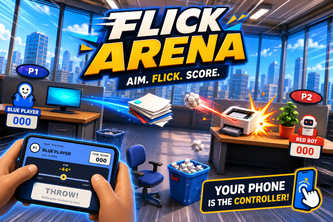
Flick Arena is a browser-based local multiplayer party game for 2–4 players, designed to run on shared displays (e.g., laptops) with phones acting as controllers. The product allows players to join via QR code scanning and use physical motion or touch input to aim and throw objects into a physics-driven arena.
What changed
The project is presented as a hackathon submission, indicating it is in an early-stage prototype or proof-of-concept phase. It was built using modern web technologies (React, Phaser.js, Cloudflare Workers) and focuses on enabling social gameplay without requiring apps, accounts, or dedicated hardware.
Single most important open question
Is there evidence of any traction, revenue, or user adoption beyond the author's own description? The self-reported nature of the project means no data on users, monetization, or market validation is available.
Note: This analysis is based entirely on the self-reported project description provided by the author. No external verification, historical data, or third-party sources are used. All claims are labeled as “the description states…” and treated as unverified assertions.
What The Product Actually Is
The description states that Flick Arena is a browser-based local multiplayer party game for two to four players. It uses:
- A host laptop or shared display as the main arena.
- Phones (already owned by players) as controllers.
- No app installation, account creation, or device pairing required.
- Players scan a QR code to join.
- Controllers support:
- Drag-to-aim
- Flick-to-throw
- On-screen Throw button as fallback
The host screen carries the game state and authority, while phones act as glanceable controllers. The system includes:
- A spectator display that shows synchronized match events.
- Support for motion sensors, haptics, audio, and fullscreen modes — but these are optional enhancements.
- Built with:
- React
- Phaser.js (for physics and rendering)
- Cloudflare Workers/Durable Objects (for multiplayer coordination)
- WebSockets for real-time communication
The description states that the product is a browser-first experience, avoiding native apps or external dependencies.
Positioning & Claim Evolution
The author positions Flick Arena as a social party game that brings the energy of couch multiplayer and arcade nights into the browser. It aims to:
- Enable quick setup: “Create a room, scan the QR code, aim, flick, and play.”
- Deliver immediate gameplay: “Journey from opening the game to landing the first hit feels almost immediate.”
- Emphasize physicality and social interaction, using phones as controllers.
- Avoid traditional barriers like apps, accounts, or hardware.
This positioning reflects a shift toward browser-native, low-friction multiplayer experiences, especially for casual or office-based play. The project is described as evolving from a simple idea into a polished experience with clear controls, physics, and spectator support.
The description states that the team focused on making the game feel “playful,” “social,” and “immediate.” It also notes that they simplified the control scheme to avoid sensor confusion, which shows an evolution in product design based on early feedback.
Target Customer & ICP
The target customer is described as:
- Office workers or casual gamers who want a quick, social multiplayer experience.
- Users who prefer not installing apps, creating accounts, or pairing devices.
- People looking for low-effort, high-reward party games in shared physical spaces.
There is no explicit mention of:
- Specific demographics
- Geographic targeting
- Industry verticals beyond "office"
- Customer segments beyond general users
The description states that the game is designed for “quick to understand, visible to everyone, and easy to laugh about,” suggesting a broad appeal but no defined ICP.
Business Model & Pricing Evidence
There is no evidence of any business model or pricing structure in the project description. The author does not mention:
- Revenue streams
- Monetization plans
- Subscription tiers
- Paid features
- Licensing or B2B use cases
The description states that Flick Arena is a hackathon submission and does not reference any commercial strategy.
Technical & Delivery Signals
The technical stack includes:
- Frontend: React, TanStack Start, TanStack Router, TypeScript, Zod
- Game Engine: Phaser 4 with Matter Physics
- Backend: Cloudflare Workers + Durable Objects
- Networking: WebSockets, HTTP routes
- Controller Input: DeviceMotion API, Screen Wake Lock API, HTML5 APIs
- Assets: Procedural textures, local SVG-style assets, generated WAV effects
Key delivery signals:
- A clear separation of concerns between UI, game logic, networking, and spectator display.
- Use of typed protocols (Zod) to validate messages.
- Support for progressive enhancement, including fallbacks for unsupported browser features.
- Designed with replayability in mind, allowing fast restarts without rejoining.
The description states that the architecture was designed to allow safe iteration and redesign without breaking core multiplayer functionality.
Traction & Maturity Signals
There is no evidence of traction or maturity beyond the hackathon submission. The author does not provide:
- User numbers
- Engagement metrics
- Retention data
- Customer feedback
- Product usage statistics
The project is described as a prototype, built in a short timeframe (hackathon), and submitted to Devpost.
The description states that this is a “public browser-first experience” but does not indicate whether it has been tested beyond the development team or deployed for public use.
Competitive Context
There is no mention of competitors or competitive landscape. The author does not reference:
- Similar games or platforms
- Existing local multiplayer solutions
- Browser-based gaming ecosystems
- Arcade-style or couch-multiplayer games
The description implies that Flick Arena fills a niche in browser-based, low-friction social gaming but does not place it within a broader market context.
Open Questions & Risks
Key risks and open questions include:
- No commercial traction or revenue: The project is described as a hackathon submission with no evidence of monetization.
- Unproven user adoption: No data on how many people actually play, or how well it works in real-world settings.
- Limited scalability assumptions: While built for 2–4 players, there's no indication of plans to scale beyond this.
- Browser dependency risks: The game relies heavily on browser APIs (motion sensors, fullscreen, etc.), which may not be consistently supported across devices or browsers.
- No long-term roadmap: No mention of future features or product evolution beyond initial testing.
These points are inferred from the lack of evidence for traction, scalability, or commercial viability in the description.
Questions the description leaves open
- What is your current user base? Have you tested with real users outside of development?
- How do you plan to monetize this product if at all?
- Are there any plans to expand beyond 2–4 players or support more complex game modes?
- What are the main technical challenges you've encountered in scaling or deploying this across different browsers and devices?
- Do you have any metrics on how long it takes new users to join and complete their first throw?
- How do you intend to handle potential latency issues in a real-time multiplayer environment?
- Is there any plan for integrating with existing platforms or services (e.g., Discord, Steam)?
- What is your strategy for improving the game feel over time, especially around physics and feedback?
Overall Assessment
Not evidenced: There is no evidence of revenue, customer traction, or financial performance to support an investment or partnership decision.
The project is presented as a hackathon prototype, built with modern web technologies, focused on social, low-friction multiplayer gaming. It shows early signs of product design maturity and technical execution but lacks any indication of market validation or commercial readiness.
The description states that this is a browser-first experience, but there is no evidence of real-world usage, monetization, or strategic positioning beyond the initial idea.
User Stories BotA demo video on every pull request
Get a demo video on every new feature
GitHub App that watches your pull requests and records a narrated, captioned demo.
Save time on demo prep and make informed decisions faster with a video walkthrough of every new feature.
Source
Submitted to the OpenAI 2026 hackathon on Devpost. Project home on Devpost. Back to the full gallery on Devpost.
This competitive analysis was produced by top-founders.com (opens in a new tab)
Generated by a language model from this project's public Devpost page — its tagline, the author's own write-up and any built-with tags listed there — as captured in August 2026. Short quotations are the author's words. It is an opinion on the idea as a business, not on the people behind it, and it reflects the description as published then. If the project has moved on, request a correction below. The analysis is not independent research and contains no verified traction, revenue or customer data.
An independent guide by KFG International LLC — not affiliated with, endorsed by, or connected to Devpost or OpenAI.