

Archive position — measured, not model output
2 likes on Devpost
221 of the 7,850 archived projects have more likes, and 284 share exactly 2 — so this project's #325 place in the like-ranked listing is a tie-break inside that group, not a ranking.
Projects (log scale)
Likes on Devpost. ▲ marks this project's group.
Show the figures
| Likes | Projects | Share of archive |
|---|---|---|
| 0 | 5,587 | 71.2% |
| 1 | 1,758 | 22.4% |
| 2 | 284 | 3.6% |
| 3–4 | 132 | 1.7% |
| 5–9 | 75 | 1.0% |
| 10+ | 14 | 0.2% |
 User Stories BotA demo video on every pull request
Get a demo video on every new feature
GitHub App that watches your pull requests and records a narrated, captioned demo.
Save time on demo prep and make informed decisions faster with a video walkthrough of every new feature.
Executive Summary
What the company appears to be
FirstAid is a self-reported web application designed to provide structured, AI-powered first-aid guidance during emergencies. The product is described as an information and coordination tool—not a replacement for emergency medical services or trained responders.
What changed
The project was built as a hackathon submission (Devpost entry) with a focus on creating a safe, focused user experience in emergency scenarios. It includes features like structured session flows, recorded timelines, and editable handover reports, all without claiming to dispatch or replace emergency services.
Single most important open question
Is there any evidence of traction, revenue, or customer adoption beyond the hackathon MVP?
Note: This analysis is based entirely on the self-reported description provided by the authors. No independent verification, archived data, or third-party sources are available. All claims are treated as stated by the author and not proven.
What The Product Actually Is
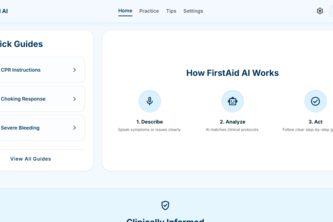
The description states that FirstAid AI is an emergency first-aid guidance web application. It allows users to begin an emergency session, select or describe a scenario (e.g., choking, severe bleeding), and follow short, structured guidance.
During the session:
- The app records answers, actions taken, notes, transcripts, and timelines.
- At the end of the session, it generates an editable handover report based only on recorded data.
- It includes features such as first-aid tips, practice flows, profile settings, and emergency-contact tools.
The system is described as:
- Not a replacement for emergency services or trained responders.
- Not claiming to contact or dispatch emergency services.
- Designed with safety in mind, avoiding diagnosis or unsupported AI behavior.
Inference: The product appears to be a frontend-facing web app with a backend API and WebSocket server, built using React, Node.js, Express, and TypeScript. It is currently an MVP for a hackathon.
Positioning & Claim Evolution
The description states that FirstAid AI is designed as:
- An information and coordination tool.
- Not a replacement for emergency medical services or trained responders.
- A calm, focused experience to help bystanders organize immediate actions, record events, and prepare clear handovers.
It avoids making claims such as:
- Diagnosing conditions.
- Automatically calling emergency services.
- Replacing clinical judgment.
The positioning is framed around safety, clarity, and preparedness, rather than AI-driven decision-making or automation.
Inference: The product’s positioning reflects a deliberate effort to avoid overpromising in a health-related domain. It emphasizes user empowerment through structured guidance, not medical intervention.
Target Customer & ICP
The description does not explicitly define the target customer or ideal customer profile (ICP). However, it implies:
- Users who may be in an emergency situation and need immediate, structured support.
- Individuals who want to prepare for emergencies (e.g., through practice flows).
- Bystanders or caregivers who might assist someone in distress.
The app is described as helping “anyone respond confidently” — suggesting a broad, non-specialized audience.
Inference: The ICP likely includes:
- General public.
- Individuals seeking first-aid training or preparedness.
- Potential users in low-resource or high-stress emergency environments.
Not evidenced: No specific customer segments, personas, or usage patterns are described.
Business Model & Pricing Evidence
There is no evidence of a business model or pricing structure in the description. The project is presented as a hackathon MVP with no mention of monetization, subscriptions, or paid features.
Inference: If this evolves into a commercial product, it may rely on:
- Free access for basic use.
- Paid premium features (e.g., authenticated accounts, secure report sharing).
- Partnerships with emergency services or training organizations.
Not evidenced: No pricing data, revenue model, or monetization strategy is provided.
Technical & Delivery Signals
The description states that the product was built using:
- Frontend: React, TypeScript, Vite, Tailwind CSS.
- Backend: Node.js, Express, TypeScript.
- WebSocket server for live session events.
- Codex with GPT-5.6 used during development for debugging, testing, documentation.
Key technical elements include:
- REST endpoints for emergency sessions and report generation.
- In-memory storage (for MVP).
- Session lifecycle management.
- Testable outputs and reproducible setup.
Inference: The team has a basic understanding of full-stack development and API integration. The use of Codex suggests an emphasis on rapid prototyping and code quality.
Not evidenced: No information about scalability, cloud infrastructure, or production deployment beyond the MVP.
Traction & Maturity Signals
The project is described as a hackathon submission, with no evidence of:
- Revenue.
- Customers.
- User adoption.
- Product-market fit.
- Post-hackathon development or iteration.
It is explicitly noted that:
- Session data is stored in memory.
- The backend is not yet publicly deployed.
- Future features are planned but not implemented.
Inference: This is a very early-stage MVP, likely with no traction or maturity beyond the hackathon phase.
Competitive Context
The description does not mention any competitors. However, it implies that FirstAid is positioned in a space where:
- Emergency response tools exist.
- Structured guidance apps may be available.
- AI-powered health tools are emerging.
It distinguishes itself by:
- Avoiding diagnosis or emergency dispatch claims.
- Focusing on coordination and documentation.
- Emphasizing safety and clarity over automation.
Inference: The competitive landscape likely includes:
- General first-aid apps.
- Emergency response platforms.
- AI chatbots in healthcare (though this one avoids clinical use).
Not evidenced: No competitor analysis, market size, or differentiation strategy is provided.
Open Questions & Risks
Key risks and open questions based on the description include:
- No traction or revenue: The product is a hackathon MVP with no evidence of adoption.
- Safety concerns: While the team avoids overpromising, the app’s use in real emergencies could be risky without professional validation.
- Limited scope: The MVP uses in-memory storage and lacks persistent data handling.
- Unproven scalability: No mention of production deployment or infrastructure.
- No monetization plan: No evidence of how the product will generate revenue.
Inference: The project is at a very early stage, with no commercial viability or market validation yet demonstrated.
Questions the description leaves open
- What is the current status of the backend deployment and data persistence?
- Have you validated any of the first-aid content with medical professionals?
- Are there plans to integrate with emergency services or certified training organizations?
- How do you plan to scale beyond the MVP, especially in terms of infrastructure and user base?
- What is your long-term vision for monetization or commercialization?
- Have you tested the app’s usability in real-world emergency scenarios?
Overall Assessment
Not evidenced: No data on valuation, funding rounds, or investor interest.
The project is described as a hackathon MVP, with no evidence of traction, revenue, or customer adoption. It is a very early-stage idea, built with limited production-grade infrastructure and no commercial model.
Inference: At this stage, the product is not suitable for investment or partnership unless there is a clear path to development, validation, and market traction.
This analysis is based entirely on self-reported information from the project description. No external verification or historical data is available.
User Stories BotA demo video on every pull request
Get a demo video on every new feature
GitHub App that watches your pull requests and records a narrated, captioned demo.
Save time on demo prep and make informed decisions faster with a video walkthrough of every new feature.
Source
Submitted to the OpenAI 2026 hackathon on Devpost. Project home on Devpost. Back to the full gallery on Devpost.
This competitive analysis was produced by top-founders.com (opens in a new tab)
Generated by a language model from this project's public Devpost page — its tagline, the author's own write-up and any built-with tags listed there — as captured in August 2026. Short quotations are the author's words. It is an opinion on the idea as a business, not on the people behind it, and it reflects the description as published then. If the project has moved on, request a correction below. The analysis is not independent research and contains no verified traction, revenue or customer data.
An independent guide by KFG International LLC — not affiliated with, endorsed by, or connected to Devpost or OpenAI.