

Archive position — measured, not model output
2 likes on Devpost
221 of the 7,850 archived projects have more likes, and 284 share exactly 2 — so this project's #323 place in the like-ranked listing is a tie-break inside that group, not a ranking.
Projects (log scale)
Likes on Devpost. ▲ marks this project's group.
Show the figures
| Likes | Projects | Share of archive |
|---|---|---|
| 0 | 5,587 | 71.2% |
| 1 | 1,758 | 22.4% |
| 2 | 284 | 3.6% |
| 3–4 | 132 | 1.7% |
| 5–9 | 75 | 1.0% |
| 10+ | 14 | 0.2% |
 User Stories BotA demo video on every pull request
Get a demo video on every new feature
GitHub App that watches your pull requests and records a narrated, captioned demo.
Save time on demo prep and make informed decisions faster with a video walkthrough of every new feature.
Executive Summary
What the company appears to be
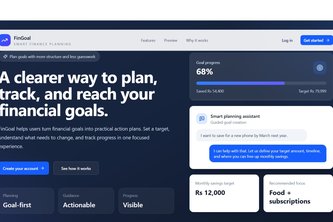
FinGoal is a self-reported personal finance assistant built as an agentic AI system. The author describes it as a conversational budgeting tool that remembers user context across sessions and adapts financial plans in real time based on ongoing conversations.
What changed
The project was submitted to the OpenAI 2026 hackathon, indicating it is a prototype or early-stage product with no evidence of prior traction, revenue, or customer adoption. It is not described as a commercial product or service yet.
Single most important open question
Is there any evidence that FinGoal has moved beyond a proof-of-concept into actual user engagement or financial planning execution?
What The Product Actually Is
The description states that FinGoal is:
- A conversational financial assistant
- Built using agentic AI, which implies an LLM-driven system capable of interpreting intent and updating goals
- Designed to remember conversations and maintain persistent user memory
- Capable of analyzing financial data automatically, including parsing statements and extracting insights
- Equipped with a dashboard for visualization of progress toward goals
It is described as a layered, containerized system built with:
- Frontend: React + TypeScript
- Backend: FastAPI
- Core engines: Conversation & Goal Engine, Financial Planning Engine
- Data persistence: PostgreSQL
- Deployment: Docker Compose
The author claims the system supports:
- Goal setting in plain English ("I want to save ₹5L for a car in 18 months")
- Real-time updates to financial plans
- Automatic expense optimization and affordability checks
- Snapshot generation for dashboard synchronization
Inference: The product is described as a prototype or MVP, not yet a commercial offering.
Positioning & Claim Evolution
The author positions FinGoal as:
- A personal budgeting assistant, distinct from generic apps that “treat you like a stranger”
- An agentic AI assistant, similar to a financial advisor in an ongoing relationship
- A system that remembers user context, unlike traditional tools that reset every session
The claim evolution shows:
- Initial inspiration: dissatisfaction with existing budgeting tools
- Core value proposition: personalization through memory and conversation
- Functional claims: goal-based planning, real-time adaptation, financial statement parsing, dashboard visualization
Inference: The positioning is aspirational and focused on user experience rather than measurable outcomes or adoption.
Target Customer & ICP
The description states:
- FinGoal targets individuals managing personal finances
- It assumes users have a financial goal, e.g., saving for a car or house
- Users are expected to upload financial statements and engage in conversational interaction
There is no evidence of segmentation beyond “personal finance users” or specific demographics.
Inference: The ICP appears to be early adopters or tech-savvy individuals interested in personal finance tools, but no data on actual user personas or targeting strategies.
Business Model & Pricing Evidence
The description does not state:
- Whether FinGoal is offered as a freemium, subscription, or one-time purchase model
- If pricing exists or how it would be monetized
- Any indication of revenue streams or monetization strategy
Inference: No evidence of business model or pricing structure. The project is described as a hackathon submission.
Technical & Delivery Signals
The author states:
- FinGoal is built using React + TypeScript, FastAPI, and PostgreSQL
- It uses Langchain, LLM, OpenAI, and JWT for authentication
- The system includes conversation memory, goal logic, and a financial planning engine
- It supports Docker Compose deployment, suggesting ease of setup and iteration
Inference: Technical architecture is described as full-stack, containerized, and modular. However, no evidence of production-grade infrastructure or scalability.
Traction & Maturity Signals
The description states:
- FinGoal was built for the OpenAI 2026 hackathon
- It is a single-person project (1 team member)
- No mention of users, customers, or adoption metrics
- No evidence of revenue, usage data, or product-market fit indicators
Inference: This is an early-stage prototype. There is no evidence of traction or maturity beyond the hackathon submission.
Competitive Context
The description does not include:
- Mention of competitors
- Any indication of market positioning relative to existing budgeting tools
- No reference to how FinGoal differentiates from other AI-powered financial apps
Inference: No competitive analysis is provided. The author focuses on internal features rather than external context.
Open Questions & Risks
Key risks and open questions based on the description:
- No traction or revenue evidence — the project is a hackathon submission with no commercial history
- Single-person team — limits scalability, product development speed, and operational capacity
- Unverified claims — all features are self-reported without independent validation
- Lack of business model clarity — no indication of monetization or pricing strategy
- Prototype nature — not yet a commercial product; no user feedback or iteration history
Questions the description leaves open
- What is the current stage of development beyond the hackathon?
- Have you conducted any user testing or gathered feedback from real users?
- How do you plan to monetize FinGoal, and what pricing model are you considering?
- Are there any technical limitations in scaling the conversation memory system?
- What financial statement formats does the OCR support currently?
- Do you have plans for multi-account aggregation or integration with banks?
Overall Assessment
Assessment: Not evidenced.
The project is described as a hackathon submission, not a commercial product. There is no evidence of:
- Revenue
- Customers
- Traction
- Product-market fit
- Business model
- Team scalability
This is an early-stage idea or prototype, likely in the concept or MVP phase. It lacks any commercial due-diligence signals.
Confidence Level: Low — based entirely on self-reported content with no external verification or historical data.
User Stories BotA demo video on every pull request
Get a demo video on every new feature
GitHub App that watches your pull requests and records a narrated, captioned demo.
Save time on demo prep and make informed decisions faster with a video walkthrough of every new feature.
Source
Submitted to the OpenAI 2026 hackathon on Devpost. Project home on Devpost. Back to the full gallery on Devpost.
This competitive analysis was produced by top-founders.com (opens in a new tab)
Generated by a language model from this project's public Devpost page — its tagline, the author's own write-up and any built-with tags listed there — as captured in August 2026. Short quotations are the author's words. It is an opinion on the idea as a business, not on the people behind it, and it reflects the description as published then. If the project has moved on, request a correction below. The analysis is not independent research and contains no verified traction, revenue or customer data.
An independent guide by KFG International LLC — not affiliated with, endorsed by, or connected to Devpost or OpenAI.