

Archive position — measured, not model output
0 likes on Devpost
2,263 of the 7,850 archived projects have more likes, and 5,587 share exactly 0 — so this project's #2,286 place in the like-ranked listing is a tie-break inside that group, not a ranking.
Projects (log scale)
Likes on Devpost. ▲ marks this project's group.
Show the figures
| Likes | Projects | Share of archive |
|---|---|---|
| 0 | 5,587 | 71.2% |
| 1 | 1,758 | 22.4% |
| 2 | 284 | 3.6% |
| 3–4 | 132 | 1.7% |
| 5–9 | 75 | 1.0% |
| 10+ | 14 | 0.2% |
 User Stories BotA demo video on every pull request
Get a demo video on every new feature
GitHub App that watches your pull requests and records a narrated, captioned demo.
Save time on demo prep and make informed decisions faster with a video walkthrough of every new feature.
Executive Summary
Company: 5 Minute Grove
Self-reported basis: The description is entirely self-reported by the author, Theo Ratkin, and unverified. No third-party evidence, financials, customers or traction are provided.
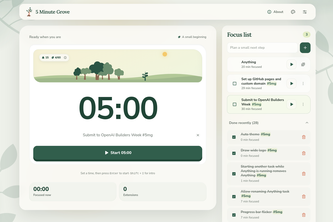
What it appears to be: A local-first focus timer app that encourages starting with five minutes of work and allows voluntary continuation or stopping. It visualizes progress through a "grove" of trees and leaves, with no account required.
What changed: The project was built in 7 days as part of the OpenAI 2026 hackathon. It is currently a personal tool, not yet a commercial product.
Single most important open question: Is there evidence that users will adopt this app beyond its creator’s personal use, or that it has a viable path to traction and monetization?
What The Product Actually Is
The description states that 5 Minute Grove is a local-first focus timer. It allows users to begin with five minutes of focused work and then choose whether to stop or continue for more five-minute intervals.
- Users can set tasks, start timers, and track progress visually through a "grove" of trees and leaves.
- The app stores data locally in the browser using IndexedDB and localStorage.
- It includes features such as task editing, reordering, hashtags, session recovery, themes, sounds, notifications, and data import/export.
- The interface supports ten languages and is built with SvelteKit, TypeScript, Tailwind CSS, and Vite.
Inference: The app appears to be a personal productivity tool designed for users who struggle with starting focused work but want flexibility in continuing or stopping. It is not described as a commercial product or service.
Positioning & Claim Evolution
The author claims that 5 Minute Grove was built to address the difficulty of starting focused work, especially when longer time blocks (like Pomodoro) feel too committed.
- The app positions itself around approachable starts and voluntary continuation, rather than rigid time commitments.
- It emphasizes a calm, visible outcome: "a grove" that grows with completed minutes, without streaks or penalties.
- The tagline — “A focus app that makes starting easier: begin with five minutes, then choose whether to stop or grow from there” — reinforces this positioning.
Inference: The product is positioned as a lightweight, non-judgmental tool for users who want autonomy in their work habits. It does not claim to be a productivity platform or enterprise solution.
Target Customer & ICP
The description states that the app was built by and for the author himself, with the goal of addressing his own struggle with starting focused work.
- The target user is described as someone who finds 25-minute Pomodoro sessions too difficult to commit to.
- It appeals to users who value flexibility, visual feedback, and local storage over cloud-based solutions.
Inference: The ICP seems to be individuals seeking autonomy in their work habits, particularly those who are self-directed or working independently. No explicit segmentation beyond this is provided.
Business Model & Pricing Evidence
The description does not state any business model, pricing, or monetization strategy.
- The app is described as local-first, with no account required.
- It includes features like data import/export and ten interface languages, but no mention of paid tiers, subscriptions, or in-app purchases.
Inference: There is no evidence of a commercial model at this stage. The app appears to be a personal tool, not a product intended for sale or monetization.
Technical & Delivery Signals
The author states that the app was built using:
- SvelteKit, Svelte 5, TypeScript, Tailwind CSS, and Vite
- Data stored in IndexedDB and localStorage
- Timer uses absolute timestamps for accuracy
- Groves are rendered with inline SVG and CSS
- Localization via Paraglide JS
- Deployed to GitHub Pages
Inference: The technical stack is modern and well-suited for a lightweight, local-first web app. The use of AI tools (Codex + GPT-5.6) during development suggests an iterative, rapid-build approach.
Traction & Maturity Signals
The description states:
- The app was built in 7 days as part of a hackathon.
- The author actively used the app while building it.
- It is currently hosted on GitHub Pages and has no account or monetization features.
- No data about users, adoption, or usage metrics are provided.
Inference: There is no evidence of traction, customer base, or commercial adoption. The product is in an early, personal development stage.
Competitive Context
The description does not mention any competitors or similar products.
- It is positioned as a focus timer, but without reference to existing tools like Pomodoro apps, Notion, or Forest.
- The unique visual element (the grove) and local-first approach may differentiate it from some apps, but no competitive analysis is provided.
Inference: No evidence of market awareness or competitive positioning. The app does not appear to be part of an existing ecosystem or product category.
Open Questions & Risks
- No commercial traction or monetization strategy: The app is described as a personal tool with no account or paid features.
- Limited scalability: It’s built for local storage and browser-based use, which may limit adoption beyond the creator.
- Unproven user demand: No evidence of external users or feedback beyond the author’s own experience.
- No long-term roadmap or business plan: The author mentions future features but does not describe a path to growth or commercial viability.
Inference: The risk is high that this remains a personal tool without a viable path to market traction or revenue generation.
Questions the description leaves open
- What evidence do you have of external users or demand for this product beyond your own use?
- Are there any plans to introduce account-based sync, monetization, or paid features?
- How do you plan to scale beyond a single-person development effort?
- Have you considered how the local-first approach affects user retention or engagement?
- What is your long-term vision for this product — is it intended to be a commercial offering?
Overall Assessment
Not evidenced: There is no evidence of revenue, customers, traction, or a clear business model. The app is described as a personal tool built in 7 days, with no indication of commercial viability or market demand.
Confidence level: Low. This is a self-reported, unverified description of a personal project with no third-party validation or evidence of adoption. It does not meet the criteria for a commercial due-diligence read at this stage.
User Stories BotA demo video on every pull request
Get a demo video on every new feature
GitHub App that watches your pull requests and records a narrated, captioned demo.
Save time on demo prep and make informed decisions faster with a video walkthrough of every new feature.
Source
Submitted to the OpenAI 2026 hackathon on Devpost. Project home on Devpost. Back to the full gallery on Devpost.
This competitive analysis was produced by top-founders.com (opens in a new tab)
Generated by a language model from this project's public Devpost page — its tagline, the author's own write-up and any built-with tags listed there — as captured in August 2026. Short quotations are the author's words. It is an opinion on the idea as a business, not on the people behind it, and it reflects the description as published then. If the project has moved on, request a correction below. The analysis is not independent research and contains no verified traction, revenue or customer data.
An independent guide by KFG International LLC — not affiliated with, endorsed by, or connected to Devpost or OpenAI.