

Archive position — measured, not model output
0 likes on Devpost
2,263 of the 7,850 archived projects have more likes, and 5,587 share exactly 0 — so this project's #4,249 place in the like-ranked listing is a tie-break inside that group, not a ranking.
Projects (log scale)
Likes on Devpost. ▲ marks this project's group.
Show the figures
| Likes | Projects | Share of archive |
|---|---|---|
| 0 | 5,587 | 71.2% |
| 1 | 1,758 | 22.4% |
| 2 | 284 | 3.6% |
| 3–4 | 132 | 1.7% |
| 5–9 | 75 | 1.0% |
| 10+ | 14 | 0.2% |
 User Stories BotA demo video on every pull request
Get a demo video on every new feature
GitHub App that watches your pull requests and records a narrated, captioned demo.
Save time on demo prep and make informed decisions faster with a video walkthrough of every new feature.
Executive Summary
What the company appears to be
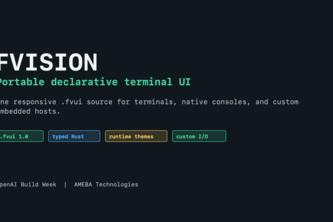
FVision is a self-reported portable declarative text UI toolkit for terminal and embedded systems. The author describes it as a new independent library that allows developers to define interfaces in a .fvui file, which can then be interpreted at runtime or compiled into Rust during build.rs. It supports responsive layouts, multiple themes, and cross-platform terminals and consoles.
What changed
The project was submitted to the OpenAI 2026 hackathon on Devpost. The author states that it had a working pre-event foundation and that GPT-5.6 was used for productization during Build Week. No prior version or evolution is described beyond this submission.
Single most important open question
Is there any evidence of real-world usage, adoption, or traction from developers or organizations using FVision? The description contains no data on customers, revenue, or product-market fit beyond the author’s own claims.
What The Product Actually Is
The description states that FVision is a portable declarative text UI toolkit. It allows developers to define interfaces in standalone .fvui files using constructs such as Rows, Columns, Grids, spacers, and percentage sizing. These files can be:
- Loaded and interpreted at runtime.
- Compiled into Rust during
build.rs. - Exposed through generated, strongly typed Rust properties, actions, callbacks, and observable models.
- Reused by future independent Python, MISRA C++, and Ada implementations.
The retained runtime includes features like dialogs, windows, menus, status bars, editors, lists, trees, tabs, validation, utility dialogs, keyboard and mouse handling, and runtime-switchable themes (Classic, Monochrome, Dark).
It supports modern ANSI/VT terminals, Linux virtual consoles with optional GPM, FreeBSD consoles, Windows Virtual Terminal and native Console APIs. Applications can also replace the entire input/output layer to target embedded character displays or other custom hardware.
Evidence
- The author describes FVision as a new, independent library.
- It uses a
.fvuifile format for interface definition. - It supports multiple runtime modes (interpreted vs compiled).
- It generates typed APIs in Rust and aims for language neutrality.
- It targets various platforms including Linux, FreeBSD, Windows, and embedded systems.
Inference The product is described as a toolkit, not an application or service. It appears to be aimed at developers building terminal-based tools or embedded UIs.
Positioning & Claim Evolution
The author positions FVision as a modern declarative UI system for text-mode applications, inspired by classic interfaces and modern toolkits like Slint, but designed independently.
Key claims:
- It applies responsive UI ideas to text interfaces.
- It supports portable
.fvuifiles that work across platforms. - It allows reuse of the same interface definition in multiple languages (Rust, Python, C++, Ada).
- It supports runtime switching between themes and responsive layout behavior.
- It is designed for developer tools, system administration, and embedded systems.
Evidence
- The tagline: “Define responsive text UIs once in portable .fvui files, then run them across modern terminals, native consoles, and custom embedded displays.”
- The write-up states it is inspired by classic interfaces and modern toolkits like Slint.
- It claims to support cross-platform deployment via
.fvuifiles.
Inference FVision positions itself as a language-agnostic UI framework for text-based environments, targeting developers who need portable, responsive UIs in terminal or embedded contexts. The positioning implies a niche but potentially high-value market for developers working with low-level interfaces.
Target Customer & ICP
The description does not explicitly name target customers or define an Ideal Customer Profile (ICP). However, the author states that FVision is intended for:
- Developer tools.
- System administration.
- Embedded systems.
It is also described as supporting terminal applications, which are often used by developers, DevOps engineers, and system administrators.
Evidence
- The write-up mentions terminal applications, developer tools, system administration, and embedded systems.
- It supports Rust, Python, C++, and Ada — languages commonly used in these domains.
Inference The likely ICP includes developers building terminal-based or embedded UIs, particularly those working in systems programming, DevOps, or embedded environments. The product is not described as targeting end-users or general consumers.
Business Model & Pricing Evidence
There is no evidence of a business model or pricing strategy in the description. The author does not mention monetization, licensing, subscriptions, or any commercial offering.
Evidence
- No mention of revenue streams.
- No mention of pricing tiers or plans.
- No indication of whether FVision is open-source or proprietary.
Inference The business model is not evidenced. It may be open-source, a freemium tool, or a paid product — but the description does not clarify.
Technical & Delivery Signals
The author describes how FVision works technically:
- Uses a
.fvuiformat for interface definition. - Parses and type-checks
.fvuifiles at build time or runtime. - Generates typed Rust bindings from
.fvui. - Supports multiple platforms via host drivers (Linux, FreeBSD, Windows).
- Implements responsive layout using weighted spacers, percentage sizing, viewport margins, and constraints.
- Handles Unicode, syntax highlighting, and grapheme-aware rendering.
- Allows custom input/output layers for embedded hardware.
Evidence
- The project is built with Rust (
cargo,rust). - It uses ANSI/VT terminals, GPM, FreeBSD console APIs, Windows Console APIs.
- It supports syntax highlighting, responsive layout, and runtime theme switching.
- It integrates with OpenAI Codex (GPT-5.6) for development.
Inference FVision is a technical toolkit, likely aimed at developers who want to build portable, responsive terminal UIs. The use of Rust and integration with GPT suggests it's built for performance and developer productivity.
Traction & Maturity Signals
There is no evidence of traction or adoption beyond the author’s own submission. No customers, users, or real-world usage are mentioned.
Evidence
- The project was submitted to a hackathon.
- It includes a demonstration application (the .fvui Inspector).
- No mention of downloads, user feedback, or production usage.
Inference There is no evidence of traction or maturity. It appears to be an early-stage prototype or proof-of-concept, not yet adopted in real-world applications.
Competitive Context
The description does not name competitors or provide a competitive analysis. However, the author references Slint, a modern declarative UI toolkit for graphical interfaces, as an inspiration.
Evidence
- The write-up states that FVision is inspired by Slint.
- It targets text-based UIs, which may overlap with tools like
tui-rs,ratatui, or other terminal UI libraries.
Inference FVision likely competes in the terminal UI space, possibly overlapping with Rust-based libraries such as tui-rs or ratatui. However, no direct competitor names are given.
Open Questions & Risks
- No traction or adoption: The project is described only as a hackathon submission. No evidence of real-world usage.
- Unproven market demand: There is no indication that developers are actively seeking this type of tool.
- Limited team size: Only one person (Florian Stöhr) is listed as part of the team, which may limit development velocity or scalability.
- Unclear business model: No information on monetization or commercial viability.
- High technical complexity: The project involves cross-platform support, responsive layout, and typed bindings — all of which are challenging to implement and maintain.
Evidence
- No revenue, customers, or usage data.
- Only one team member listed.
- No mention of funding or investment.
- No indication of a sustainable business model.
Questions the description leaves open
- What is the actual use case for FVision? Is it solving a specific problem in terminal UI development?
- Are there any existing users or early adopters of FVision?
- How does FVision compare to existing tools like
tui-rsorratatuiin terms of functionality and performance? - What is the long-term roadmap for language support (Python, C++, Ada)?
- Is there a plan to monetize FVision? If so, how?
- How does the team plan to scale beyond a single developer?
- What are the key technical challenges that remain unresolved or under-tested?
Overall Assessment
Not evidenced.
There is no evidence of revenue, customers, traction, or commercial viability. The project appears to be an early-stage hackathon submission with no demonstrated product-market fit or business model.
Confidence Low. The description is self-reported and unverified. No data supports the claims made about adoption, usage, or commercial potential. The lack of any evidence for traction, revenue, or customer feedback makes it difficult to assess whether this represents a viable investment or partnership opportunity.
User Stories BotA demo video on every pull request
Get a demo video on every new feature
GitHub App that watches your pull requests and records a narrated, captioned demo.
Save time on demo prep and make informed decisions faster with a video walkthrough of every new feature.
Source
Submitted to the OpenAI 2026 hackathon on Devpost. Project home on Devpost. Back to the full gallery on Devpost.
This competitive analysis was produced by top-founders.com (opens in a new tab)
Generated by a language model from this project's public Devpost page — its tagline, the author's own write-up and any built-with tags listed there — as captured in August 2026. Short quotations are the author's words. It is an opinion on the idea as a business, not on the people behind it, and it reflects the description as published then. If the project has moved on, request a correction below. The analysis is not independent research and contains no verified traction, revenue or customer data.
An independent guide by KFG International LLC — not affiliated with, endorsed by, or connected to Devpost or OpenAI.