

Archive position — measured, not model output
0 likes on Devpost
2,263 of the 7,850 archived projects have more likes, and 5,587 share exactly 0 — so this project's #4,983 place in the like-ranked listing is a tie-break inside that group, not a ranking.
Projects (log scale)
Likes on Devpost. ▲ marks this project's group.
Show the figures
| Likes | Projects | Share of archive |
|---|---|---|
| 0 | 5,587 | 71.2% |
| 1 | 1,758 | 22.4% |
| 2 | 284 | 3.6% |
| 3–4 | 132 | 1.7% |
| 5–9 | 75 | 1.0% |
| 10+ | 14 | 0.2% |
 User Stories BotA demo video on every pull request
Get a demo video on every new feature
GitHub App that watches your pull requests and records a narrated, captioned demo.
Save time on demo prep and make informed decisions faster with a video walkthrough of every new feature.
Executive Summary
What the company appears to be
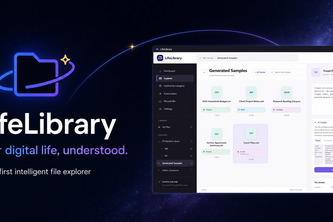
LifeLibrary is a self-reported Windows desktop file explorer that adds AI-powered intelligence to help users understand, search, and organize their files by meaning rather than name or location. It integrates local or cloud-based AI models (e.g., LM Studio or GPT-5.6) to summarize, categorize, tag, and visualize relationships between files. The product is described as a tool for individuals and small teams seeking a more intelligent but familiar file browsing experience.
What changed
The author states that LifeLibrary rethinks the traditional file explorer by embedding AI understanding into it without replacing the filesystem. It preserves folder structures and native file operations while introducing semantic search, persistent categorization, and visual exploration of file relationships.
Single most important open question
Is there any evidence of actual user adoption or traction beyond the author’s own development and submission to a hackathon?
What The Product Actually Is
The description states that LifeLibrary is a Windows desktop file explorer built with Electron, Node.js, HTML, CSS, and JavaScript. It allows users to:
- Browse folders and preview files.
- Analyze documents using either local AI (e.g., LM Studio) or cloud-based models (e.g., GPT-5.6).
- Extract content from PDFs, DOCX, PPTX, CSV, JSON, Markdown, and plain-text files.
- Search across filenames, summaries, categories, tags, and AI evidence.
- Visualize file relationships in a zoomable "file universe."
- Maintain real file paths, thumbnails, and native open behavior.
It is described as not replacing the filesystem but enhancing it with AI understanding. The product includes features like persistent indexing, adaptive taxonomy, and recovery workflows (e.g., recycle bin).
Inference The author claims this is a runnable desktop application, but there is no evidence of public availability or distribution beyond the Devpost submission.
Positioning & Claim Evolution
The description states that LifeLibrary positions itself as:
- A personal knowledge layer over the file system.
- An alternative to traditional file management tools that rely on rigid folder structures or opaque AI automation.
- A tool that preserves familiarity (folders, double-click to open) while adding intelligence.
It emphasizes three principles:
- Familiar: Files remain files; folders remain folders.
- Explainable: AI outputs include summaries, confidence, tags, and evidence.
- Private by choice: Users can choose local or cloud-based AI processing.
Inference The positioning reflects a shift from file-scanning tools to an intelligent file browser that integrates AI into everyday workflows. However, the claim of being “a personal knowledge operating layer” is self-reported and lacks traction data.
Target Customer & ICP
The description states that LifeLibrary is useful for:
- Students
- Researchers
- Creators
- Families
- Freelancers
- Small teams
It is described as a tool that can grow from a personal desktop utility into an intelligent knowledge layer for all file storage locations.
Inference The target audience appears to be individuals or small groups who value organization and privacy but are not enterprise-focused. However, there is no evidence of specific customer segments or personas defined beyond broad categories.
Business Model & Pricing Evidence
There is no evidence in the description of a business model or pricing structure. The author does not mention monetization, licensing, subscriptions, or any commercial framework.
Inference The product is described as a hackathon submission and not as a commercial offering. There is no indication that it has moved beyond prototype or personal use.
Technical & Delivery Signals
The description states that LifeLibrary was built using:
- Technologies: Electron, Node.js, HTML, CSS, JavaScript
- AI models: Codex, LM Studio, GPT-5.6 (via OpenAI-compatible API)
- Features: Local or cloud AI processing, document extraction, semantic search, persistent indexing, visual knowledge graph, filesystem safety
It includes:
- Context-isolated IPC bridge
- Bounded document parsers
- Structured AI output pipeline
- Visual category browser and file universe
- Windows installer with branded iconography
Inference The technical stack suggests a desktop application with strong integration of AI and filesystem operations. However, no evidence is provided about scalability, performance metrics, or production deployment.
Traction & Maturity Signals
There is no evidence of traction, revenue, customers, or adoption beyond the author’s own development and hackathon submission.
The description states:
- Team size: 0
- No members listed
- No funding rounds or valuations
- No public product release or user base
Inference This is a prototype or proof-of-concept project submitted to a hackathon. It has not demonstrated real-world usage or market traction.
Competitive Context
The description does not provide any information about competitors or the competitive landscape.
Inference No evidence exists of how LifeLibrary compares to existing file management or AI-powered knowledge tools (e.g., Notion, Roam Research, OneNote, or file-scanning tools). The author does not reference prior art or market positioning.
Open Questions & Risks
- No traction or user base: The product is described as a hackathon submission with no evidence of real-world adoption.
- Unproven business model: No indication of monetization or commercial viability.
- Limited team size: Team size is listed as 0, suggesting no development team beyond the author.
- Self-reported only: All claims are unverified and based on the author’s own description.
- No public availability: No evidence of a downloadable product or live demo.
Inference The project appears to be an experimental idea with no commercial or operational maturity. It is not ready for investment or partnership consideration without further development and validation.
Questions the description leaves open
- What is the current status of the product? Is it available for download or testing?
- How does the AI integration work in practice—what are the accuracy and reliability metrics?
- Are there any plans to monetize this tool, and if so, what model is being considered?
- Has the team validated the need for this product with real users or early adopters?
- What are the technical limitations of running on local AI models vs. cloud-based ones?
- How does the visual file universe scale with larger datasets?
Overall Assessment
Not evidenced.
The description provides no evidence of revenue, customers, traction, or a viable business model. The product is described as a hackathon submission and not yet a commercial offering.
Inference At this stage, LifeLibrary is an experimental concept with no demonstrated commercial potential. It would require significant development, user validation, and market testing before any investment or partnership consideration could be justified.
User Stories BotA demo video on every pull request
Get a demo video on every new feature
GitHub App that watches your pull requests and records a narrated, captioned demo.
Save time on demo prep and make informed decisions faster with a video walkthrough of every new feature.
Source
Submitted to the OpenAI 2026 hackathon on Devpost. Project home on Devpost. Back to the full gallery on Devpost.
This competitive analysis was produced by top-founders.com (opens in a new tab)
Generated by a language model from this project's public Devpost page — its tagline, the author's own write-up and any built-with tags listed there — as captured in August 2026. Short quotations are the author's words. It is an opinion on the idea as a business, not on the people behind it, and it reflects the description as published then. If the project has moved on, request a correction below. The analysis is not independent research and contains no verified traction, revenue or customer data.
An independent guide by KFG International LLC — not affiliated with, endorsed by, or connected to Devpost or OpenAI.