

Archive position — measured, not model output
1 like on Devpost
505 of the 7,850 archived projects have more likes, and 1,758 share exactly 1 — so this project's #1,059 place in the like-ranked listing is a tie-break inside that group, not a ranking.
Projects (log scale)
Likes on Devpost. ▲ marks this project's group.
Show the figures
| Likes | Projects | Share of archive |
|---|---|---|
| 0 | 5,587 | 71.2% |
| 1 | 1,758 | 22.4% |
| 2 | 284 | 3.6% |
| 3–4 | 132 | 1.7% |
| 5–9 | 75 | 1.0% |
| 10+ | 14 | 0.2% |
 User Stories BotA demo video on every pull request
Get a demo video on every new feature
GitHub App that watches your pull requests and records a narrated, captioned demo.
Save time on demo prep and make informed decisions faster with a video walkthrough of every new feature.
Executive Summary
What the company appears to be
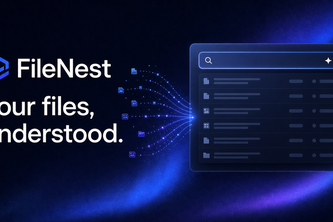
FileNest is a self-reported local-first desktop application for macOS and Windows that indexes, organizes, and searches files using private AI-powered tools. It claims to enable users to find files by content rather than name, with features like semantic search, chat-based retrieval, and OCR support.
What changed
The project was submitted as part of the OpenAI 2026 hackathon. The author describes it as a personal solution to the problem of growing folders losing useful context, aiming to provide a desktop companion that works without requiring cloud uploads.
Single most important open question
Is there any evidence of user adoption or traction beyond the author’s own development and testing?
What The Product Actually Is
The description states that FileNest is a local-first desktop app for macOS and Windows, designed to watch chosen folders, index files in the background, extract text and run OCR when needed, and maintain searchable metadata on-device. It supports private AI-powered search and chat capabilities.
It uses Swift/SwiftUI for macOS and Electron/React/TypeScript for Windows. The product integrates local indexing, SQLite-backed storage, OCR, retrieval-augmented generation (RAG), vector search, and configurable local models through Ollama.
The author notes that cloud providers are optional and only used when the user chooses them.
Evidence
- Self-reported by the author.
- No independent verification or data on actual product functionality beyond the description.
Positioning & Claim Evolution
The author positions FileNest as a practical desktop companion for people who struggle with file organization due to growing folders and disappearing context. It is described as an alternative to cloud-based solutions, emphasizing privacy and local processing.
Key claims include:
- Enables search by meaning, not just filename.
- Combines filenames, paths, extracted content, notes, and semantic retrieval.
- Offers chat-based search that starts with matching files and continues as a conversation.
- Keeps original source files close at hand.
- Supports on-device knowledge retrieval and faster, more trustworthy results.
Evidence
- Self-reported by the author.
- No evidence of market positioning or competitive differentiation beyond stated intent.
Target Customer & ICP
The description implies that FileNest targets individuals who manage large collections of files on their desktops and want better search capabilities without uploading data to the cloud. It is framed as a personal tool for users seeking more control over their file organization and privacy.
Evidence
- Self-reported by the author.
- No evidence of specific customer segments, personas, or usage patterns beyond general user needs.
Business Model & Pricing Evidence
There is no mention of pricing, monetization strategy, or business model in the description. The author does not state whether FileNest will be free, paid, or offered through any commercial channel.
Evidence
- Not evidenced.
- No indication of revenue streams or pricing models.
Technical & Delivery Signals
FileNest is built using:
- macOS: Swift and SwiftUI
- Windows: Electron, React, TypeScript
It integrates:
- Local indexing
- SQLite-backed storage
- OCR
- Retrieval-augmented generation (RAG)
- Vector search
- Configurable local models via Ollama
For the OpenAI Build Week hackathon, it used Codex powered by GPT-5.6 to accelerate development.
Evidence
- Self-reported by the author.
- No evidence of scalability, performance metrics, or production deployment details.
Traction & Maturity Signals
There is no evidence of traction, customers, revenue, or usage beyond the author’s own development and testing. The project was submitted as a hackathon entry, and there is no indication of any prior market validation or product launch.
Evidence
- Not evidenced.
- No data on adoption, retention, or user engagement.
Competitive Context
The description does not provide information about competitors or the competitive landscape. It does not reference similar products or platforms that might offer comparable functionality.
Evidence
- Not evidenced.
- No mention of existing tools or market positioning relative to others.
Open Questions & Risks
- Lack of traction: The project is described as a hackathon submission with no evidence of real-world usage or adoption.
- Single-founder team: Only one member listed ("she zhe"), which may limit execution capacity.
- Unproven commercial viability: No pricing, monetization, or business model details.
- Limited scope: The app is only available on macOS and Windows; no mobile support mentioned.
- Privacy vs. utility trade-off: While privacy is emphasized, the effectiveness of local AI tools for complex tasks remains untested in real-world conditions.
Evidence
- Inferences based on self-reported description.
- No external validation or performance data.
Questions the description leaves open
- What specific problems are users facing that FileNest solves?
- How do you plan to monetize the product, if at all?
- Have you conducted any user research or testing beyond your own use case?
- What is the roadmap for expanding support beyond macOS and Windows?
- How do you intend to scale indexing and search performance across large file collections?
- Are there plans for integrations with other tools or services?
- What are the key technical challenges that remain unresolved?
Evidence
- Inferences from self-reported description.
- No prior data or responses available.
Overall Assessment
At this stage, FileNest appears to be a conceptual prototype or hackathon project, not yet validated in the market. There is no evidence of revenue, customers, traction, or a clear path to monetization. The author describes it as a personal solution to a common problem but provides no indication of broader commercial potential.
Confidence Level Low
Next Steps
If this were part of an investment process, further due diligence would require validation of user needs, technical feasibility at scale, and evidence of traction or early adoption.
Evidence
- Self-reported only.
- No third-party verification or market data.
User Stories BotA demo video on every pull request
Get a demo video on every new feature
GitHub App that watches your pull requests and records a narrated, captioned demo.
Save time on demo prep and make informed decisions faster with a video walkthrough of every new feature.
Source
Submitted to the OpenAI 2026 hackathon on Devpost. Project home on Devpost. Back to the full gallery on Devpost.
This competitive analysis was produced by top-founders.com (opens in a new tab)
Generated by a language model from this project's public Devpost page — its tagline, the author's own write-up and any built-with tags listed there — as captured in August 2026. Short quotations are the author's words. It is an opinion on the idea as a business, not on the people behind it, and it reflects the description as published then. If the project has moved on, request a correction below. The analysis is not independent research and contains no verified traction, revenue or customer data.
An independent guide by KFG International LLC — not affiliated with, endorsed by, or connected to Devpost or OpenAI.