

Archive position — measured, not model output
1 like on Devpost
505 of the 7,850 archived projects have more likes, and 1,758 share exactly 1 — so this project's #1,060 place in the like-ranked listing is a tie-break inside that group, not a ranking.
Projects (log scale)
Likes on Devpost. ▲ marks this project's group.
Show the figures
| Likes | Projects | Share of archive |
|---|---|---|
| 0 | 5,587 | 71.2% |
| 1 | 1,758 | 22.4% |
| 2 | 284 | 3.6% |
| 3–4 | 132 | 1.7% |
| 5–9 | 75 | 1.0% |
| 10+ | 14 | 0.2% |
 User Stories BotA demo video on every pull request
Get a demo video on every new feature
GitHub App that watches your pull requests and records a narrated, captioned demo.
Save time on demo prep and make informed decisions faster with a video walkthrough of every new feature.
Executive Summary
What the company appears to be
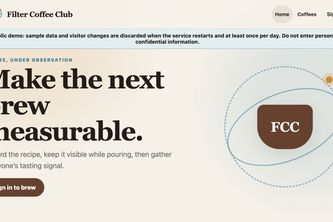
Filter Coffee Club is a self-reported web application built by one developer (Clemens Lange) for a small team at a research lab in Switzerland. It allows users to plan, track, and rate filter coffee brewing processes using a lightweight app deployed on a Raspberry Pi touch screen and mobile devices.
What changed
The project was submitted as part of the OpenAI 2026 hackathon. The author states they built it to solve an internal problem — decision fatigue around coffee recipes — and to improve upon prior ideas that were never implemented.
Single most important open question
Is there any evidence of actual usage or adoption beyond the initial team? The description does not indicate whether the app is being used beyond its creators, nor if it has been adopted by others. This is critical for assessing product-market fit and potential scalability.
What The Product Actually Is
The description states that Filter Coffee Club is a small web app designed to help plan and track filter coffee brewing processes. It allows users to vote on the results of different brews, aiming to identify the best recipe and coffee for a group.
- The backend uses FastAPI, and the frontend is built with SvelteKit, with all dependencies embedded and pages statically rendered.
- It was deployed on a VM and intended for use on a shared Raspberry Pi touch screen display and mobile devices.
- The app was developed using Codex (5.6-Sol Extra High), which the author says helped in planning and fixing logical and design issues.
Note
No evidence of actual product features or UI/UX details beyond this description is provided.
Positioning & Claim Evolution
The project description states that Filter Coffee Club was built to address a personal problem — decision fatigue around coffee recipes. It evolved from an idea that had been discussed but never implemented, and now the team has something they are proud of.
- The app is positioned as a tool for small teams or groups who want to experiment with filter coffee and find optimal brewing parameters.
- The author claims it is better than what they would have thought possible, suggesting an improvement over prior attempts or expectations.
Inference The positioning seems niche, focused on internal use within a lab setting. There is no indication of broader commercial intent or market expansion plans.
Target Customer & ICP
The description states that the app was built for a small team at a research lab in Switzerland, where they brew filter coffee using advanced equipment and vary parameters like water temperature, grind size, and extraction time.
- The target customer is likely a research lab or small group with an interest in optimizing coffee brewing.
- There is no evidence of any external customers or broader market targeting beyond the internal team.
Not evidenced No indication of whether this is a prototype for a larger product or if there are plans to expand beyond the initial use case.
Business Model & Pricing Evidence
There is no evidence in the description of any business model, pricing, monetization strategy, or revenue streams.
- The app was built as part of a hackathon and deployed internally.
- No mention of paid features, subscriptions, or commercial partnerships.
Inference The project appears to be a personal or internal tool, not a commercial product with a defined business model.
Technical & Delivery Signals
The author reports that the app was built using:
- Backend: FastAPI
- Frontend: SvelteKit
- Deployment: VM
- Device use: Raspberry Pi touch screen and mobile
- The app was designed to be lightweight, with all dependencies embedded and pages statically rendered.
- It was developed using Codex (5.6-Sol Extra High) for planning and fixing issues.
Not evidenced No information on scalability, performance metrics, or technical architecture beyond the tools used.
Traction & Maturity Signals
The description states that:
- The app is being used by the team over the next few weeks to test for issues.
- The team is considering writing a paper about their findings and possibly contacting Nescafe for sponsorship.
Not evidenced No data on actual usage, user engagement, or adoption beyond the initial team. There is no indication of customer acquisition, retention, or product-market fit.
Competitive Context
There is no evidence in the description of any competitive landscape or existing solutions in the filter coffee or brewing space.
- The app was built for internal use and not described as a commercial offering.
- No mention of competitors, market size, or differentiation from existing tools.
Inference If this is a standalone tool, it may not be competing with anything specific. However, if it were to expand, it would likely face competition in the niche of coffee brewing optimization or lab-based experimentation tools.
Open Questions & Risks
- The app was built by one person (Clemens Lange) and is described as a personal project, not a scalable product.
- No evidence of traction, revenue, or adoption beyond the initial team.
- The project is part of a hackathon, suggesting it may be a prototype or proof-of-concept rather than a commercial offering.
- The app is designed for a very specific use case (lab-based coffee brewing) with no indication of broader market appeal.
Inference If this were to become a commercial product, it would face risks related to scalability, market demand, and lack of early traction or user feedback.
Questions the description leaves open
- Is the app currently being used by more than just the initial team?
- What is the intended path from internal tool to potential commercial product?
- Are there any plans for monetization or partnerships beyond Nescafe sponsorship?
- How does the team plan to scale beyond a single lab use case?
- What are the technical limitations of the current architecture, and how might they be addressed?
Overall Assessment
The project is described as a personal or internal tool built by one developer for a small group in a research lab. There is no evidence of commercial traction, revenue, or adoption beyond its creators.
Assessment Not suitable for investment or partnership at this stage. The project appears to be a prototype or proof-of-concept with no demonstrated market demand or scalability potential. It would require significant further development and evidence of traction before it could be considered a viable business opportunity.
User Stories BotA demo video on every pull request
Get a demo video on every new feature
GitHub App that watches your pull requests and records a narrated, captioned demo.
Save time on demo prep and make informed decisions faster with a video walkthrough of every new feature.
Source
Submitted to the OpenAI 2026 hackathon on Devpost. Project home on Devpost. Back to the full gallery on Devpost.
This competitive analysis was produced by top-founders.com (opens in a new tab)
Generated by a language model from this project's public Devpost page — its tagline, the author's own write-up and any built-with tags listed there — as captured in August 2026. Short quotations are the author's words. It is an opinion on the idea as a business, not on the people behind it, and it reflects the description as published then. If the project has moved on, request a correction below. The analysis is not independent research and contains no verified traction, revenue or customer data.
An independent guide by KFG International LLC — not affiliated with, endorsed by, or connected to Devpost or OpenAI.