

Archive position — measured, not model output
0 likes on Devpost
2,263 of the 7,850 archived projects have more likes, and 5,587 share exactly 0 — so this project's #4,985 place in the like-ranked listing is a tie-break inside that group, not a ranking.
Projects (log scale)
Likes on Devpost. ▲ marks this project's group.
Show the figures
| Likes | Projects | Share of archive |
|---|---|---|
| 0 | 5,587 | 71.2% |
| 1 | 1,758 | 22.4% |
| 2 | 284 | 3.6% |
| 3–4 | 132 | 1.7% |
| 5–9 | 75 | 1.0% |
| 10+ | 14 | 0.2% |
 User Stories BotA demo video on every pull request
Get a demo video on every new feature
GitHub App that watches your pull requests and records a narrated, captioned demo.
Save time on demo prep and make informed decisions faster with a video walkthrough of every new feature.
Executive Summary
What the company appears to be
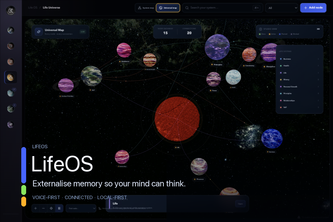
LifeOS is a self-reported voice-first personal decision system that aims to externalize memory and connect memories, beliefs, priorities, decisions, and actions into a unified experience for better decision-making. It is described as a personal AI assistant with 3D visualizations of life’s interconnected elements.
What changed
The project was submitted to the OpenAI 2026 hackathon by one founder, Ravi Jangid. The description indicates this is an early-stage prototype built over a short timeframe, likely using AI tools like Codex and GPT-5.6 for development support.
Single most important open question
Is there any evidence of user testing, feedback loops, or real-world usage beyond the author’s own account? Without such evidence, it's unclear whether LifeOS has moved beyond concept into a functional product with traction or adoption.
What The Product Actually Is
The description states that LifeOS is a voice-first personal decision system. It allows users to speak naturally, ask questions, explore past experiences, and update information. Key features include:
- Natural voice conversations with live transcripts
- Connected memories, principles, decisions, and experiences
- Voice commands for creating and updating data
- Unified to-do list connected to original nodes
- System Map and Universal Map showing life’s interconnectedness
- Conversation history and memory versioning
- JSON import/export capabilities
It is built using Next.js, React, TypeScript, Prisma, SQLite, Three.js, and React Three Fiber, with Gemini Live API powering the voice experience.
The author claims it supports local-first storage via SQLite and uses structured data management through Prisma. The 3D visualizations are rendered using Three.js and React Three Fiber.
Note
This is a self-reported description of functionality, not verified or demonstrated in practice.
Positioning & Claim Evolution
The project positions itself as an AI-driven tool that helps individuals externalize memory to improve decision-making. The tagline — “LifeOS is a voice-first personal decision twin that connects the memories, beliefs, choices and outcomes you choose to keep, then brings the right context forward when you need to decide.” — reflects this positioning.
The author emphasizes:
- A focus on personal context over generic advice
- The ability to connect disparate parts of life (e.g., Focus → Unclear Priorities → Avoidance → Business)
- A system that remains under user control, with changes only made upon explicit request
There is no indication of a shift in positioning from the description. It remains focused on personal decision-making, memory management, and voice interaction.
Inference The positioning suggests a niche market for individuals seeking clarity in their lives rather than enterprise or productivity tools.
Target Customer & ICP
The description does not name specific customer segments or personas. However, it implies a target audience of:
- Individuals who struggle with decision-making
- People looking to organize and reflect on personal memories, beliefs, and choices
- Users interested in voice-based interaction with AI systems
It is unclear if the system targets professionals, students, or general consumers.
Not evidenced No explicit ICP or customer segmentation provided.
Business Model & Pricing Evidence
There is no mention of pricing models, monetization strategies, or business plans in the description. The project appears to be a prototype submitted for a hackathon and lacks any indication of commercial viability or revenue streams.
Not evidenced No evidence of business model or pricing structure.
Technical & Delivery Signals
The author reports building LifeOS using:
- Frontend: Next.js, React, TypeScript
- Backend/Data: Prisma, SQLite
- 3D Visualization: Three.js, React Three Fiber
- Voice Experience: Gemini Live API
- Development Tools: Codex, GPT-5.6
Challenges mentioned include:
- Making voice interactions feel natural and reliable
- Handling live transcripts and interruptions
- Safely allowing voice updates without unrestricted database access
- Optimizing 3D maps for performance and clarity
Inference The use of local-first architecture (SQLite) suggests a privacy-conscious approach, but also limits scalability or cloud-based features.
Traction & Maturity Signals
There is no evidence of traction, user adoption, or real-world usage beyond the author’s own account. The project was submitted to a hackathon and described as a prototype built in a short time frame.
Not evidenced No data on users, customers, revenue, or product maturity.
Competitive Context
The description does not reference competitors or similar products. It is unclear whether LifeOS competes with existing personal AI assistants (e.g., Notion, Obsidian, or AI-powered decision tools), or if it occupies a unique space in the market.
Not evidenced No competitive analysis or positioning relative to other tools.
Open Questions & Risks
- No external validation: The project is entirely self-reported and unverified.
- Single founder: Only one team member (Ravi Jangid) is mentioned, raising questions about scalability and execution capacity.
- Prototype nature: Submitted as a hackathon entry; no indication of ongoing development or product-market fit.
- Privacy concerns: While local-first storage is noted, the system handles sensitive personal data and voice interactions — risks around data handling are not addressed.
- Technical complexity: The integration of 3D visualization, voice processing, and memory management in a single tool may be technically challenging to scale.
Inference Without traction or feedback, there is no way to assess whether the product solves a real need or works as intended.
Questions the description leaves open
- What specific problems are users facing that this system aims to solve?
- Have you tested the system with actual users? If so, what were the results?
- How do you plan to handle data privacy and security in a real-world setting?
- Is there any roadmap for expanding beyond the current prototype?
- What is your long-term vision for monetization or product development?
Overall Assessment
At this stage, LifeOS appears to be an early-stage prototype submitted as part of a hackathon. There is no evidence of traction, revenue, or customer validation. The project is described as a personal decision system built with voice and 3D visualization, but lacks any demonstration of real-world utility or commercial viability.
Confidence Level Low
Assessment Not ready for investment or partnership consideration without further evidence of product-market fit, user testing, or traction.
User Stories BotA demo video on every pull request
Get a demo video on every new feature
GitHub App that watches your pull requests and records a narrated, captioned demo.
Save time on demo prep and make informed decisions faster with a video walkthrough of every new feature.
Source
Submitted to the OpenAI 2026 hackathon on Devpost. Project home on Devpost. Back to the full gallery on Devpost.
This competitive analysis was produced by top-founders.com (opens in a new tab)
Generated by a language model from this project's public Devpost page — its tagline, the author's own write-up and any built-with tags listed there — as captured in August 2026. Short quotations are the author's words. It is an opinion on the idea as a business, not on the people behind it, and it reflects the description as published then. If the project has moved on, request a correction below. The analysis is not independent research and contains no verified traction, revenue or customer data.
An independent guide by KFG International LLC — not affiliated with, endorsed by, or connected to Devpost or OpenAI.