

Archive position — measured, not model output
0 likes on Devpost
2,263 of the 7,850 archived projects have more likes, and 5,587 share exactly 0 — so this project's #4,984 place in the like-ranked listing is a tie-break inside that group, not a ranking.
Projects (log scale)
Likes on Devpost. ▲ marks this project's group.
Show the figures
| Likes | Projects | Share of archive |
|---|---|---|
| 0 | 5,587 | 71.2% |
| 1 | 1,758 | 22.4% |
| 2 | 284 | 3.6% |
| 3–4 | 132 | 1.7% |
| 5–9 | 75 | 1.0% |
| 10+ | 14 | 0.2% |
 User Stories BotA demo video on every pull request
Get a demo video on every new feature
GitHub App that watches your pull requests and records a narrated, captioned demo.
Save time on demo prep and make informed decisions faster with a video walkthrough of every new feature.
Executive Summary
What the company appears to be
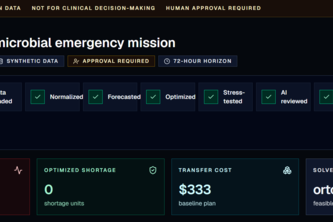
LifelineOS — Antimicrobial Crisis Edition is a self-reported healthcare operations platform designed to coordinate synthetic antibiotic supply emergencies across multiple hospitals. It ingests fragmented hospital inventory data, normalizes it into a canonical model, forecasts shortages, optimizes transfers, and runs stress tests under adverse scenarios. The system includes an AI review layer that interprets deterministic outputs but does not override them.
What changed
The project was submitted as part of the OpenAI 2026 hackathon. It is described as a demonstration-only tool built in a short timeframe using a mix of deterministic computation and AI-assisted development (via Codex), with no live model calls in the demo.
Single most important open question
Is there any evidence that this system has been deployed or tested in real-world hospital settings, or that it has moved beyond the demonstration phase?
What The Product Actually Is
The description states that LifelineOS is a healthcare operations platform for coordinating synthetic antibiotic supply emergencies across multiple hospitals. It transforms disconnected inventory data from incompatible formats into one canonical model.
It performs:
- Data normalization
- Forecasting of stockouts
- Optimization of transfers between hospitals
- Stress testing under adverse scenarios
- Structured multi-agent evidence review
- Human approval gate before export
- Export of auditable response packages
The system uses deterministic computation (e.g., Python, FastAPI, OR-Tools) for core logic and AI tools like Codex for development workflow support. The AI layer is described as a reviewer, not an executor.
Not evidenced: actual deployment, real hospital integration, or production use cases.
Positioning & Claim Evolution
The author positions LifelineOS as:
- A tool to turn fragmented hospital inventory data into a stress-tested, auditable crisis response
- Designed specifically for antimicrobial shortages, not general supply chain issues
- Built with deterministic logic and AI-assisted development, not AI-generated decisions
Key claims:
- It reduces projected shortage from 220 to 0 units in the demo.
- It does not hide failure; it labels plans as fragile when they fail under stress.
- It separates AI interpretation from deterministic decision-making.
Inferences:
- The tool is intended for hospital crisis teams, not frontline clinicians or patients.
- It aims to be a trustworthy AI system that emphasizes reproducibility, auditability, and honest failure reporting.
Not evidenced: market positioning beyond the hackathon submission, customer feedback, or adoption metrics.
Target Customer & ICP
The description states that LifelineOS is designed for:
- Hospitals managing antimicrobial supply crises
- Crisis response teams coordinating multi-hospital transfers
- Pharmacy and procurement staff needing structured decision support
It is not intended for:
- Clinicians or prescribing physicians
- Patients
- General inventory management (outside of antimicrobial shortages)
Not evidenced: actual customers, user personas, or specific hospital use cases beyond the synthetic demo.
Business Model & Pricing Evidence
The description does not state any business model or pricing structure.
It is described as a demo project submitted to a hackathon and not intended for commercial deployment.
Inferences:
- If commercialized, it may be sold as an SaaS platform, possibly with enterprise licensing.
- It could target healthcare systems or regional health authorities managing antimicrobial stewardship.
Not evidenced: revenue model, pricing tiers, or monetization strategy.
Technical & Delivery Signals
The system is built using:
- Backend: Python, FastAPI, Pandas, Pydantic, OR-Tools CP-SAT
- Frontend: Next.js, TypeScript, Tailwind CSS, Recharts
- Infrastructure: Docker, Docker Compose, PowerShell smoke tests
- AI tools: Codex for development workflow (not live model calls in demo)
Key technical signals:
- Deterministic-first architecture
- Separation of AI interpretation from decision-making
- Structured outputs and audit trails
- SHA-256 hashes for exported artifacts
- One-command Docker deployment
Not evidenced: production scalability, API access, or integration with real hospital systems.
Traction & Maturity Signals
The project is described as:
- A synthetic demonstration built in a hackathon context
- Not connected to real hospitals or clinical data
- Not validated for clinical use or regulatory compliance
Inferences:
- It has not yet reached production maturity.
- It may be a prototype or proof-of-concept.
Not evidenced: customer adoption, usage metrics, or real-world performance data.
Competitive Context
The description does not mention any direct competitors. However, it implies a space involving:
- Supply chain optimization for healthcare
- Crisis response and emergency logistics
- AI-assisted decision support in clinical operations
Not evidenced: competitive landscape, market size, or existing solutions in this domain.
Open Questions & Risks
Open questions
- The system is described as a demo only, not a deployed solution.
- No evidence of real-world testing or integration with hospitals.
- It is not clinically validated, nor intended for patient-level decisions.
- The AI layer is not live in the demo, raising questions about its future capability.
Risks
- Lack of clinical validation and regulatory approval
- Unclear path to production deployment
- Dependency on synthetic data, not real-world inputs
- Potential overstatement of AI capabilities (e.g., “AI review” vs. actual execution)
Not evidenced: risk mitigation strategies or real-world testing protocols.
Questions the description leaves open
- Has this system been tested in any real hospital setting?
- What are the plans for integrating with actual hospital inventory systems?
- How does the team plan to ensure clinical safety and regulatory compliance?
- Are there any existing partnerships or pilot programs with healthcare providers?
- What is the roadmap for moving from a demo to a production-grade system?
- Is there any intention to monetize this platform, and if so, how?
Overall Assessment
This is a self-reported hackathon demo with no evidence of traction, revenue, or real-world deployment.
The project shows technical capability in building a deterministic AI system for healthcare crisis coordination, but it remains unproven in practice.
Assessment Not ready for investment or partnership. It is a promising prototype that requires significant development and validation before any commercial or strategic move can be considered.
User Stories BotA demo video on every pull request
Get a demo video on every new feature
GitHub App that watches your pull requests and records a narrated, captioned demo.
Save time on demo prep and make informed decisions faster with a video walkthrough of every new feature.
Source
Submitted to the OpenAI 2026 hackathon on Devpost. Project home on Devpost. Back to the full gallery on Devpost.
This competitive analysis was produced by top-founders.com (opens in a new tab)
Generated by a language model from this project's public Devpost page — its tagline, the author's own write-up and any built-with tags listed there — as captured in August 2026. Short quotations are the author's words. It is an opinion on the idea as a business, not on the people behind it, and it reflects the description as published then. If the project has moved on, request a correction below. The analysis is not independent research and contains no verified traction, revenue or customer data.
An independent guide by KFG International LLC — not affiliated with, endorsed by, or connected to Devpost or OpenAI.