

Archive position — measured, not model output
0 likes on Devpost
2,263 of the 7,850 archived projects have more likes, and 5,587 share exactly 0 — so this project's #3,733 place in the like-ranked listing is a tie-break inside that group, not a ranking.
Projects (log scale)
Likes on Devpost. ▲ marks this project's group.
Show the figures
| Likes | Projects | Share of archive |
|---|---|---|
| 0 | 5,587 | 71.2% |
| 1 | 1,758 | 22.4% |
| 2 | 284 | 3.6% |
| 3–4 | 132 | 1.7% |
| 5–9 | 75 | 1.0% |
| 10+ | 14 | 0.2% |
 User Stories BotA demo video on every pull request
Get a demo video on every new feature
GitHub App that watches your pull requests and records a narrated, captioned demo.
Save time on demo prep and make informed decisions faster with a video walkthrough of every new feature.
Executive Summary
What the company appears to be
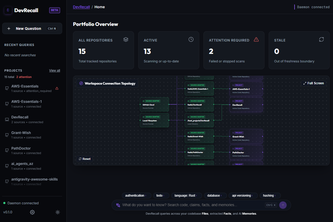
DevRecall is a self-reported local-first developer-memory platform that claims to help developers resume work on codebases by reconstructing context from GitHub repositories or local Git folders. It builds immutable snapshots of project history, structures facts and citations, and powers a React dashboard for inspection.
What changed
The author states this is their personal problem — needing hours to re-understand old projects — and that they built DevRecall to solve it. The platform uses Rust-based scanning, SQLite for persistence, and integrates with GitHub APIs and AI tools like Codex and GPT-5.6.
Single most important open question
Is there any evidence of real-world usage or developer adoption beyond the author's own experience?
What The Product Actually Is
The description states that DevRecall is a local-first developer-memory platform. It connects to GitHub repositories or local Git working trees and creates bounded snapshots. These snapshots include:
- Structured facts and citations
- Deterministic scanning results
- Evidence-backed claims
- Resume-ready project briefs
It persists this data in SQLite, exposes REST APIs and live status events, and powers a React dashboard.
The system is described as:
- Scanning repository structure, Git history, issues, PRs, releases, README content, and source markers.
- Supporting local-first controls where evidence stays separate from optional AI-provider settings.
- Using Rust daemon, Axum, SQLite/FTS5, React, TypeScript, Vite, Docker, GitHub APIs, and Server-Sent Events.
Inference The product is a developer tool for context reconstruction, not an AI agent or project manager. It is built with Rust and React, and uses Docker for deployment.
Positioning & Claim Evolution
The author states that DevRecall is not another project manager or Notion, but a project memory system. It aims to be:
- Highly automated
- Evidence-backed
- Local-first
- Resume-ready
It addresses the problem of re-entering old projects and rebuilding mental context from scratch.
The author also mentions that they used Codex and GPT-5.6 for planning and UI/UX design, and GPT-5.4, GPT-5.6-Nano, and Gemini for implementation tasks and polish.
Inference The positioning is to serve as a developer’s personal memory layer — not an AI assistant or task manager — but a tool that makes codebases legible again, especially for long-term or side projects.
Target Customer & ICP
The description states that DevRecall targets developers, particularly those who work on side projects or long-lived codebases where context is lost over time. The author says:
“As a developer it is my own personal problem .. i am running some mobile apps every time i try to improve or add fetures in my weekend to get start to understand it take hours.”
This implies the primary user is a developer working on personal or intermittent projects, not enterprise teams.
Inference The ICP is likely individual developers or small teams who work with Git repositories and need to quickly resume work without relearning project context.
Business Model & Pricing Evidence
The description does not state anything about pricing, business model, monetization, or revenue. It only describes the technical architecture and functionality.
Not evidenced
Technical & Delivery Signals
The author states that DevRecall is built with:
- Rust daemon
- Axum
- SQLite/FTS5
- React
- TypeScript
- Vite
- Docker
- GitHub APIs
- Server-Sent Events
It uses Codex and GPT-5.6 for planning, and GPT-5.4, GPT-5.6-Nano, and Gemini for implementation.
The system is described as:
- Supporting local-first controls
- Using deterministic scanning
- Exposing REST APIs and live status events
- Supporting GitHub integration via GitHub API
Inference The technical stack suggests a developer-focused, local-first tool with a dashboard UI. It uses AI tools in planning and implementation but does not appear to be an AI-native product.
Traction & Maturity Signals
The description states that DevRecall was submitted to the OpenAI 2026 hackathon, and includes documentation for running it locally using Docker.
It also mentions:
- A team of two members
- The project is self-reported and not independently verified
- No mention of customers, revenue, or usage metrics
Not evidenced
Competitive Context
The author references three side projects as examples:
- Daymarker
- Ironwill
- Goalflow7030
These are described as tools that may have similar goals (e.g., project tracking or memory systems), but no direct comparison to existing products is made.
Inference DevRecall appears to be a novel approach in the developer tooling space, aiming to solve context loss in codebases. It does not appear to directly compete with existing tools like Notion, Jira, or GitHub Projects, but rather fills a gap in personal project memory and resume capability.
Open Questions & Risks
- The product is self-reported only, with no evidence of traction, revenue, or customer usage.
- It’s built for local-first use, which may limit scalability or enterprise adoption.
- The author mentions using AI tools like GPT-5.6 and Codex in development but does not state whether the tool itself uses AI inference or is purely deterministic.
- No mention of security, privacy, or data governance features — especially important for a local-first system handling Git history.
- The team size is only two, which may limit execution speed or product maturity.
Questions the description leaves open
- What is the actual problem you're solving? Is it a common pain point among developers?
- Have you tested DevRecall with other developers, or is it just your personal tool?
- How does DevRecall handle large repositories or complex Git histories?
- Does the system support integration with other tools (e.g., IDEs, CI/CD pipelines)?
- What are the long-term plans for monetization or product evolution?
- Is there any plan to move beyond local-first use cases?
Overall Assessment
Not evidenced
The description is self-reported and unverified. There is no evidence of revenue, customers, traction, or a clear business model. The tool appears to be a personal project built for the author’s own use case, with no indication of broader market demand or scalability.
Confidence Low
Next Step
If this were a real investment opportunity, further due diligence would require evidence of usage, customer feedback, and product-market fit beyond the author's own experience.
User Stories BotA demo video on every pull request
Get a demo video on every new feature
GitHub App that watches your pull requests and records a narrated, captioned demo.
Save time on demo prep and make informed decisions faster with a video walkthrough of every new feature.
Source
Submitted to the OpenAI 2026 hackathon on Devpost. Project home on Devpost. Back to the full gallery on Devpost.
This competitive analysis was produced by top-founders.com (opens in a new tab)
Generated by a language model from this project's public Devpost page — its tagline, the author's own write-up and any built-with tags listed there — as captured in August 2026. Short quotations are the author's words. It is an opinion on the idea as a business, not on the people behind it, and it reflects the description as published then. If the project has moved on, request a correction below. The analysis is not independent research and contains no verified traction, revenue or customer data.
An independent guide by KFG International LLC — not affiliated with, endorsed by, or connected to Devpost or OpenAI.