

Archive position — measured, not model output
0 likes on Devpost
2,263 of the 7,850 archived projects have more likes, and 5,587 share exactly 0 — so this project's #3,734 place in the like-ranked listing is a tie-break inside that group, not a ranking.
Projects (log scale)
Likes on Devpost. ▲ marks this project's group.
Show the figures
| Likes | Projects | Share of archive |
|---|---|---|
| 0 | 5,587 | 71.2% |
| 1 | 1,758 | 22.4% |
| 2 | 284 | 3.6% |
| 3–4 | 132 | 1.7% |
| 5–9 | 75 | 1.0% |
| 10+ | 14 | 0.2% |
 User Stories BotA demo video on every pull request
Get a demo video on every new feature
GitHub App that watches your pull requests and records a narrated, captioned demo.
Save time on demo prep and make informed decisions faster with a video walkthrough of every new feature.
Executive Summary
What the company appears to be
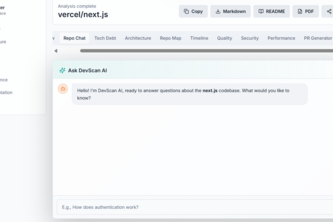
DevScan is an AI-powered tool that analyzes GitHub repositories and generates structured engineering insights such as health scores, architecture diagrams, code quality reports, security reviews, performance metrics, technical debt detection, refactoring suggestions, and more. It is built as a web application using modern frontend and backend technologies.
What changed
The project was submitted to the OpenAI 2026 hackathon on Devpost. The description indicates it was developed over a short timeframe (likely a hackathon) with no evidence of prior traction or commercial deployment.
Single most important open question
Is there any evidence that this tool has been used by developers beyond the hackathon context, or whether it has evolved into a product with real-world adoption?
What The Product Actually Is
The description states:
- DevScan is an AI-powered software engineering assistant.
- It analyzes GitHub repositories and transforms raw code into actionable engineering insights.
- Users paste a GitHub repository URL to initiate analysis.
- The tool generates outputs including:
- Engineering Health Score
- Architecture Overview & Interactive Diagrams
- Code Quality Analysis
- Security Review
- Performance Insights
- Technical Debt Detection
- AI Refactoring Suggestions
- Repository-Aware AI Chat
- Smart README Generation
- AI Pull Request Generator
- Interactive Repository Map
The tool is described as being built with:
- Frontend: Next.js, React, TypeScript, Tailwind CSS, Framer Motion
- Backend: Next.js API Routes, GitHub REST API, Google Gemini API, fallback heuristic engine
Inference This is a developer-facing SaaS-style web application that leverages AI to provide engineering intelligence from codebases.
Positioning & Claim Evolution
The description states:
- The core idea was to help developers understand unfamiliar codebases faster—“in minutes instead of hours.”
- It positions itself as an “AI-powered software engineering assistant.”
- The author claims it helps with onboarding, open-source contribution, and repository evaluation.
- Future plans include CI/CD integration, GitHub App support, IDE extensions, and team collaboration features.
Inference The positioning appears to be evolving from a hackathon prototype into a full-fledged AI-powered engineering assistant. However, the claims are self-reported and lack evidence of actual usage or market traction.
Target Customer & ICP
The description states:
- The tool targets developers who need to understand unfamiliar codebases.
- It is aimed at teams joining new projects, open-source contributors, and those evaluating repositories.
- Future plans include support for VS Code and JetBrains IDEs, suggesting a focus on developer workflows.
Inference The primary customer segment is software engineers or engineering teams working with large or unknown codebases. The ICP likely includes developers in mid-to-large tech companies or open-source contributors.
Business Model & Pricing Evidence
Not evidenced.
The description does not mention any pricing model, monetization strategy, or business model. It only describes the product features and technical architecture.
Technical & Delivery Signals
The description states:
- Built with modern full-stack web architecture.
- Uses Next.js for frontend and backend API routes.
- Integrates GitHub REST API and Google Gemini API.
- Includes a fallback heuristic engine to ensure reliability during demos.
- Features responsive UI, animations, loading states, and interactive visualizations.
Inference The tool is technically feasible and shows some polish in user experience design. However, the lack of data on performance, scalability, or production usage limits conclusions about delivery maturity.
Traction & Maturity Signals
Not evidenced.
There is no mention of:
- Revenue
- Customers
- Users
- Adoption metrics
- Product usage data
- Any form of traction beyond the hackathon submission
The project was submitted to a hackathon and has no evidence of being deployed or used outside that context.
Competitive Context
Not evidenced.
The description does not reference competitors, market size, or competitive positioning. No information is provided about existing tools in this space (e.g., SonarQube, CodeClimate, Snyk, etc.).
Open Questions & Risks
- No traction or revenue evidence: The tool exists only as a hackathon submission with no sign of real-world adoption.
- Unverified claims: All features and capabilities are self-reported without independent validation.
- Single-founder team: Only one member listed, which may limit execution capacity.
- Dependency on external APIs: Reliance on Google Gemini API and GitHub REST API introduces potential instability or cost concerns.
- Lack of business model clarity: No indication of monetization strategy or target pricing.
Questions the description leaves open
- Has the tool been used by developers beyond the hackathon?
- What is the current level of technical debt in the codebase, and how does it scale?
- Are there any plans to integrate with enterprise systems or CI/CD pipelines?
- How do you plan to monetize this product?
- What are the key assumptions behind your roadmap, especially around IDE integrations and GitHub App support?
- Have you considered data privacy implications of analyzing user repositories?
Overall Assessment
Not evidenced.
There is no evidence of revenue, customers, or traction that would support an investment or partnership decision. The project remains at the prototype stage, as evidenced by its hackathon origin and lack of commercial activity.
The author states they are building a “complete AI-powered repository analysis platform,” but this is a claim without supporting data. Any potential value lies in future development, not current performance or market readiness.
User Stories BotA demo video on every pull request
Get a demo video on every new feature
GitHub App that watches your pull requests and records a narrated, captioned demo.
Save time on demo prep and make informed decisions faster with a video walkthrough of every new feature.
Source
Submitted to the OpenAI 2026 hackathon on Devpost. Project home on Devpost. Back to the full gallery on Devpost.
This competitive analysis was produced by top-founders.com (opens in a new tab)
Generated by a language model from this project's public Devpost page — its tagline, the author's own write-up and any built-with tags listed there — as captured in August 2026. Short quotations are the author's words. It is an opinion on the idea as a business, not on the people behind it, and it reflects the description as published then. If the project has moved on, request a correction below. The analysis is not independent research and contains no verified traction, revenue or customer data.
An independent guide by KFG International LLC — not affiliated with, endorsed by, or connected to Devpost or OpenAI.