

Archive position — measured, not model output
0 likes on Devpost
2,263 of the 7,850 archived projects have more likes, and 5,587 share exactly 0 — so this project's #5,697 place in the like-ranked listing is a tie-break inside that group, not a ranking.
Projects (log scale)
Likes on Devpost. ▲ marks this project's group.
Show the figures
| Likes | Projects | Share of archive |
|---|---|---|
| 0 | 5,587 | 71.2% |
| 1 | 1,758 | 22.4% |
| 2 | 284 | 3.6% |
| 3–4 | 132 | 1.7% |
| 5–9 | 75 | 1.0% |
| 10+ | 14 | 0.2% |
 User Stories BotA demo video on every pull request
Get a demo video on every new feature
GitHub App that watches your pull requests and records a narrated, captioned demo.
Save time on demo prep and make informed decisions faster with a video walkthrough of every new feature.
Executive Summary
What the company appears to be
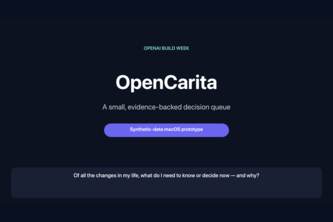
OpenCarita is a self-reported macOS prototype built by a single developer (종웅 박) that explores a decision queue system for calendar events. It uses synthetic data and deterministic logic to present reviewable actions derived from calendar changes, with an emphasis on safety, privacy, and clarity of intent.
What changed
The project was submitted as part of the OpenAI 2026 hackathon. The author describes it as a "Gate A" prototype — a sandboxed, synthetic-only demonstration that does not access live Calendar data or perform external actions.
Single most important open question
Is there evidence that this concept has traction or user demand beyond the single developer's own prototype?
What The Product Actually Is
The description states:
- OpenCarita is a native macOS app built with Swift, SwiftUI, and Xcode.
- It is a "Gate A" prototype using only compiled synthetic data.
- It demonstrates one narrow calendar scenario where a change in event timing creates a decision candidate.
- The system includes:
- Reason for item importance
- Evidence linked to observations
- Decision deadline
- Explicit uncertainty
- Recommended next step
- Clear boundary that no Calendar write or external effect occurs
Inference The product is not a production-ready system but a proof-of-concept built in a sandboxed environment with no live data access.
Positioning & Claim Evolution
The description states:
- The goal is to create an “evidence-backed decision queue” that stays quiet when no action is needed.
- It aims to avoid being another "noisy dashboard" or archive.
- The system treats safety, uncertainty, and permission boundaries as first-class elements.
Inference The positioning is centered on minimalism, safety, and clarity in personal decision-making — not on scale or automation.
Target Customer & ICP
The description states:
- No explicit customer segment or persona is defined.
- The system is built for a single developer’s own use case, with no mention of users beyond the author.
Inference There is no evidence of a target customer or ideal customer profile (ICP). The product appears to be self-directed and not yet validated in the market.
Business Model & Pricing Evidence
The description states:
- No pricing model or business model is described.
- It is a prototype, not a commercial offering.
- The author notes that it is not a production personal-data system.
Inference There is no evidence of a monetization strategy or pricing structure.
Technical & Delivery Signals
The description states:
- Built with Swift, SwiftUI, Xcode, and Swift Package Manager.
- Uses deterministic logic, versioned projections, idempotent observation, and canonical decision pairs.
- No live Calendar access or external effects.
- Includes 40 synthetic tests, architecture document, and MIT license.
- Implemented using GPT-5.6 in ChatGPT Codex Desktop.
Inference The technical approach is focused on safety, determinism, and sandboxing — not scalability or integration with live systems.
Traction & Maturity Signals
The description states:
- It is a prototype (Gate A).
- No live data access.
- No real-world usage or adoption.
- No revenue, customers, or traction data are provided.
Inference There is no evidence of traction or maturity beyond the single developer’s prototype.
Competitive Context
The description states:
- No mention of competitors or existing solutions in the calendar or decision queue space.
- The author does not reference similar tools or platforms.
Inference No competitive landscape is described, and there is no evidence of prior market analysis or competitive positioning.
Open Questions & Risks
The description states:
- It is a prototype with no live data access.
- No external effects or real-world actions are enabled.
- The system fails closed and does not link to EventKit.
- No user feedback, testing, or validation beyond synthetic tests.
Inference Key risks include lack of market validation, absence of real-world use cases, and no evidence of product-market fit or traction.
Questions the description leaves open
- What is the intended user journey for someone who would benefit from this system?
- How does the author plan to validate the value of a decision queue in real-world usage?
- Has there been any user research or feedback on the concept beyond the prototype?
- What are the next steps after Gate A, and how will live Calendar access be introduced safely?
- Are there any plans to expand beyond macOS or to integrate with other data sources?
Overall Assessment
The description states:
- It is a single-developer hackathon prototype.
- No revenue, customers, or traction are evidenced.
- The system is not production-ready and does not access live data.
Inference At this stage, there is no commercial due-diligence basis for investment or partnership. The project is exploratory and unproven in terms of market demand or viability.
User Stories BotA demo video on every pull request
Get a demo video on every new feature
GitHub App that watches your pull requests and records a narrated, captioned demo.
Save time on demo prep and make informed decisions faster with a video walkthrough of every new feature.
Source
Submitted to the OpenAI 2026 hackathon on Devpost. Project home on Devpost. Back to the full gallery on Devpost.
This competitive analysis was produced by top-founders.com (opens in a new tab)
Generated by a language model from this project's public Devpost page — its tagline, the author's own write-up and any built-with tags listed there — as captured in August 2026. Short quotations are the author's words. It is an opinion on the idea as a business, not on the people behind it, and it reflects the description as published then. If the project has moved on, request a correction below. The analysis is not independent research and contains no verified traction, revenue or customer data.
An independent guide by KFG International LLC — not affiliated with, endorsed by, or connected to Devpost or OpenAI.