

Archive position — measured, not model output
0 likes on Devpost
2,263 of the 7,850 archived projects have more likes, and 5,587 share exactly 0 — so this project's #5,698 place in the like-ranked listing is a tie-break inside that group, not a ranking.
Projects (log scale)
Likes on Devpost. ▲ marks this project's group.
Show the figures
| Likes | Projects | Share of archive |
|---|---|---|
| 0 | 5,587 | 71.2% |
| 1 | 1,758 | 22.4% |
| 2 | 284 | 3.6% |
| 3–4 | 132 | 1.7% |
| 5–9 | 75 | 1.0% |
| 10+ | 14 | 0.2% |
 User Stories BotA demo video on every pull request
Get a demo video on every new feature
GitHub App that watches your pull requests and records a narrated, captioned demo.
Save time on demo prep and make informed decisions faster with a video walkthrough of every new feature.
Executive Summary
What the company appears to be
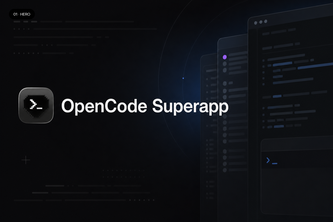
OpenCode Superapp is a self-reported macOS-native desktop application built with GPT-5.6 through Codex. The author describes it as a local-first, multi-provider agent workspace that enables users to build, test, extend, and operate their Mac using developer agents.
What changed
The project description indicates the author has developed a full native macOS app integrating local and cloud AI models, with support for extensions and computer interaction via explicit permissions. It is presented as an evolution of agent tooling toward a more integrated, user-controlled desktop experience.
Single most important open question
Is there evidence of any real-world usage or adoption beyond the author’s own development process? The description states no revenue, customers, or traction data are available.
Note: This analysis is based solely on the self-reported, unverified project description provided by the caller. No external corroboration exists for any claims made.
What The Product Actually Is
- The description states that OpenCode Superapp is a "full native macOS agent application built on the OpenCode harness."
- It combines features such as projects, sessions, worktrees, terminals, Git, model and provider selection, permissions, skills, MCP servers, extensions, voice, whiteboards, remote access, and computer interaction.
- The app supports both local models (via an app-managed Ollama engine) and cloud providers.
- It includes a "Computer Use system" that can inspect and interact with desktop applications through explicit permissions and supervised control.
- Extensions are supported via defined Skill and MCP contracts, allowing developers to add tools, widgets, and native capabilities.
- The application is built using Tauri (Rust), React, and TypeScript.
Inference: Based on the description, it appears to be a desktop-first platform for managing AI agents across local and cloud environments, with an emphasis on user control and extensibility. However, this is not verified traction or usage data.
Positioning & Claim Evolution
- The author positions OpenCode Superapp as a solution to the fragmentation in developer agent tools — specifically addressing issues around privacy, provider freedom, extensibility, and desktop experience.
- It claims to offer a "complete agent workspace that lives on the user's computer," aiming for a "coherent and alive" experience without locking users into one model provider.
- The product is described as not being a "thin model wrapper," but rather a "native, local-first, multi-provider platform for working with agents across the entire computer."
Claim vs Fact: These are self-reported positioning statements. There is no evidence of market testing or competitive differentiation beyond what the author describes.
Target Customer & ICP
- The description implies that OpenCode Superapp targets developers who work on macOS and want to use AI agents in a local-first, extensible environment.
- It suggests users may be interested in building, testing, researching, organizing, and operating their Mac through agent-based workflows.
- The mention of "Computer Use system" and "privileged computer actions" points toward advanced users or developers who need fine-grained control over automation.
Not evidenced: No explicit customer personas, segments, or buyer profiles are provided. The target audience is inferred from the stated use cases.
Business Model & Pricing Evidence
- There is no mention of pricing, licensing, monetization strategy, or business model in the description.
- The project is described as a hackathon submission and appears to be under development by a single individual (Mario A Flores).
- No indication of revenue streams, subscriptions, or paid features.
Not evidenced: No evidence of any commercial structure or pricing model.
Technical & Delivery Signals
- Built with Tauri (Rust), React, TypeScript.
- Uses Codex and GPT-5.6 for development.
- Integrates local AI via Ollama engine on a private loopback endpoint.
- Supports MCP servers and extensions through defined contracts.
- Includes support for voice, whiteboards, remote access, and computer interaction with permission controls.
Inference: The technical stack suggests a focus on native performance, security boundaries, and extensibility. However, no delivery timeline or production readiness is stated.
Traction & Maturity Signals
- The project was submitted to the OpenAI 2026 hackathon.
- It is described as a "full native macOS agent application" built from scratch using GPT-5.6.
- The author mentions that the development process can be inspected via Codex session IDs.
- No evidence of user adoption, downloads, or usage metrics.
Not evidenced: No traction data, customer base, or product maturity indicators are available.
Competitive Context
- The description does not reference existing competitors directly.
- It positions itself as a local-first alternative to fragmented agent tools that force users into single providers.
- The mention of "Computer Use system" and "MCP servers" suggests alignment with broader trends in AI agent platforms and tooling ecosystems.
Not evidenced: No competitive landscape or benchmarking data is included. The author does not name or compare against specific competitors.
Open Questions & Risks
- The project is a single-person effort (1 team member), which raises questions about scalability, maintenance, and long-term viability.
- It is presented as a hackathon submission — no indication of product-market fit or commercial traction.
- There is no evidence of any revenue, customers, or monetization strategy.
- The claim that the app "lives on the user's computer" may imply significant complexity in deployment, security, and user experience.
- The reliance on GPT-5.6 for development raises concerns about reproducibility and dependency risks.
Inference: Risks include lack of product-market fit, limited team capacity, and absence of commercial viability or traction.
Questions the description leaves open
- What specific use cases are you targeting, and how do they differ from existing tools?
- How does the extension platform work in practice? Are there any third-party integrations yet?
- Has the app been tested by anyone other than yourself?
- Is there a plan to monetize or scale this beyond a personal project?
- What are the key technical challenges you've faced during development, and how were they resolved?
- How do you intend to ensure security and privacy when interacting with the user’s computer?
Overall Assessment
- The description presents OpenCode Superapp as an ambitious, self-contained desktop agent platform built for developers.
- However, there is no evidence of traction, revenue, or customer adoption beyond the author's own development.
- The project appears to be in early-stage development (hackathon submission), with no clear path to commercialization or scalability.
- Given its current state and lack of external validation, it does not meet typical due-diligence thresholds for investment or partnership consideration.
Assessment: Not evidenced as a viable commercial opportunity at this time. A follow-up evaluation would require evidence of product-market fit, user engagement, or early traction.
User Stories BotA demo video on every pull request
Get a demo video on every new feature
GitHub App that watches your pull requests and records a narrated, captioned demo.
Save time on demo prep and make informed decisions faster with a video walkthrough of every new feature.
Source
Submitted to the OpenAI 2026 hackathon on Devpost. Project home on Devpost. Back to the full gallery on Devpost.
This competitive analysis was produced by top-founders.com (opens in a new tab)
Generated by a language model from this project's public Devpost page — its tagline, the author's own write-up and any built-with tags listed there — as captured in August 2026. Short quotations are the author's words. It is an opinion on the idea as a business, not on the people behind it, and it reflects the description as published then. If the project has moved on, request a correction below. The analysis is not independent research and contains no verified traction, revenue or customer data.
An independent guide by KFG International LLC — not affiliated with, endorsed by, or connected to Devpost or OpenAI.