

Archive position — measured, not model output
0 likes on Devpost
2,263 of the 7,850 archived projects have more likes, and 5,587 share exactly 0 — so this project's #5,700 place in the like-ranked listing is a tie-break inside that group, not a ranking.
Projects (log scale)
Likes on Devpost. ▲ marks this project's group.
Show the figures
| Likes | Projects | Share of archive |
|---|---|---|
| 0 | 5,587 | 71.2% |
| 1 | 1,758 | 22.4% |
| 2 | 284 | 3.6% |
| 3–4 | 132 | 1.7% |
| 5–9 | 75 | 1.0% |
| 10+ | 14 | 0.2% |
 User Stories BotA demo video on every pull request
Get a demo video on every new feature
GitHub App that watches your pull requests and records a narrated, captioned demo.
Save time on demo prep and make informed decisions faster with a video walkthrough of every new feature.
Executive Summary
What the company appears to be
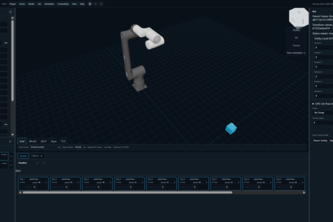
OpenDigitalTwin is a browser-based digital twin platform for industrial automation. The author describes it as a lightweight tool that allows small manufacturers and engineering teams to simulate robot motion, visualize automation data, and validate machine layouts using only a web browser.
What changed
The project was submitted to the OpenAI 2026 hackathon by a single developer (Yunsoo Jang). It is described as a prototype with functional OPC UA integration, 3D visualization, and robot kinematic simulation. The author states that it was built in a short timeframe using React, TypeScript, and Three.js.
The single most important open question
Is there any evidence of traction or commercial adoption beyond the hackathon submission?
What The Product Actually Is
The description states that OpenDigitalTwin is a browser-based environment for building and testing industrial 3D scenes, designed to help small manufacturers validate machine layouts, robot motion, and PLC data connections without requiring expensive simulation tools.
It supports:
- Importing robot and equipment geometry
- Configuring robot links, joints, tools, TCPs, and coordinate frames
- Positioning objects using X, Y, Z, Roll, Pitch, and Yaw
- Creating robot poses and organizing them into executable Jobs
- Visualizing robot and object motion in a 3D scene
- Binding scene objects to OPC UA variables for live data visualization
- Saving and reloading digital-twin projects
- Performing geometry-based collision checks
The system uses a middleware gateway to connect to OPC UA servers, as browsers cannot directly communicate with native OPC UA endpoints.
It is built with:
- React, TypeScript, Three.js, React Three Fiber, Zustand, Vite
- Technologies such as Docker, GLB, STEP, HTML5, CSS3, WebSocket, and OPC UA
Inference The product appears to be a prototype tool for early-stage industrial validation, not a full-fledged engineering or simulation platform.
Positioning & Claim Evolution
The author states that OpenDigitalTwin is not meant to replace advanced physics simulation or safety-certified tools, but instead offers an accessible starting point for small businesses.
It positions itself as:
- A lightweight web-based alternative to Unity, Unreal Engine, or industrial physics platforms
- A tool for early-stage kinematic validation
- A way to visualize automation data and communicate machine concepts using only a browser
The author also notes that the project was initially more ambitious but narrowed its scope to focus on:
- OPC UA-driven object motion
- Browser-based robot kinematic verification
Claim
The tool aims to make industrial digital twin development faster, more accessible, and less resource-intensive for small manufacturers.
Target Customer & ICP
The description states that the target audience includes:
- Small manufacturers
- Engineering teams
- Users who need to verify machine layout, robot motion, or PLC data connection before committing to physical equipment
It is implied that these users are likely:
- Not using full simulation tools due to cost or complexity
- Looking for a way to validate early-stage designs without specialized expertise
The author also mentions that the tool is intended for those who cannot dedicate a large budget or specialized team to industrial simulation.
Inference The ICP appears to be small-to-medium-sized manufacturers and engineering teams working in industrial automation, with limited access to advanced tools.
Business Model & Pricing Evidence
There is no evidence of pricing, business model, or monetization strategy in the description.
The project is described as a hackathon submission by a single developer (Yunsoo Jang), with no mention of any commercial offering or revenue streams.
Claim
The tool is presented as a prototype for early-stage validation and not yet positioned for sale or licensing.
Technical & Delivery Signals
The system architecture includes:
- A middleware OPC UA gateway
- A browser-based runtime store
- Integration with Three.js 3D rendering
- Support for STEP, GLB, and other CAD formats
- Use of React, TypeScript, Zustand, Vite
Key technical features include:
- OPC UA variable binding to 3D objects
- Clear indication of data ownership (manual vs. OPC UA)
- Robot Jobs with configurable transition speeds
- Geometry-based collision checks
- Support for manual and OPC UA-controlled transforms
The system is described as having:
- A production web build
- 2,190 automated unit tests
Inference The tool is built with modern web technologies and has a clear separation between data ownership and visualization.
Traction & Maturity Signals
There is no evidence of traction or adoption beyond the hackathon submission.
The project is described as:
- A prototype
- Built in a short timeframe (hackathon)
- Submitted to the OpenAI 2026 hackathon
- Not yet commercialized or deployed at scale
No customer data, revenue figures, usage metrics, or user feedback are provided.
Absence of evidence
No indication of:
- Customers
- Revenue
- Product usage
- Market traction
- Commercial deployment
Competitive Context
The author states that OpenDigitalTwin is not intended to replace advanced tools like Unity, Unreal Engine, or industrial physics platforms. However, it aims to offer a lightweight alternative for early-stage validation.
It competes with:
- Industrial simulation tools
- 3D visualization platforms
- PLC integration environments
The author does not mention any direct competitors by name, nor does the description provide market positioning or competitive differentiation beyond its lightweight nature and browser-based delivery.
Inference It is positioned as a low-cost, early-stage validation tool, not a full simulation platform.
Open Questions & Risks
- No commercial traction or adoption: The project is described only as a hackathon submission.
- Single developer team: No indication of a larger team or organizational support.
- Prototype status: Not yet a production-ready product.
- Limited scope: The author narrowed the demo to a specific workflow, not a full platform.
- Dependency on middleware: Relies on OPC UA gateway for connectivity, which may be a limitation in some environments.
- No pricing or monetization model: No evidence of how it would generate revenue.
Open question
The lack of any commercial or user feedback makes it difficult to assess real-world utility or demand.
Questions the description leaves open
- What is the current status of the product? Is it being used in any real-world applications?
- How does the middleware gateway architecture scale, and what are its limitations?
- Are there any plans for monetization or commercial deployment?
- Has the tool been tested with actual industrial users or partners?
- What are the main technical challenges that remain unresolved?
- How does the team plan to evolve from a prototype to a scalable product?
Overall Assessment
Not evidenced.
There is no evidence of:
- Revenue
- Customers
- Product-market fit
- Commercial traction
- Team scalability or funding
The project is described as a hackathon submission by one developer, with no indication of commercial viability, market demand, or investment readiness.
Inference The tool may have potential as a proof-of-concept for early-stage industrial validation, but it is not yet ready for investment or partnership consideration. It would require further development, traction, and commercialization before being evaluated as a viable business opportunity.
User Stories BotA demo video on every pull request
Get a demo video on every new feature
GitHub App that watches your pull requests and records a narrated, captioned demo.
Save time on demo prep and make informed decisions faster with a video walkthrough of every new feature.
Source
Submitted to the OpenAI 2026 hackathon on Devpost. Project home on Devpost. Back to the full gallery on Devpost.
This competitive analysis was produced by top-founders.com (opens in a new tab)
Generated by a language model from this project's public Devpost page — its tagline, the author's own write-up and any built-with tags listed there — as captured in August 2026. Short quotations are the author's words. It is an opinion on the idea as a business, not on the people behind it, and it reflects the description as published then. If the project has moved on, request a correction below. The analysis is not independent research and contains no verified traction, revenue or customer data.
An independent guide by KFG International LLC — not affiliated with, endorsed by, or connected to Devpost or OpenAI.