

Archive position — measured, not model output
0 likes on Devpost
2,263 of the 7,850 archived projects have more likes, and 5,587 share exactly 0 — so this project's #5,702 place in the like-ranked listing is a tie-break inside that group, not a ranking.
Projects (log scale)
Likes on Devpost. ▲ marks this project's group.
Show the figures
| Likes | Projects | Share of archive |
|---|---|---|
| 0 | 5,587 | 71.2% |
| 1 | 1,758 | 22.4% |
| 2 | 284 | 3.6% |
| 3–4 | 132 | 1.7% |
| 5–9 | 75 | 1.0% |
| 10+ | 14 | 0.2% |
 User Stories BotA demo video on every pull request
Get a demo video on every new feature
GitHub App that watches your pull requests and records a narrated, captioned demo.
Save time on demo prep and make informed decisions faster with a video walkthrough of every new feature.
Executive Summary
What the company appears to be
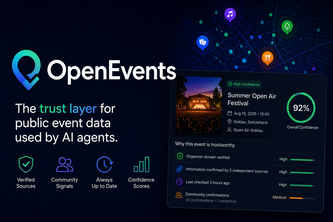
OpenEvents is a self-reported project that aims to build a trust layer for public event data used by AI agents. It positions itself as an append-only ledger system that verifies event details by tracing claims back to their sources, detecting copied information, and enabling corrections through conversational interfaces (MCP). The author describes it as an end-to-end hackathon MVP built using AI tools like GPT-5.6 and Codex.
What changed
The project evolved from a personal frustration with scattered event data to a structured system for verifying event facts via AI-assisted interaction. It was built in a short timeframe (a hackathon) and includes a deterministic trust engine, an MCP interface, and a React-based web UI for transparency.
Single most important open question
Is there any evidence that OpenEvents has moved beyond the MVP stage or gained traction with users or developers who might adopt or integrate it? The description states no revenue, customers, or adoption data are available.
What The Product Actually Is
The description states:
- OpenEvents is an "append-only SQLite assertion ledger" for event data.
- It uses a "fixed-rule assertion parser", a "deterministic TypeScript trust engine", and a "stdio MCP server".
- A "React web experience" shows provenance and reasoning behind AI answers.
- It includes three structured MCP tools and domain/integration tests.
Inferred from the description:
- The system is designed to store event claims as assertions with metadata (publisher, source, timestamp, evidence).
- It evaluates each field independently for confidence.
- It groups copied sources into clusters and detects when multiple listings copy the same origin.
- It supports conversational interaction via MCP but also provides a secondary web UI.
Not evidenced:
- Whether any production deployment exists or is accessible.
- If the system actually handles real-world event data or only demo scenarios.
- The actual performance or scalability of the trust engine in practice.
Positioning & Claim Evolution
The description states:
- OpenEvents was inspired by the frustration of finding local events, which are scattered across multiple sources.
- It aims to provide AI assistants with a shared trust layer for public events—local or online.
- The product is built around the idea that people increasingly interact with services through AI assistants, not standalone websites.
- MCP is described as the primary interaction layer; the web app is secondary but used for transparency.
Inferred from the description:
- The positioning shifted from a general-purpose tool to an infrastructure component (MCP) supporting a broader use case (event discovery and correction).
- The author redirected the categorization from "Developer Tools" to "Apps for Your Life", emphasizing that MCP is infrastructure, not the product itself.
Not evidenced:
- Any external validation or user feedback on positioning.
- Whether this approach has been tested in real-world AI assistant integrations.
- How the trust model compares to existing platforms like Google Maps or Airbnb.
Target Customer & ICP
The description states:
- The primary audience is people who interact with services through AI assistants.
- It targets users asking questions about events nearby, on a specific date, or online.
- Event organizers, venues, and other providers are mentioned as potential future users who could create verified profiles.
Inferred from the description:
- The core ICP includes individuals seeking event information via chat-based AI agents.
- Future ICP may include event providers looking to establish credibility through verified profiles.
Not evidenced:
- Any actual customer base or user personas.
- Whether there is a defined buyer persona beyond general AI users.
- No evidence of segmentation or targeting strategies beyond stated intent.
Business Model & Pricing Evidence
The description states:
- There is no explicit mention of pricing, revenue models, or monetization plans.
- The author mentions adding policy-gated ticket and booking integrations that act only when confidence thresholds are met—this implies a potential future integration-based model.
Inferred from the description:
- Future monetization could come from partnerships with event platforms or ticketing systems.
- The system may be offered as an API or service for developers to integrate into their own AI tools.
Not evidenced:
- Any pricing structure, subscription tiers, or revenue streams.
- No evidence of pilot customers or commercial relationships.
- No indication of whether the project intends to charge for access or use.
Technical & Delivery Signals
The description states:
- Built with: ai-agents, chatgpt, codex, express.js, mcp, node.js, openai, react, sqlite, typescript, vite, vitest, zod.
- The MVP uses TypeScript, SQLite, and a deterministic verification engine.
- It includes an append-only assertion ledger, MCP tools, and tests.
- The demo runs locally without API keys or live connections.
Inferred from the description:
- The architecture is modular and built for reproducibility.
- The system supports both conversational access (MCP) and web inspection.
- The use of deterministic logic suggests a focus on reliability over probabilistic inference.
Not evidenced:
- Any production deployment, scalability metrics, or performance data.
- Whether the system has been tested in real-world environments or under load.
- No evidence of ongoing development beyond the MVP stage.
Traction & Maturity Signals
The description states:
- This is an end-to-end hackathon MVP.
- It includes fixtures, tests, linting, and production builds.
- A controlled seed scenario demonstrates how it handles conflicting event data.
Inferred from the description:
- The project shows early-stage maturity with functional components.
- It has been validated through automated testing and demo scenarios.
Not evidenced:
- Any real-world usage or adoption.
- No evidence of user engagement, feedback loops, or retention metrics.
- No indication of whether it has moved past MVP into beta or production.
Competitive Context
The description states:
- The author researched trust models used by platforms like Google Maps, Airbnb, and eBay.
- It aims to avoid opaque trust scores in favor of explicit provenance tracking.
- It distinguishes itself from other event aggregators by focusing on verification and correction mechanisms.
Inferred from the description:
- OpenEvents competes indirectly with event aggregators that lack robust verification systems.
- It positions itself as a solution for AI agents needing reliable data sources.
Not evidenced:
- Any direct competitors or market share data.
- No evidence of competitive advantages beyond stated design principles.
- No indication of how it differentiates from existing trust frameworks in the marketplace.
Open Questions & Risks
The description states:
- The hardest challenge was balancing openness with trust—allowing contributions without admitting unreliable information.
- It uses deterministic logic to avoid probabilistic model outputs in production, which is a positive signal.
Inferred from the description:
- Risk of low-quality data entry due to open contribution model.
- Risk that the MVP may not scale or be adopted beyond its current form.
- Dependency on AI tools (GPT-5.6) for research and development, but not for core operations—this could limit long-term autonomy.
Open questions:
- No evidence of traction, revenue, or customer adoption.
- The project is described as a hackathon MVP with no indication of post-hackathon progress.
- Heavy reliance on AI tools for building, which may not be sustainable without continued access or control.
Questions the description leaves open
- What specific event data sources does OpenEvents currently support?
- Has the system been tested with real-world event data beyond the demo scenario?
- Are there any plans to integrate with existing event platforms or APIs?
- How will the open contribution model be managed to prevent spam or malicious entries?
- Is there a roadmap for moving beyond the MVP stage, and what resources are needed?
- What is the long-term vision for monetization or commercial viability?
- Has the system been validated by any third parties or external users?
Overall Assessment
The description states:
- This is an end-to-end hackathon MVP.
- It includes a functional trust engine, MCP interface, and web UI.
- The author built it quickly using AI tools.
Inferred from the description:
- The project shows early-stage innovation in event data verification.
- It has potential for integration into AI assistant workflows.
- However, there is no evidence of traction, revenue, or adoption beyond the MVP.
Assessment:
Not evidenced.
There is insufficient evidence to assess whether OpenEvents represents a viable business opportunity or strategic fit for investment or partnership. The project remains at the MVP stage with no demonstrated market validation, user base, or commercial progress.
User Stories BotA demo video on every pull request
Get a demo video on every new feature
GitHub App that watches your pull requests and records a narrated, captioned demo.
Save time on demo prep and make informed decisions faster with a video walkthrough of every new feature.
Source
Submitted to the OpenAI 2026 hackathon on Devpost. Project home on Devpost. Back to the full gallery on Devpost.
This competitive analysis was produced by top-founders.com (opens in a new tab)
Generated by a language model from this project's public Devpost page — its tagline, the author's own write-up and any built-with tags listed there — as captured in August 2026. Short quotations are the author's words. It is an opinion on the idea as a business, not on the people behind it, and it reflects the description as published then. If the project has moved on, request a correction below. The analysis is not independent research and contains no verified traction, revenue or customer data.
An independent guide by KFG International LLC — not affiliated with, endorsed by, or connected to Devpost or OpenAI.