

Archive position — measured, not model output
0 likes on Devpost
2,263 of the 7,850 archived projects have more likes, and 5,587 share exactly 0 — so this project's #3,735 place in the like-ranked listing is a tie-break inside that group, not a ranking.
Projects (log scale)
Likes on Devpost. ▲ marks this project's group.
Show the figures
| Likes | Projects | Share of archive |
|---|---|---|
| 0 | 5,587 | 71.2% |
| 1 | 1,758 | 22.4% |
| 2 | 284 | 3.6% |
| 3–4 | 132 | 1.7% |
| 5–9 | 75 | 1.0% |
| 10+ | 14 | 0.2% |
 User Stories BotA demo video on every pull request
Get a demo video on every new feature
GitHub App that watches your pull requests and records a narrated, captioned demo.
Save time on demo prep and make informed decisions faster with a video walkthrough of every new feature.
Executive Summary
What the company appears to be
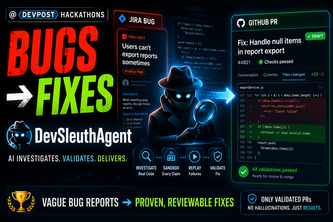
DevSleuthAgent is a self-reported tool designed to automate the process of turning vague Jira bug reports into verifiable fixes. It uses GPT-5.6 to investigate code, sandbox test cases, and draft GitHub PRs only after validating that a bug exists and a fix works.
What changed
The author states they built this as a hackathon project (OpenAI 2026) with a focus on improving developer workflows by reducing time spent on ambiguous bug reports. The tool is described as being in an early stage, with plans to scale for enterprise use.
Single most important open question
Is there any evidence of actual usage or traction beyond the author's own development and testing?
What The Product Actually Is
The description states that DevSleuthAgent:
- Watches for labeled Jira tickets.
- Maps them to approved repositories.
- Pins exact commits.
- Uses GPT-5.6 to generate regression tests in a sandboxed environment.
- Runs tests in isolated Docker environments with no network access or write permissions.
- Replays failures across clean sandboxes before accepting a bug as reproduced.
- Suggests code changes and validates those fixes using multiple checks (failure without change, pass with change, full suite still passes).
- Opens draft GitHub PRs only after validation.
- Does not merge or deploy code; it only drafts for review.
- Operates through FastAPI-based Python service with background job tracking, evidence store, Jira webhooks, and GitHub integration.
Inference The system is built around a combination of AI-driven code analysis, sandboxed execution, and workflow automation. It is not a general-purpose AI coding assistant but a specific tool for validating bugs and generating PRs in a controlled way.
Positioning & Claim Evolution
The author claims:
- Bug reports are usually vague.
- The goal is to speed up the process of determining whether a bug is real and how to fix it.
- DevSleuthAgent turns vague Jira bugs into “proven, reviewable fixes.”
- It uses GPT-5.6 to investigate real code, sandbox every claim, replay failures, and open draft PRs only after validation.
Inference The positioning appears to be a developer productivity tool aimed at reducing time spent on ambiguous bug reports by automating verification and fix generation. It is positioned as a solution for teams struggling with unclear or unactionable bug tickets.
Target Customer & ICP
The description states:
- The tool targets teams working with Jira and GitHub.
- It is designed to help engineers who receive vague bug reports.
- It aims to scale for “enterprise teams running thousands of repos and millions of events.”
Inference The target customer seems to be engineering teams or organizations using Jira and GitHub, particularly those dealing with large volumes of unclear bug reports. However, no specific customer segment or use case beyond this general description is provided.
Business Model & Pricing Evidence
Not evidenced.
The description does not mention any pricing model, monetization strategy, or business model. It only describes the tool’s functionality and architecture.
Technical & Delivery Signals
The author states:
- Built with FastAPI, Docker, Python, Jira webhooks, GitHub API, OpenAI GPT-5.6.
- Uses sandboxed Docker containers for test execution.
- Implements a restricted model interface (no shell access, no repo write access).
- Includes background job tracking and evidence storage.
- Has a live web UI.
Inference The technical stack suggests a Python-based backend with strong emphasis on security through sandboxing. It uses event-driven architecture concepts (webhooks), and integrates with existing developer tools like Jira and GitHub.
Traction & Maturity Signals
Not evidenced.
There is no mention of:
- Revenue
- Customers
- Users
- Adoption metrics
- Product usage data
- Any form of traction beyond the author’s own development
The project is described as a hackathon submission, implying it has not yet reached market readiness or user adoption.
Competitive Context
Not evidenced.
There is no information about:
- Competitors
- Market landscape
- Prior art
- Differentiation from existing tools
This section cannot be assessed without external data.
Open Questions & Risks
- No traction or revenue evidence: The project is described as a hackathon submission with no indication of real-world usage.
- Unverified claims about GPT-5.6: The author references GPT-5.6, which may not exist in reality; this is a self-reported claim.
- Highly technical and risky architecture: Sandboxing, model validation, and automated PR generation are complex and prone to failure or misalignment.
- Limited team size: Only one member (Dishant Sharma) is listed, raising questions about scalability and long-term maintenance.
- No clear path to monetization or product-market fit: The tool is described as a proof-of-concept rather than a commercial offering.
Questions the description leaves open
- What specific Jira and GitHub workflows does DevSleuthAgent support?
- How does it handle edge cases where the model fails to reproduce or validate bugs?
- Has it been tested in any real-world environments beyond the author’s own setup?
- Are there plans for user feedback loops or integration with existing CI/CD pipelines?
- What are the actual limitations of the current sandboxing approach?
- How does the tool distinguish between valid and invalid model-generated tests?
- Is there a plan to support more than one repository or team at a time?
Overall Assessment
Not evidenced.
There is no evidence of:
- Revenue
- Customers
- Traction
- Market validation
- Financials
- Team experience beyond the single founder
This project appears to be an early-stage idea, likely in prototype form, submitted as part of a hackathon. It lacks any commercial due-diligence signals that would indicate viability for investment or partnership at this time.
User Stories BotA demo video on every pull request
Get a demo video on every new feature
GitHub App that watches your pull requests and records a narrated, captioned demo.
Save time on demo prep and make informed decisions faster with a video walkthrough of every new feature.
Source
Submitted to the OpenAI 2026 hackathon on Devpost. Project home on Devpost. Back to the full gallery on Devpost.
This competitive analysis was produced by top-founders.com (opens in a new tab)
Generated by a language model from this project's public Devpost page — its tagline, the author's own write-up and any built-with tags listed there — as captured in August 2026. Short quotations are the author's words. It is an opinion on the idea as a business, not on the people behind it, and it reflects the description as published then. If the project has moved on, request a correction below. The analysis is not independent research and contains no verified traction, revenue or customer data.
An independent guide by KFG International LLC — not affiliated with, endorsed by, or connected to Devpost or OpenAI.