

Archive position — measured, not model output
0 likes on Devpost
2,263 of the 7,850 archived projects have more likes, and 5,587 share exactly 0 — so this project's #3,737 place in the like-ranked listing is a tie-break inside that group, not a ranking.
Projects (log scale)
Likes on Devpost. ▲ marks this project's group.
Show the figures
| Likes | Projects | Share of archive |
|---|---|---|
| 0 | 5,587 | 71.2% |
| 1 | 1,758 | 22.4% |
| 2 | 284 | 3.6% |
| 3–4 | 132 | 1.7% |
| 5–9 | 75 | 1.0% |
| 10+ | 14 | 0.2% |
 User Stories BotA demo video on every pull request
Get a demo video on every new feature
GitHub App that watches your pull requests and records a narrated, captioned demo.
Save time on demo prep and make informed decisions faster with a video walkthrough of every new feature.
Executive Summary
The company appears to be a prototype project named Dhwani, developed as part of the OpenAI 2026 hackathon. The description states that it is an acoustic biomarker screening tool for early childhood speech development assessment, intended for use by frontline workers in low-connectivity environments such as Anganwadi centers in India.
The project is self-reported and unverified — no revenue, customers, or traction data are provided. It is built with Flutter/Dart for the mobile app, Android native audio processing using Kotlin and ONNX models, and a Next.js dashboard for analytics. The system uses local processing to avoid sending raw audio to the cloud.
It implements a modest screening workflow that includes child profile creation, developmental questionnaires (in English and Malayalam), guided interaction activities, on-device acoustic analysis, and referral pathways via WhatsApp. The acoustic scoring is based on three biomarkers: VTTL, CVR, and PFV, with GREEN/YELLOW/RED tiers.
Key commercial due-diligence questions include:
- Whether the prototype has been validated in real-world settings.
- If there are plans to integrate questionnaire and acoustic signals.
- How the referral system will be localized and made secure.
- What clinical validation or regulatory compliance steps are planned.
The single most important open question is: Has this prototype been tested with actual frontline workers and children, and does it have any mechanism for ongoing clinical validation or integration into existing healthcare systems?
What The Product Actually Is
The description states that Dhwani is a mobile application designed to assess early childhood speech development using acoustic biomarkers derived from caregiver-child interactions.
It includes:
- A Flutter-based worker-facing app for Android and browser.
- On-device audio processing, including recording, voice activity detection (VAD), speaker segmentation via ONNX model, pitch tracking, and feature extraction.
- Acoustic scoring engine that evaluates three biomarkers: VTTL, CVR, and PFV.
- A local SQLite database for session storage.
- Optional Supabase sync for non-demo sessions.
- A Next.js dashboard for analytics (currently using mock data).
- A referral pathway via WhatsApp, with a PDF generator (not yet wired into the UI).
The app is designed to run offline and supports:
- Child profile creation
- Developmental goal review
- Parent questionnaire completion
- Guided interaction activities (Rattle, Toy hide & reveal, Imitate “aaa”)
- Local acoustic result display (GREEN/YELLOW/RED tier)
- Offline session saving and later sync
Not evidenced: No information on actual deployment, usage, or performance metrics.
Positioning & Claim Evolution
The description states that Dhwani is a prototype tool aimed at helping frontline workers notice potential developmental concerns, particularly in early childhood (ages 12–36 months). It emphasizes:
- That it does not replace clinical assessment or caregiver judgment.
- That it focuses on non-semantic properties of interaction such as response timing, vocalization time, and pitch variation.
- That it uses on-device processing to maintain privacy and reduce reliance on connectivity.
The positioning is modest — the authors state that the goal is to provide a consistent additional signal, not a diagnostic tool. It is framed as a screening aid, not a replacement for validated tools or specialists.
Inference: The project appears to be positioned in the early-stage healthcare technology space, targeting underserved regions with limited access to specialists.
Target Customer & ICP
The description states that Dhwani is intended for frontline workers such as those in Anganwadi centers, which are part of India’s child welfare system. These workers:
- Often have limited time and unreliable connectivity
- Need tools that can help them identify when a screening may warrant closer attention
- Are expected to use the app during caregiver–child interactions
The app supports:
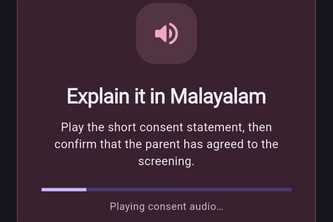
- Malayalam language for consent guidance
- Age-matched developmental questions (MyChild engine)
- Local session history and referral workflows
Not evidenced: No data on actual users, their training, or adoption rates. The ICP is inferred from the stated use case.
Business Model & Pricing Evidence
The description does not provide any information about:
- Revenue streams
- Pricing models
- Customer acquisition costs
- Monetization strategy
It only describes a prototype workflow for screening and referral, with no indication of how this would scale or be monetized in a commercial setting.
Not evidenced: No business model or pricing data.
Technical & Delivery Signals
The system is built using:
- Flutter/Dart for the mobile app
- Android native Kotlin for audio processing (AudioRecord, ONNX Runtime)
- ONNX model (Pyannote segmentation) bundled with SHA-256 verification
- SQLite for local data persistence
- Supabase for optional sync to cloud
- Next.js dashboard for analytics (mocked currently)
Key technical features include:
- On-device audio processing without sending raw PCM
- Local scoring engine using acoustic thresholds
- Evidence checks for recording quality
- Support for offline workflows with later sync
Inference: The prototype is built with a focus on local processing and minimal cloud dependency, which may be suitable for low-connectivity environments.
Traction & Maturity Signals
The description states that this is a hackathon submission (OpenAI 2026) and does not include any evidence of:
- Revenue
- Customers or users
- Product-market fit
- Adoption or usage data
- Clinical validation or regulatory approval
It is described as a prototype, with many features still in development or unimplemented, such as:
- Combining questionnaire and acoustic signals
- Full referral system localization (PDF generation not wired)
- Real-time sync retry/conflict handling
Not evidenced: No traction or maturity data.
Competitive Context
The description does not mention any direct competitors. However, it implies that Dhwani is positioned in the early childhood development screening space, which may include:
- Traditional developmental screening tools
- Digital health platforms for child assessment
- AI-based speech and language development tools
It differs by focusing on acoustic biomarkers and on-device processing, which could be a unique value proposition if validated.
Not evidenced: No competitive landscape or market positioning data.
Open Questions & Risks
- Prototype-only status: The system is described as a hackathon prototype with many unimplemented features.
- No clinical validation: The description explicitly states that the acoustic scoring and age references are placeholders pending local clinical validation.
- Incomplete referral system: PDF generation and localization (Malayalam) are not yet implemented.
- Privacy and compliance risks: While privacy safeguards are described, no formal privacy impact assessment or ethics approval is mentioned.
- Limited scalability: The app is designed for offline use but lacks robust sync retry logic or monitoring.
- No monetization strategy: No indication of how the tool would be commercialized or scaled.
Questions the description leaves open
- Has the prototype been tested with actual frontline workers and children in real-world settings?
- What clinical validation steps are planned for the acoustic biomarkers (VTTL, CVR, PFV)?
- How will the system handle uncertainty in audio quality or device performance?
- Are there plans to integrate questionnaire and acoustic signals into a unified screening result?
- What is the roadmap for localizing the referral system (PDF generation, WhatsApp message)?
- Is there any plan for regulatory approval or ethical review before deployment?
- How will the system be maintained and updated in the field?
Overall Assessment
Not evidenced: No financial data, traction, or commercial viability indicators are provided.
The project is a self-reported prototype, built as part of a hackathon. It shows potential in addressing a real-world problem (early childhood screening in low-connectivity environments) but lacks evidence of:
- Real-world testing
- Clinical validation
- Scalability or monetization plans
- Product-market fit
Inference: If the team can demonstrate field testing, clinical validation, and a clear path to commercialization, this could be an interesting opportunity. However, as presented, it is not ready for investment or partnership, and further due diligence would be required before any commitment.
User Stories BotA demo video on every pull request
Get a demo video on every new feature
GitHub App that watches your pull requests and records a narrated, captioned demo.
Save time on demo prep and make informed decisions faster with a video walkthrough of every new feature.
Source
Submitted to the OpenAI 2026 hackathon on Devpost. Project home on Devpost. Back to the full gallery on Devpost.
This competitive analysis was produced by top-founders.com (opens in a new tab)
Generated by a language model from this project's public Devpost page — its tagline, the author's own write-up and any built-with tags listed there — as captured in August 2026. Short quotations are the author's words. It is an opinion on the idea as a business, not on the people behind it, and it reflects the description as published then. If the project has moved on, request a correction below. The analysis is not independent research and contains no verified traction, revenue or customer data.
An independent guide by KFG International LLC — not affiliated with, endorsed by, or connected to Devpost or OpenAI.