

Archive position — measured, not model output
0 likes on Devpost
2,263 of the 7,850 archived projects have more likes, and 5,587 share exactly 0 — so this project's #7,659 place in the like-ranked listing is a tie-break inside that group, not a ranking.
Projects (log scale)
Likes on Devpost. ▲ marks this project's group.
Show the figures
| Likes | Projects | Share of archive |
|---|---|---|
| 0 | 5,587 | 71.2% |
| 1 | 1,758 | 22.4% |
| 2 | 284 | 3.6% |
| 3–4 | 132 | 1.7% |
| 5–9 | 75 | 1.0% |
| 10+ | 14 | 0.2% |
 User Stories BotA demo video on every pull request
Get a demo video on every new feature
GitHub App that watches your pull requests and records a narrated, captioned demo.
Save time on demo prep and make informed decisions faster with a video walkthrough of every new feature.
Executive Summary
What the company appears to be
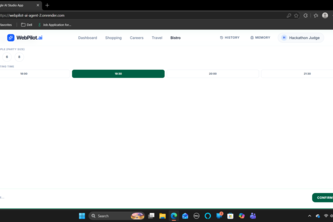
WebPilot is an AI web agent that interprets natural-language goals and translates them into completed web tasks. The description states it distinguishes between independent tasks (e.g., “find a restaurant”) and larger goals (e.g., “plan a birthday party”), offering different interaction modes for each. It is built as a web application using React/TypeScript frontend and Node.js/Express backend, with GPT-5.6 powering intent understanding and workflow generation.
What changed
The project was submitted to the OpenAI 2026 hackathon on Devpost. The author describes it as a working, live-deployed product that evolved from an idea through iterative development using Codex and GPT-5.6.
Single most important open question — the commercial due-diligence read
Is there evidence of user adoption or traction beyond the single developer’s prototype? The description states no revenue, customers, or usage data are available; all claims are self-reported.
What The Product Actually Is
The description states that WebPilot is an AI web agent designed to understand natural-language requests and convert them into completed web tasks. It supports two interaction modes:
- Independent tasks, such as “Find a restaurant in Paris for 20 people at 8 PM.”
- Larger goals, such as “I want to plan a birthday party for 20 people.”
It is built with:
- Frontend: React, TypeScript
- Backend: Node.js/Express
- AI layer: GPT-5.6
- Development tools: Codex, GitHub, Vite, Tailwind CSS
The system is described as distinguishing between tasks and goals, and offering structured workflows for multi-step actions while maintaining user control over consequential decisions.
Evidence
- The author states the product is a web application with React/TypeScript frontend and Node.js backend.
- It uses GPT-5.6 for intent interpretation and workflow generation.
- It supports multiple use cases including shopping, travel, restaurants, careers, and planning.
- It includes memory and task history features.
Inference The product is a prototype or early-stage tool, not a commercial offering with users or revenue.
Positioning & Claim Evolution
The author positions WebPilot as an AI agent that helps users move from intention to execution using natural language. The core claim is that it understands the difference between a single task and a larger goal, enabling tailored workflows.
Evidence
- The tagline: “You set the goal. WebPilot browses, thinks, and gets it done.”
- The write-up emphasizes that users can describe what they want in natural language.
- It distinguishes between independent tasks and goals, with different handling logic for each.
- The project was built iteratively, starting with core intent understanding.
Inference The positioning is centered on user control and human-centered AI. However, the description does not indicate any market testing or feedback loops beyond internal development.
Target Customer & ICP
The description states that WebPilot supports everyday use cases across areas such as:
- Shopping
- Travel
- Restaurants
- Careers
- Personal planning
It is described as helping users move from intention to execution, with a focus on delegation and user control.
Evidence
- The author lists several domains where the agent can be applied.
- It supports multi-step workflows for larger goals like birthday party planning.
- It is designed to be used by individuals seeking help with web-based tasks.
Inference The target customer appears to be individual users who want AI assistance in managing complex or repetitive online activities. No specific persona or segment is defined beyond general use cases.
Business Model & Pricing Evidence
Not evidenced.
Evidence
- No pricing information, subscription models, or monetization strategy are mentioned.
- The project is described as a hackathon submission and deployed live, but no commercial structure is detailed.
Inference There is no indication of how the product would be monetized or whether it has a business model beyond its current prototype state.
Technical & Delivery Signals
The application was built using:
- Frontend: React, TypeScript
- Backend: Node.js/Express
- AI: GPT-5.6 and Codex
- Deployment: Render (as per technology tags)
It includes features such as:
- Natural-language interface
- Intent understanding
- Workflow handling for tasks vs. goals
- Memory and task history
Evidence
- The author describes the stack used.
- It was deployed as a live web service.
- Codex was used for development, debugging, and feature implementation.
- GPT-5.6 powers intent recognition and workflow generation.
Inference The technical architecture suggests a full-stack web application with AI integration. However, no production metrics or scalability data are provided.
Traction & Maturity Signals
Not evidenced.
Evidence
- The project is described as a hackathon submission.
- It was deployed live but no user base, engagement, or performance data are mentioned.
- No revenue, customer acquisition, or usage statistics are provided.
Inference There is no evidence of traction or product-market fit beyond the single developer’s prototype. The maturity level is that of an early-stage tool.
Competitive Context
Not evidenced.
Evidence
- No mention of competitors or market landscape.
- No reference to existing AI agents, task automation tools, or web browsing assistants.
Inference The competitive environment for AI-powered web agents is not described. The author does not position WebPilot relative to other tools in the space.
Open Questions & Risks
- No commercial traction or user data: The product is a prototype with no evidence of real-world adoption.
- Single developer team: Only one member listed, which may limit scalability and execution capability.
- Unverified AI performance claims: GPT-5.6 is used for intent understanding but no accuracy or reliability metrics are shared.
- No business model: No indication of how the product would generate revenue or sustain itself.
- Lack of market positioning: The description does not clarify how WebPilot differentiates from existing tools or who it targets beyond general use cases.
Questions the description leaves open
- What specific user problems are you solving, and how do you know?
- How is the AI agent trained or fine-tuned for intent recognition?
- Are there any real-world tests or feedback from users beyond the prototype phase?
- What is your plan to scale beyond a single developer?
- How will you monetize this product if it remains a web-based tool?
- What are the technical limitations of using GPT-5.6 in production for task execution?
- Have you considered how user privacy and data handling would work in practice?
Overall Assessment
Not evidenced.
Evidence
- No financials, funding rounds, or valuation data are provided.
- The project is described as a hackathon submission with no commercialization plan.
- No third-party validation or partnership opportunities are mentioned.
Inference At this stage, the project appears to be an early prototype without clear commercial viability or investment potential. It lacks traction, business model clarity, and market positioning. Any strategic interest would depend on future development and evidence of product-market fit.
User Stories BotA demo video on every pull request
Get a demo video on every new feature
GitHub App that watches your pull requests and records a narrated, captioned demo.
Save time on demo prep and make informed decisions faster with a video walkthrough of every new feature.
Source
Submitted to the OpenAI 2026 hackathon on Devpost. Project home on Devpost. Back to the full gallery on Devpost.
This competitive analysis was produced by top-founders.com (opens in a new tab)
Generated by a language model from this project's public Devpost page — its tagline, the author's own write-up and any built-with tags listed there — as captured in August 2026. Short quotations are the author's words. It is an opinion on the idea as a business, not on the people behind it, and it reflects the description as published then. If the project has moved on, request a correction below. The analysis is not independent research and contains no verified traction, revenue or customer data.
An independent guide by KFG International LLC — not affiliated with, endorsed by, or connected to Devpost or OpenAI.