

Archive position — measured, not model output
0 likes on Devpost
2,263 of the 7,850 archived projects have more likes, and 5,587 share exactly 0 — so this project's #5,696 place in the like-ranked listing is a tie-break inside that group, not a ranking.
Projects (log scale)
Likes on Devpost. ▲ marks this project's group.
Show the figures
| Likes | Projects | Share of archive |
|---|---|---|
| 0 | 5,587 | 71.2% |
| 1 | 1,758 | 22.4% |
| 2 | 284 | 3.6% |
| 3–4 | 132 | 1.7% |
| 5–9 | 75 | 1.0% |
| 10+ | 14 | 0.2% |
 User Stories BotA demo video on every pull request
Get a demo video on every new feature
GitHub App that watches your pull requests and records a narrated, captioned demo.
Save time on demo prep and make informed decisions faster with a video walkthrough of every new feature.
Executive Summary
Company: OpenBerichtsheft
Self-reported basis: The entire analysis is based on a single author-supplied description from Devpost, submitted as part of the OpenAI 2026 hackathon. No external verification or historical data is available.
What it appears to be: A digital platform for vocational training documentation, built as an open-source tool using Next.js 16 and TypeScript. It supports four user roles (Admin, Instructor, Training Officer, Trainee) with features like autosave, Gantt charts, PDF exports, and GDPR anonymization.
What changed: The project is a new software solution submitted to a hackathon; no prior version or commercial history is evident.
Most important open question: Is there any evidence of real-world usage, adoption, or traction beyond the author’s own development?
What The Product Actually Is
The description states that OpenBerichtsheft digitizes vocational training documentation for German trainees and mentors. It supports four user roles: Admin, Instructor, Training Officer, and Trainee.
- Trainees use an editor with autosave, pre-fills from previous weeks, and a heatmap-style calendar.
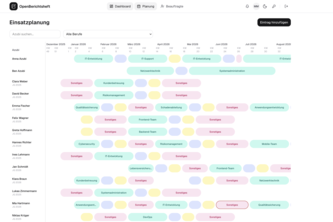
- Instructors & Officers have dashboards to review, comment on, or approve reports, plus Gantt charts for deployment planning.
- Administrators manage users, assignments, and profession profiles.
The system is built using:
- Framework: Next.js 16 (App Router)
- Styling: Tailwind CSS 4
- Database & ORM: PostgreSQL 16 with Prisma 6
- Authentication: Auth.js 5 (NextAuth)
- Tooling: Docker, Vitest, Playwright
Inference: The product is a web-based application designed for a specific vertical (German vocational training), not a general-purpose SaaS offering.
Positioning & Claim Evolution
The author claims that vocational training documentation is “fundamentally stuck in the past,” and that their solution transforms this into a “modern, digital-first, and open-source” workflow. The positioning emphasizes:
- Digital transformation of outdated processes
- Open-source nature (implied by project name and tech stack)
- Compliance with legal requirements (e.g., GDPR)
Inference: This is a niche tool targeting a specific regulatory domain in Germany, likely with limited scalability unless integrated into broader systems or expanded beyond its current scope.
Target Customer & ICP
The description does not explicitly define target customers or personas. However, it implies usage by:
- Trainees (in vocational programs)
- Instructors and supervisors
- Administrators managing training structures
It also mentions alignment with German regulatory bodies like IHK/HWK, suggesting institutional adoption is intended.
Inference: The ICP likely includes vocational schools, training centers, or public institutions in Germany that manage structured trainee reporting. No evidence of external customers or B2B buyers beyond internal use.
Business Model & Pricing Evidence
No business model or pricing information is provided. The project is described as open-source and built for a hackathon context.
Inference: There is no indication of monetization, licensing, or paid features at this stage.
Technical & Delivery Signals
The author describes:
- A production-ready, enterprise-grade architecture
- Use of TypeScript, Next.js 16, Tailwind CSS 4, PostgreSQL 16, Prisma 6, Auth.js 5
- Dockerized environment with API protection and test automation (Vitest + Playwright)
- Features like autosave, GDPR anonymization engine, and PDF export
Inference: The technical stack suggests a modern, scalable approach to backend/frontend development. However, no evidence of deployment in production or performance metrics.
Traction & Maturity Signals
There is no evidence of traction, users, customers, or revenue. The project was submitted to a hackathon and has no mention of real-world usage or adoption beyond the author’s own work.
Inference: This is an early-stage prototype or proof-of-concept with no demonstrated market traction.
Competitive Context
The description does not reference competitors directly. However, it implies a gap in digital solutions for vocational training documentation in Germany. The mention of IHK/HWK integration suggests alignment with existing standards and potential competition from government-backed platforms or enterprise vendors serving similar verticals.
Inference: No clear competitive landscape is evident; the tool may be addressing an underserved niche without known direct competitors.
Open Questions & Risks
- No traction or user base: The project is not demonstrated to have any real-world usage.
- Limited scope: Built for a single vertical (German vocational training), with no indication of broader applicability.
- Open-source nature: May limit monetization potential unless there’s a clear path to commercialization.
- Founder-only team: One-person development raises questions about scalability and long-term maintenance.
Inference: The lack of evidence for adoption or revenue makes this a high-risk, unproven concept with unclear commercial viability.
Questions the description leaves open
- What is the actual regulatory environment in Germany that necessitates this tool? Is there demand from institutions?
- Has any institution expressed interest in adopting or piloting this system?
- How does the open-source model align with potential future monetization strategies?
- What are the technical challenges around integrating with existing vocational training systems?
- Are there plans to expand beyond German vocational training contexts?
Overall Assessment
Not evidenced: There is no evidence of revenue, customers, or traction to support an investment or partnership decision.
Confidence level: Low — based entirely on self-reported claims and a hackathon submission with no external validation.
Assessment: This project appears to be a prototype or proof-of-concept for a niche use case. It lacks commercial viability indicators and shows no signs of traction, adoption, or monetization strategy. Any investment or partnership would be speculative at this stage.
User Stories BotA demo video on every pull request
Get a demo video on every new feature
GitHub App that watches your pull requests and records a narrated, captioned demo.
Save time on demo prep and make informed decisions faster with a video walkthrough of every new feature.
Source
Submitted to the OpenAI 2026 hackathon on Devpost. Project home on Devpost. Back to the full gallery on Devpost.
This competitive analysis was produced by top-founders.com (opens in a new tab)
Generated by a language model from this project's public Devpost page — its tagline, the author's own write-up and any built-with tags listed there — as captured in August 2026. Short quotations are the author's words. It is an opinion on the idea as a business, not on the people behind it, and it reflects the description as published then. If the project has moved on, request a correction below. The analysis is not independent research and contains no verified traction, revenue or customer data.
An independent guide by KFG International LLC — not affiliated with, endorsed by, or connected to Devpost or OpenAI.