

Archive position — measured, not model output
0 likes on Devpost
2,263 of the 7,850 archived projects have more likes, and 5,587 share exactly 0 — so this project's #3,487 place in the like-ranked listing is a tie-break inside that group, not a ranking.
Projects (log scale)
Likes on Devpost. ▲ marks this project's group.
Show the figures
| Likes | Projects | Share of archive |
|---|---|---|
| 0 | 5,587 | 71.2% |
| 1 | 1,758 | 22.4% |
| 2 | 284 | 3.6% |
| 3–4 | 132 | 1.7% |
| 5–9 | 75 | 1.0% |
| 10+ | 14 | 0.2% |
 User Stories BotA demo video on every pull request
Get a demo video on every new feature
GitHub App that watches your pull requests and records a narrated, captioned demo.
Save time on demo prep and make informed decisions faster with a video walkthrough of every new feature.
Executive Summary
What the company appears to be
Context Hub is a self-reported platform for building and managing organizational knowledge graphs through configurable ontologies. The author states it allows users to define object types, properties, relationships, and interfaces visually; connect data from multiple formats (JSON, CSV, REST, GraphQL); map fields to ontology properties; and explore the resulting graph in 2D or 3D. It integrates with the Model Context Protocol (MCP) to make knowledge available for AI agents.
What changed
The project was built as a solo effort by Sebastian Kipping over a short timeframe (likely during a hackathon), using technologies like Rust, ClickHouse, DataFusion, and Next.js. The author describes it as a monorepo with frontend and backend components, including visual editors, mapping engines, and graph storage.
The single most important open question
Is there any evidence of real-world usage or traction beyond the author’s own demonstration? The description makes no claims about revenue, customers, or adoption — only self-reported features and implementation details.
What The Product Actually Is
The description states that Context Hub is a platform for creating and managing organizational knowledge graphs via configurable ontologies. It supports:
- Visual creation of object types, properties, relationships, interfaces, and derived values.
- Mapping data from multiple formats (JSON, CSV, Parquet, REST, GraphQL).
- Transformation using Apache Arrow and DataFusion.
- Storage in ClickHouse with support for versioned ontologies and provenance tracking.
- Exploration through 2D/3D visualizations and a Graph Query Builder.
- Integration with the Model Context Protocol (MCP) to provide AI-ready context.
It is described as a monorepo built with:
- Frontend: Next.js, React Flow, Tailwind CSS
- Backend: Rust, Tokio, Axum, gRPC, Tonic, Prost
- Data processing: Apache Arrow, DataFusion
- Storage: ClickHouse, MinIO
The author claims to have implemented the MCP protocol and tool contracts, but notes that connecting these tools directly to the graph repository is still pending.
Positioning & Claim Evolution
The description states that Context Hub was inspired by platforms like Palantir Foundry and GitLab Orbit, but aims to let users define their own ontology instead of working with a predefined model. It positions itself as a tool for turning raw data into actionable knowledge for AI agents.
Key claims:
- “AI needs context” — Context Hub provides structured relationships and semantics.
- “Organizations generate enormous amounts of data, but most of it remains disconnected.”
- “ContextHub is designed to make organizational knowledge available to AI agents through the Model Context Protocol.”
These are self-reported intentions. There is no evidence of market positioning beyond the author’s own narrative.
Target Customer & ICP
The description implies that Context Hub targets organizations with large volumes of disconnected data, particularly those using AI agents who need structured business context. It suggests use cases around:
- Engineering teams managing service ownership and dependencies.
- Data integration challenges in enterprise environments.
- AI agents needing grounded reasoning over organizational knowledge.
However, the author does not specify any named customer segments or personas beyond general “organizations.” No evidence of early adopters or target accounts is provided.
Business Model & Pricing Evidence
There is no mention of pricing, monetization strategy, or business model in the description. The project appears to be a solo developer effort submitted for a hackathon and lacks any indication of commercial viability or revenue streams.
Technical & Delivery Signals
The author reports:
- A monorepo architecture with frontend (Next.js) and backend (Rust) components.
- Use of React Flow for visual ontology editing.
- Mapping engine based on Apache Arrow and DataFusion, supporting transformations like rename, cast, string replacement, arithmetic, etc.
- Storage using ClickHouse and MinIO.
- Support for streaming imports, resumable jobs, idempotent operations.
- Integration with gRPC APIs, MCP protocol, and WASM modules.
- End-to-end tests (Playwright), benchmarks (1 million nodes, 5 million edges).
These are technical implementation details, not evidence of product-market fit or traction.
Traction & Maturity Signals
The description contains no evidence of:
- Revenue
- Customers
- Users
- Adoption metrics
- Product usage data
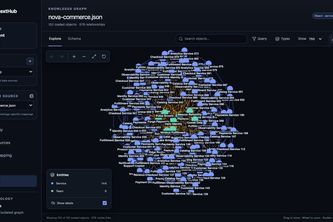
It does state that the author built the entire system solo and submitted it to a hackathon. The demo shows a fictional commerce platform with 144 services, 8 teams, and various relationships — but this is not real-world usage.
Competitive Context
The description mentions inspirations from:
- Palantir Foundry
- GitLab Orbit
It also notes that the project is designed to work with the Model Context Protocol (MCP), which is a newer standard for AI agent context sharing. However, no competitive analysis or differentiation from existing tools is provided.
Open Questions & Risks
- Solo developer effort: No team, no external validation.
- No traction evidence: No customers, revenue, or usage data.
- Unproven commercial viability: The project was submitted to a hackathon and lacks any business model or monetization plan.
- Limited scope: The demo uses a fictional dataset; no real-world application is shown.
- Technical complexity without validation: While the architecture is detailed, there’s no evidence that it has been tested at scale or validated in production.
Questions the description leaves open
- What specific use cases are you targeting for enterprise adoption?
- Have you identified any early adopters or pilot customers?
- How do you plan to monetize this platform?
- Is there a roadmap for expanding beyond the current MVP?
- What is your strategy for scaling storage and performance with larger datasets?
- Are you planning to support additional data sources or integrations beyond what’s described?
- How will you ensure data privacy and access control in multi-tenant environments?
Overall Assessment
Not evidenced.
There is no evidence of revenue, customers, traction, or commercial viability. The project appears to be a technical proof-of-concept built by one person for a hackathon. It lacks any indication of market demand or product-market fit.
This is a highly speculative opportunity with no demonstrated traction, and thus cannot be evaluated as an investment or partnership candidate based on the provided information alone.
User Stories BotA demo video on every pull request
Get a demo video on every new feature
GitHub App that watches your pull requests and records a narrated, captioned demo.
Save time on demo prep and make informed decisions faster with a video walkthrough of every new feature.
Source
Submitted to the OpenAI 2026 hackathon on Devpost. Project home on Devpost. Back to the full gallery on Devpost.
This competitive analysis was produced by top-founders.com (opens in a new tab)
Generated by a language model from this project's public Devpost page — its tagline, the author's own write-up and any built-with tags listed there — as captured in August 2026. Short quotations are the author's words. It is an opinion on the idea as a business, not on the people behind it, and it reflects the description as published then. If the project has moved on, request a correction below. The analysis is not independent research and contains no verified traction, revenue or customer data.
An independent guide by KFG International LLC — not affiliated with, endorsed by, or connected to Devpost or OpenAI.