

Archive position — measured, not model output
0 likes on Devpost
2,263 of the 7,850 archived projects have more likes, and 5,587 share exactly 0 — so this project's #3,488 place in the like-ranked listing is a tie-break inside that group, not a ranking.
Projects (log scale)
Likes on Devpost. ▲ marks this project's group.
Show the figures
| Likes | Projects | Share of archive |
|---|---|---|
| 0 | 5,587 | 71.2% |
| 1 | 1,758 | 22.4% |
| 2 | 284 | 3.6% |
| 3–4 | 132 | 1.7% |
| 5–9 | 75 | 1.0% |
| 10+ | 14 | 0.2% |
 User Stories BotA demo video on every pull request
Get a demo video on every new feature
GitHub App that watches your pull requests and records a narrated, captioned demo.
Save time on demo prep and make informed decisions faster with a video walkthrough of every new feature.
Executive Summary
Company: Context Vault
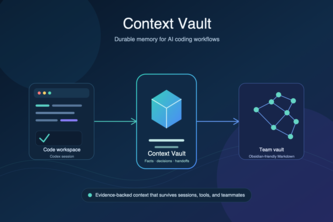
Self-reported purpose: A tool to help developers and teams capture, store, and retrieve project context using Markdown and Git, with support for AI agent workflows.
What changed: The author describes a self-contained CLI plugin built as a Codex extension that enables structured, time-aware, and team-shared documentation of development decisions and progress. It is positioned as an alternative to transient chat history for AI agents.
Single most important open question: Is there evidence of real-world usage or adoption by developers or teams beyond the author’s own use?
What The Product Actually Is
The description states that Context Vault is a Python CLI tool packaged as a Codex plugin, designed to help developers and teams capture and retrieve project context. It uses Markdown as its canonical format, with structured frontmatter in records for facts, decisions, sessions, people, withdrawals, and conflicts.
It supports two workflows:
- Manual mode: requires explicit developer approval for each new record.
- Auto mode: allows standing consent for Codex to create evidence-stamped checkpoints at meaningful milestones.
The system integrates Git for versioning and team sharing, with features like append-only validation, conflict quarantine, author attribution, and support for dedicated vault branches and linked Git worktrees. It also includes experimental Obsidian Sync transport for teams already using shared Obsidian vaults.
Inference: The tool is described as a developer-facing plugin that works within AI agent workflows (e.g., Codex), but no evidence of actual deployment or usage exists beyond the author's own account.
Positioning & Claim Evolution
The description states that Context Vault aims to solve the problem of AI agents forgetting project context between sessions. It positions itself as a way to make project memory visible, inspectable, and shareable—both for humans and AI agents.
Key claims:
- Project memory should be visible to humans, not hidden inside models.
- It should be easy to version and review.
- It must be useful with or without an AI agent.
- It should be owned by the developer or team.
The author also notes that they built it because chat history is not a reliable project memory system, being temporary, hard to inspect, and not naturally shared.
Inference: The positioning reflects a shift from ephemeral chat-based AI interaction toward persistent, structured, and human-readable documentation. However, this is a self-stated intent, not evidence of traction or adoption.
Target Customer & ICP
The description states that Context Vault targets:
- Developers
- Teams working on software projects
- Users who work with AI agents like Codex
It is designed to be used in developer workflows, especially where AI tools are involved. The plugin integrates with Codex and supports Obsidian for browsing context as a graph.
There is no mention of specific verticals, industries, or roles beyond developers and teams using AI agents.
Inference: The ICP appears to be technical users (developers) working in software development environments where AI tools are used. No evidence of customer segmentation or targeting beyond this.
Business Model & Pricing Evidence
The description does not contain any information about:
- Revenue streams
- Pricing models
- Monetization strategy
- Paid features or tiers
It only describes the tool as a free CLI plugin, built for personal or team use within developer workflows.
Inference: No business model is evident from the description. The tool appears to be open-source or freemium in nature, but there is no indication of how it might generate value or income.
Technical & Delivery Signals
The system is built using:
- Python
- Git
- Markdown
- Obsidian (for browsing and linking)
- Codex plugin architecture
Key technical features include:
- Git-backed vault syncing
- Append-only history validation
- Conflict quarantine
- Author attribution
- Support for dedicated vault branches and linked Git worktrees
- Experimental Obsidian Sync transport
The tool supports both manual and auto modes, with explicit consent metadata and distinction between observed facts, inferences, and user-stated information.
Inference: The technical stack suggests a lightweight, developer-focused solution that prioritizes portability, inspectability, and human readability. No evidence of scalability or enterprise-grade infrastructure is provided.
Traction & Maturity Signals
The description states:
- It was submitted to the OpenAI 2026 hackathon
- The team size is 1 (manu setty)
- It is a CLI plugin, not a hosted product
- No mention of users, customers, or adoption metrics
There is no evidence of:
- Revenue
- Customers
- Usage data
- Product-market fit
- Market traction
Inference: The project is in early development or prototype stage. There is no indication of real-world usage or impact beyond the author’s own use.
Competitive Context
The description does not mention any competitors or existing solutions in this space.
It does not reference:
- Other AI memory tools
- Project documentation systems
- Git-based knowledge management tools
- Obsidian plugins or workflows
Inference: No competitive landscape is evident. The author does not position the tool against others, nor does it appear to be part of a known category or ecosystem.
Open Questions & Risks
- No evidence of real-world usage or adoption
- Single-person team suggests limited resources for product development or market traction
- Self-reported only: No independent verification of claims or performance
- No pricing or monetization strategy — unclear how the tool will be sustained
- Limited scope: Built as a CLI plugin, not a full platform or SaaS offering
- Highly technical and niche: May struggle to reach broader audiences without clear value propositions
Inference: The risk of failure is high due to lack of traction, limited team size, and absence of business model or market validation.
Questions the description leaves open
- What specific workflows or use cases have you tested Context Vault with?
- Have you received feedback from other developers or teams using it?
- How do you plan to scale beyond a single developer’s use case?
- Is there any intention to monetize the tool, and if so, how?
- What are the biggest challenges in getting developers to adopt structured documentation practices?
- Are there plans for integrations with other tools or platforms beyond Codex and Obsidian?
Overall Assessment
Not evidenced: There is no evidence of revenue, customers, traction, or market validation.
Confidence level: Low — based entirely on a self-reported project description from one individual.
Assessment: Context Vault appears to be an early-stage developer tool built as a hackathon submission. It has potential in the AI agent memory space but lacks any indication of real-world usage or commercial viability. Further due diligence would require evidence of adoption, user feedback, and business model development.
User Stories BotA demo video on every pull request
Get a demo video on every new feature
GitHub App that watches your pull requests and records a narrated, captioned demo.
Save time on demo prep and make informed decisions faster with a video walkthrough of every new feature.
Source
Submitted to the OpenAI 2026 hackathon on Devpost. Project home on Devpost. Back to the full gallery on Devpost.
This competitive analysis was produced by top-founders.com (opens in a new tab)
Generated by a language model from this project's public Devpost page — its tagline, the author's own write-up and any built-with tags listed there — as captured in August 2026. Short quotations are the author's words. It is an opinion on the idea as a business, not on the people behind it, and it reflects the description as published then. If the project has moved on, request a correction below. The analysis is not independent research and contains no verified traction, revenue or customer data.
An independent guide by KFG International LLC — not affiliated with, endorsed by, or connected to Devpost or OpenAI.