

Archive position — measured, not model output
0 likes on Devpost
2,263 of the 7,850 archived projects have more likes, and 5,587 share exactly 0 — so this project's #7,413 place in the like-ranked listing is a tie-break inside that group, not a ranking.
Projects (log scale)
Likes on Devpost. ▲ marks this project's group.
Show the figures
| Likes | Projects | Share of archive |
|---|---|---|
| 0 | 5,587 | 71.2% |
| 1 | 1,758 | 22.4% |
| 2 | 284 | 3.6% |
| 3–4 | 132 | 1.7% |
| 5–9 | 75 | 1.0% |
| 10+ | 14 | 0.2% |
 User Stories BotA demo video on every pull request
Get a demo video on every new feature
GitHub App that watches your pull requests and records a narrated, captioned demo.
Save time on demo prep and make informed decisions faster with a video walkthrough of every new feature.
Executive Summary
What the company appears to be
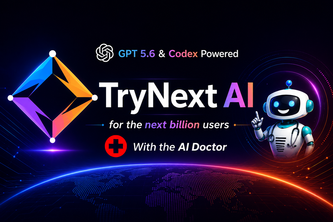
TryNext AI, as described by its author, is a self-reported voice-to-software factory built with GPT-5.6 and Codex. It claims to convert natural language or voice commands into live web applications, supports multilingual input, and includes an AI Doctor for code maintenance.
What changed
The project was submitted to the OpenAI 2026 hackathon on Devpost by a single founder, Ranajit Dhar. No prior version or product history is evident; this is a self-reported new development effort.
Single most important open question
Is there any evidence of real-world usage, revenue, or customer traction beyond the author's own description?
What The Product Actually Is
The description states that TryNext AI is a GPT-5.6-powered, Codex-built self-healing software factory. It claims to:
- Convert natural voice commands into live web applications.
- Use a three-agent system: Manager/Architect, Coder, and Evaluator.
- Support multilingual input (99+ languages).
- Allow live modification of generated UI and logic via voice.
- Include a reference-driven cloning workflow to analyze reference websites.
- Have an AI Doctor that scans repositories for issues and opens conservative GitHub PRs.
- Deploy apps to Vercel, with metadata stored in DynamoDB.
- Use a resilient inference system with fallbacks across multiple AI providers (Nova 2 Lite, GPT-5.6, Qwen3 Coder Next, AWS Bedrock Llama 3.3).
The author describes the core architecture as involving three cooperating agents and a provider-neutral askBrain() contract.
Inference: The product appears to be an experimental or prototype system built for a hackathon, not yet commercialized or validated in production.
Positioning & Claim Evolution
The author states that TryNext AI is "for the next billion users", aiming to make software creation accessible through voice and natural language. It positions itself as a solution to:
- The difficulty of coding.
- High costs of hiring developers.
- Language barriers preventing participation in the digital economy.
It also claims to address ongoing maintenance challenges by offering an AI Doctor that helps improve code post-deployment.
Inference: The positioning is aspirational and centered on accessibility, but no evidence of market validation or user feedback exists beyond the author’s own account.
Target Customer & ICP
The description states TryNext AI is built for:
- "Millions of people with brilliant ideas for apps and websites, but no practical way to build them."
- "Next billion users" — implying non-technical individuals or those in multilingual regions.
- Users who can describe their idea in natural language or voice.
It also targets users who may want to improve or maintain software post-deployment, through the AI Doctor feature.
Inference: The ICP is likely non-technical end-users, but there is no evidence of actual user segmentation or targeting beyond the author’s own assumptions.
Business Model & Pricing Evidence
The description does not include any information about:
- Revenue streams
- Pricing models
- Monetization strategy
- Customer acquisition costs
- Subscription or usage-based pricing
It mentions Razorpay as a payment integration, but no details are given on how payments would be processed or used.
Inference: No business model or pricing evidence is provided in the description.
Technical & Delivery Signals
The project is built with:
- Codex as an engineering copilot.
- Next.js, React, TypeScript, Tailwind, Vercel, DynamoDB, AWS, GitHub API, OpenAI, GPT-5.6, Whisper, Qwen3, Nova 2 Lite, Bedrock Llama 3.3.
- Uses a three-agent architecture: Manager, Coder, Evaluator.
- Implements a provider-neutral inference system with fallbacks.
- Includes an AI Doctor that opens GitHub PRs without auto-merging.
It also uses Vercel API routes and DynamoDB for serverless persistence.
Inference: The technical stack is advanced and modular, suggesting a prototype or early-stage product. No evidence of production deployment or scalability data.
Traction & Maturity Signals
The description states:
- The project was submitted to the OpenAI 2026 hackathon.
- It was built by one person, Ranajit Dhar.
- It includes a working, testable system as per the author’s own account.
There is no evidence of:
- Revenue
- Customers
- User adoption
- Product-market fit
- Iteration history or prior versions
Inference: This is an early-stage prototype with no demonstrated traction or maturity beyond the hackathon submission.
Competitive Context
The description does not mention any competitors. It does not reference existing tools for:
- Voice-to-code conversion.
- AI-powered app generation.
- Self-healing software systems.
- Multilingual developer tools.
- No-code or low-code platforms.
Inference: No competitive analysis is evident in the description, and it’s unclear whether similar products already exist or how TryNext AI would differentiate.
Open Questions & Risks
- No revenue or customer data: The product is described as a prototype with no evidence of monetization or real-world usage.
- Single-founder project: No team or external validation.
- Unverified claims: All features and capabilities are self-reported without independent verification.
- No production deployment: The system is described as testable but not yet in production.
- Lack of business model clarity: No pricing, monetization or go-to-market strategy.
- Technical complexity without traction: The architecture is advanced, but no evidence of real-world performance or scalability.
Inference: The project is experimental and lacks commercial viability indicators.
Questions the description leaves open
- What specific user feedback or testing has been conducted beyond the hackathon?
- How does TryNext AI handle edge cases in multilingual input or voice recognition?
- Has the AI Doctor ever opened a PR that was accepted by a human developer?
- What is the current plan for monetization and customer acquisition?
- Are there any existing users or pilot programs?
- How does the system ensure safety during code generation and modification?
- What are the technical limitations of the current architecture in real-world use?
Overall Assessment
The description states that TryNext AI is a self-healing software factory built for the next billion users, using GPT-5.6 and Codex. It includes a working prototype with advanced features like voice-to-app conversion, multilingual support, and an AI Doctor.
However, there is no evidence of revenue, customers, or traction beyond the author’s own account. The project is described as a hackathon submission by one person, with no indication of commercial viability or scalability.
Assessment: Not evidenced for investment or partnership. This is a self-reported prototype with no demonstrated product-market fit or commercial traction. Any potential value lies in its technical architecture and vision, but not in current business performance or readiness.
User Stories BotA demo video on every pull request
Get a demo video on every new feature
GitHub App that watches your pull requests and records a narrated, captioned demo.
Save time on demo prep and make informed decisions faster with a video walkthrough of every new feature.
Source
Submitted to the OpenAI 2026 hackathon on Devpost. Project home on Devpost. Back to the full gallery on Devpost.
This competitive analysis was produced by top-founders.com (opens in a new tab)
Generated by a language model from this project's public Devpost page — its tagline, the author's own write-up and any built-with tags listed there — as captured in August 2026. Short quotations are the author's words. It is an opinion on the idea as a business, not on the people behind it, and it reflects the description as published then. If the project has moved on, request a correction below. The analysis is not independent research and contains no verified traction, revenue or customer data.
An independent guide by KFG International LLC — not affiliated with, endorsed by, or connected to Devpost or OpenAI.