

Archive position — measured, not model output
1 like on Devpost
505 of the 7,850 archived projects have more likes, and 1,758 share exactly 1 — so this project's #830 place in the like-ranked listing is a tie-break inside that group, not a ranking.
Projects (log scale)
Likes on Devpost. ▲ marks this project's group.
Show the figures
| Likes | Projects | Share of archive |
|---|---|---|
| 0 | 5,587 | 71.2% |
| 1 | 1,758 | 22.4% |
| 2 | 284 | 3.6% |
| 3–4 | 132 | 1.7% |
| 5–9 | 75 | 1.0% |
| 10+ | 14 | 0.2% |
 User Stories BotA demo video on every pull request
Get a demo video on every new feature
GitHub App that watches your pull requests and records a narrated, captioned demo.
Save time on demo prep and make informed decisions faster with a video walkthrough of every new feature.
Executive Summary
Company: CodeGuardian (self-reported, unverified)
What it appears to be: An AI-powered debugging IDE for developers that helps fix broken repositories with minimal, verified patches while showing exactly what changed and why.
Key change: The project is described as a focused debugging tool, not a general AI coding assistant. It positions itself as a "debugger, not a software engineer."
Single most important open question: Is there evidence of real developer adoption or usage beyond the hackathon demo?
Commercial Due-Diligence Read: This is a self-reported, unverified product concept with no demonstrated traction, revenue, customers, or market validation. The description shows a clear vision and some technical implementation details but lacks any evidence of commercial viability or user feedback.
What The Product Actually Is
The description states that CodeGuardian is:
- An IDE-style debugging environment for broken repositories
- A debugger, not a software engineer
- Designed to repair reproducible failures with minimal, verified patches
- A tool that shows what failed, why it failed, what changed, and whether it was verified
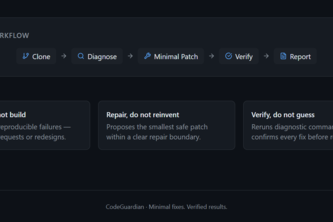
Evidence: The author's own write-up describes the product as an IDE-style debugging environment with workflow: Clone Repository → Diagnose → Minimal Patch → Verify → Report.
Inference: Based on the description, this appears to be a developer tool that integrates AI for debugging purposes rather than general coding assistance. It is positioned as a specialized debugging layer for broken repositories.
Positioning & Claim Evolution
The author states:
- CodeGuardian is a debugger, not a software engineer
- It repairs reproducible failures, not redesigns apps or adds features
- The core idea is to help developers fix broken repositories with minimal, verified patches
- It shows exactly what failed, why it failed, what changed, and whether it was verified
Evidence: The author's own write-up explicitly states these positioning claims.
Inference: This represents a shift from general AI coding tools toward specialized debugging assistance. The positioning emphasizes trust, verification, and minimal change over broad code generation capabilities.
Target Customer & ICP
The description states:
- Primary users are developers working with broken repositories
- It's designed for "developers who want to know what failed, why it failed, what changed, and whether it was verified"
- The tool is built for a debugging workflow rather than general coding
Evidence: The author describes the target as developers working with broken repositories and emphasizes debugging over code generation.
Inference: The ICP appears to be technical developers who encounter broken codebases and need structured debugging assistance. However, there's no evidence of specific developer personas or market segmentation beyond this general description.
Business Model & Pricing Evidence
Not evidenced.
The description does not contain any information about:
- Revenue model
- Pricing structure
- Monetization approach
- Customer acquisition costs
- Unit economics
Evidence: No business model or pricing information is provided in the self-reported description.
Technical & Delivery Signals
The description states:
- Built with Next.js, TypeScript, React, Tailwind CSS, Monaco Editor, Firebase Authentication
- Uses server-side repo clone route for import flow
- Has Guardian Chat architecture prepared for server-side AI responses
- Implements local session persistence for "resume previous debug sessions"
- Uses Codex for scaffolding and iteration across auth flow, IDE shell layout, diagnostics/repair UX, etc.
Evidence: The author lists specific technologies used in development and describes technical implementation details.
Inference: This suggests a modern web-based developer tool with session management capabilities. The use of AI APIs (OpenAI) indicates integration with generative AI for debugging assistance.
Traction & Maturity Signals
Not evidenced.
The description contains no information about:
- Customer adoption
- Revenue generation
- User engagement metrics
- Product usage data
- Market traction
- Customer feedback or testimonials
- Product iteration history
Evidence: The project is described as a hackathon submission with a polished demo path, but no evidence of real-world usage or market validation.
Competitive Context
Not evidenced.
The description does not contain any information about:
- Direct competitors
- Market size
- Competitive advantages
- Market positioning relative to existing tools
- Industry trends
- Alternative solutions in the space
Evidence: No competitive analysis or market context is provided in the self-reported description.
Open Questions & Risks
Key Risks:
- No demonstrated traction: The product is described as a hackathon submission with no evidence of real usage or adoption
- Unproven commercial viability: No revenue, customers, or business model evidence
- Limited team size: Only 2 team members may constrain execution capabilities
- AI integration uncertainty: While AI is mentioned, there's no evidence of actual AI performance or reliability
- Market validation gap: No evidence of developer demand or feedback beyond the author's own claims
Open Questions:
- Self-reported only: All information comes from unverified sources without independent corroboration
- No competitive differentiation: The description doesn't clearly articulate how CodeGuardian differs from existing debugging tools
- Limited scope: The product appears to be narrowly focused on a specific debugging workflow
Questions the description leaves open
- What specific debugging problems are you solving that existing tools don't address?
- How do you plan to validate developer adoption beyond the hackathon demo?
- What is your path to monetization and customer acquisition?
- Can you demonstrate real-world usage or feedback from developers?
- What are the technical limitations of current AI integration in debugging workflows?
- How do you plan to scale beyond a 2-person team?
- What specific metrics would indicate product-market fit for this tool?
Overall Assessment
Not evidenced.
The description provides no information about:
- Financial performance
- Market opportunity size
- Competitive positioning
- Team track record
- Investment requirements or returns
- Partnership potential
Confidence Level: Very low. This is a self-reported concept with no demonstrated traction, revenue, customers, or market validation. The project appears to be at the prototype/demo stage based on its hackathon submission context.
The author states this is for the OpenAI 2026 hackathon, which indicates it's an experimental concept rather than a commercial product. No evidence exists of any commercial viability, user adoption, or business model development beyond the initial concept and demo implementation.
User Stories BotA demo video on every pull request
Get a demo video on every new feature
GitHub App that watches your pull requests and records a narrated, captioned demo.
Save time on demo prep and make informed decisions faster with a video walkthrough of every new feature.
Source
Submitted to the OpenAI 2026 hackathon on Devpost. Project home on Devpost. Back to the full gallery on Devpost.
This competitive analysis was produced by top-founders.com (opens in a new tab)
Generated by a language model from this project's public Devpost page — its tagline, the author's own write-up and any built-with tags listed there — as captured in August 2026. Short quotations are the author's words. It is an opinion on the idea as a business, not on the people behind it, and it reflects the description as published then. If the project has moved on, request a correction below. The analysis is not independent research and contains no verified traction, revenue or customer data.
An independent guide by KFG International LLC — not affiliated with, endorsed by, or connected to Devpost or OpenAI.