

Archive position — measured, not model output
0 likes on Devpost
2,263 of the 7,850 archived projects have more likes, and 5,587 share exactly 0 — so this project's #2,793 place in the like-ranked listing is a tie-break inside that group, not a ranking.
Projects (log scale)
Likes on Devpost. ▲ marks this project's group.
Show the figures
| Likes | Projects | Share of archive |
|---|---|---|
| 0 | 5,587 | 71.2% |
| 1 | 1,758 | 22.4% |
| 2 | 284 | 3.6% |
| 3–4 | 132 | 1.7% |
| 5–9 | 75 | 1.0% |
| 10+ | 14 | 0.2% |
 User Stories BotA demo video on every pull request
Get a demo video on every new feature
GitHub App that watches your pull requests and records a narrated, captioned demo.
Save time on demo prep and make informed decisions faster with a video walkthrough of every new feature.
Executive Summary
What the company appears to be
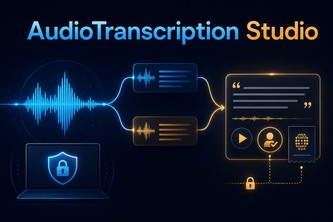
AudioTranscription Studio: Proof-Carrying Quotes is a self-reported tool for handling audio transcription disagreements, particularly in dual-ASR (Automatic Speech Recognition) setups. It allows users to review conflicting transcriptions, hear the original clip, and copy a "qualified quote" with an immutable receipt.
What changed
The project was submitted to the OpenAI 2026 hackathon, indicating it is likely early-stage or experimental in nature. No evidence of prior development, traction, or commercial activity is provided.
Single most important open question
Is there any evidence of actual use cases, customer feedback, or product-market fit beyond the hackathon submission?
Analysis basis
This report is based entirely on the self-reported project description supplied by the caller. It contains no archived data, third-party verification, or independent corroboration. All claims are unverified and should be treated as stated by the author.
What The Product Actually Is
The description states that AudioTranscription Studio: Proof-Carrying Quotes is a tool designed to resolve disagreements between two ASR systems (Automatic Speech Recognition). It enables users to:
- Hear the original audio clip
- Review conflicting transcriptions
- Copy a "qualified quote" with an immutable receipt
This suggests a product focused on improving transcription accuracy and accountability in dual-ASR workflows.
Evidence The tagline and project name describe the core functionality. No further technical details or screenshots are provided.
Positioning & Claim Evolution
The author positions the tool as solving a specific problem: "local dual-ASR disagreements." It is framed as a solution that allows users to make decisions based on audio review, rather than relying solely on text output from two competing ASR systems.
It also claims to provide an "immutable receipt" for quotes, suggesting a focus on verifiability and auditability.
Evidence The tagline and project name imply this is a niche tool addressing a specific technical challenge in transcription workflows. No prior positioning or evolution of claims is evident.
Target Customer & ICP
The description does not identify any specific customer personas or ideal customer profiles (ICP). It implies usage by individuals or teams working with dual-ASR systems, but no explicit target audience is defined.
Evidence Not evidenced. The project description does not define who would use this tool or in what context beyond general ASR users.
Business Model & Pricing Evidence
There is no evidence of a business model or pricing structure in the provided description. No mention of monetization, licensing, subscriptions, or fees is present.
Evidence Not evidenced. The project is described as a hackathon submission with no indication of commercial intent or revenue streams.
Technical & Delivery Signals
The author lists several technologies used in building the product:
- Frameworks: Flask, React, Tauri
- Languages: Python, TypeScript, Rust
- Libraries/Tools: PyTorch, CUDA, faster-whisper, nvidia-nemo, pyannote.audio, Vitest
- AI models: GPT-5.6, Canary, Codex
This suggests a technical stack focused on audio processing, ASR integration, and possibly AI-driven transcription or analysis.
Evidence The author-declared tech stack supports the idea of a software product built with modern tools for audio and AI processing.
Traction & Maturity Signals
There is no evidence of traction, adoption, or maturity beyond its submission to a hackathon. No customer data, usage metrics, or product development history are provided.
Evidence Not evidenced. The project is described as a hackathon entry with no indication of prior user engagement or product evolution.
Competitive Context
The description does not mention any competitors or existing solutions in the dual-ASR transcription space. No market analysis or competitive positioning is evident.
Evidence Not evidenced. No information about existing tools, markets, or competition is provided.
Open Questions & Risks
Key risks and open questions include:
- The project is a hackathon submission with no evidence of traction or product-market fit.
- No customer feedback, revenue, or adoption data.
- No indication of scalability or commercial viability.
- The use of AI model names like "GPT-5.6" may be speculative or misreported; this is not verified.
Evidence Inferences based on the lack of any substantive evidence beyond a hackathon submission.
Questions the description leaves open
- What specific problem in dual-ASR workflows does this tool address?
- Have you tested this with real users or actual ASR systems?
- Is there an existing market need for this functionality, or is it experimental?
- How do you plan to monetize this product if at all?
- What are the technical limitations of the current implementation?
Inference These questions aim to uncover whether the tool has moved beyond a proof-of-concept and into real-world application.
Overall Assessment
At this stage, there is no evidence of commercial viability, traction, or product-market fit. The project is described as a hackathon submission with no indication of prior development or use. It is unclear whether the tool has moved beyond experimental status.
Inference Based on the thin evidence provided, it is not possible to assess investment or partnership potential. This is an early-stage idea with no demonstrated value proposition or market validation.
User Stories BotA demo video on every pull request
Get a demo video on every new feature
GitHub App that watches your pull requests and records a narrated, captioned demo.
Save time on demo prep and make informed decisions faster with a video walkthrough of every new feature.
Source
Submitted to the OpenAI 2026 hackathon on Devpost. Project home on Devpost. Back to the full gallery on Devpost.
This competitive analysis was produced by top-founders.com (opens in a new tab)
Generated by a language model from this project's public Devpost page — its tagline and any built-with tags listed there, since the author published no write-up — as captured in August 2026. Short quotations are the author's words. It is an opinion on the idea as a business, not on the people behind it, and it reflects the description as published then. If the project has moved on, request a correction below. The analysis is not independent research and contains no verified traction, revenue or customer data.
An independent guide by KFG International LLC — not affiliated with, endorsed by, or connected to Devpost or OpenAI.