

Archive position — measured, not model output
0 likes on Devpost
2,263 of the 7,850 archived projects have more likes, and 5,587 share exactly 0 — so this project's #3,214 place in the like-ranked listing is a tie-break inside that group, not a ranking.
Projects (log scale)
Likes on Devpost. ▲ marks this project's group.
Show the figures
| Likes | Projects | Share of archive |
|---|---|---|
| 0 | 5,587 | 71.2% |
| 1 | 1,758 | 22.4% |
| 2 | 284 | 3.6% |
| 3–4 | 132 | 1.7% |
| 5–9 | 75 | 1.0% |
| 10+ | 14 | 0.2% |
 User Stories BotA demo video on every pull request
Get a demo video on every new feature
GitHub App that watches your pull requests and records a narrated, captioned demo.
Save time on demo prep and make informed decisions faster with a video walkthrough of every new feature.
Executive Summary
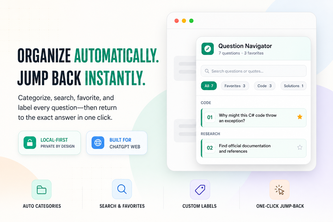
The description states that ChatGPT Question Navigator is a local-first Chrome/Edge browser extension designed to index and organize long ChatGPT conversations into a searchable question-based navigator with automatic categorization, labels, favorites, and one-click jump-back functionality. The author claims the tool works entirely locally without uploading conversation content or requiring an API key.
Key commercial signals:
- The project is self-developed by one person (Xu Zi Han)
- It targets users of ChatGPT who want to manage long conversations
- It uses deterministic local classification powered by GPT-5.6 and Codex during development, but not at runtime
- No revenue, customer or traction data is provided
Most important open question: Is there a meaningful market need for this tool beyond the author's personal use case? The description does not indicate any evidence of user adoption, demand, or commercial viability.
What The Product Actually Is
The description states that ChatGPT Question Navigator is:
- A Chrome and Edge browser extension
- Built using Manifest V3, JavaScript, HTML, CSS
- Designed to index questions in ChatGPT conversations into a searchable navigator
- Capable of automatic categorization (Code, Solutions, Research, To-dos, Other)
- Features include:
- Search across question text and quoted assistant snippets
- Favorite important turns
- Manual category correction
- Reusable custom labels and batch labeling
- One-click jump-back to original message
- Bilingual UI (Simplified Chinese and English)
- The extension is local-first, storing only metadata locally via
chrome.storage.local - It does not upload or store conversation content
The author states that the tool was built using Codex and GPT-5.6 during development, but these are not used at runtime.
Positioning & Claim Evolution
The description states:
- The product is positioned as a "local-first Chrome/Edge extension"
- It aims to solve the problem of "long ChatGPT conversations becoming valuable working documents"
- The author's stated goal was to create a "private index that makes a long conversation feel like a navigable research notebook"
- It is described as "without sending the conversation to another service"
The positioning evolved from:
- A personal solution to a common problem (scrolling through hundreds of messages)
- To a tool that offers local-first privacy and searchability
- To a tool with automatic categorization, labels, and favorites
The author claims the extension is "deterministic" and runs entirely on the user's device, so no API key is required.
Target Customer & ICP
The description states:
- The target customer is users of ChatGPT who have long conversations
- These users want to manage and navigate long ChatGPT conversations more efficiently
- The tool is intended for those who value privacy, as it does not upload conversation content
No explicit customer segments or personas are defined. The description implies the tool targets:
- Individuals using ChatGPT regularly
- Users who create long, complex conversations
- People concerned with privacy and local data handling
The ICP appears to be ChatGPT users who want better organization of their conversations.
Business Model & Pricing Evidence
Not evidenced.
The description does not state anything about:
- Revenue model
- Pricing structure
- Monetization strategy
- Subscription or one-time payment models
- Freemium vs. paid tiers
No evidence of any business model is provided in the self-reported description.
Technical & Delivery Signals
The description states:
- Built with Manifest V3, JavaScript, HTML, CSS
- Uses chrome.storage.local for metadata storage only (no conversation content)
- Implements deterministic bilingual classification using local signals like code blocks, file names, error text, research terms, planning language, and action-item phrases
- Handles dynamic ChatGPT page structure with delayed history loading
- Uses stable message IDs, DOM-order anchors, and placeholder completion to maintain correct ordering
- Supports Simplified Chinese and English UI
- No external runtime dependencies
- Open-sourced under GPL-3.0
- Includes installation and testing instructions
The author claims that:
- The tool was built using Codex and GPT-5.6 during development, but not at runtime
- It uses local-first processing, so no API key is required
Traction & Maturity Signals
Not evidenced.
The description does not provide any evidence of:
- User adoption or downloads
- Customer base or usage metrics
- Product maturity or iteration history
- Market traction or growth indicators
- Revenue or monetization activity
No traction data is provided beyond the author's own account.
Competitive Context
Not evidenced.
The description does not mention:
- Competitors in the market
- Existing tools for organizing ChatGPT conversations
- Market positioning relative to similar products
- Competitive advantages or differentiators
No competitive analysis is included in the self-reported description.
Open Questions & Risks
Inferences based on the description:
- Single-person development: The project is built by one person (Xu Zi Han), which may limit scalability and long-term maintenance.
- No commercial traction: There is no evidence of user adoption, revenue, or market demand beyond the author's personal use case.
- Limited scope: The tool only supports Chrome/Edge browsers and ChatGPT, limiting its potential reach.
- Self-reported nature: All claims are unverified; there is no independent validation of functionality or effectiveness.
- Open-source risk: While open-sourced under GPL-3.0, this may not align with commercial interests or monetization strategies.
- Dependency on ChatGPT UI changes: The tool relies heavily on ChatGPT's page structure, which could break with UI updates.
Questions the description leaves open
- What is the actual demand for this tool beyond your personal use case?
- Have you validated the need for this product with potential users?
- How do you plan to monetize or scale this tool?
- What are the technical challenges of maintaining compatibility with ChatGPT's evolving UI?
- Are there any competitors in the market, and how does your solution differ?
- What is your roadmap beyond the current features?
- How do you intend to distribute or promote the extension?
Overall Assessment
Not evidenced.
The description provides no information about:
- Financial performance
- Valuation or funding history
- Strategic fit for potential partners
- Investment readiness or commercial viability
No investment or partnership assessment can be drawn from the self-reported description alone.
User Stories BotA demo video on every pull request
Get a demo video on every new feature
GitHub App that watches your pull requests and records a narrated, captioned demo.
Save time on demo prep and make informed decisions faster with a video walkthrough of every new feature.
Source
Submitted to the OpenAI 2026 hackathon on Devpost. Project home on Devpost. Back to the full gallery on Devpost.
This competitive analysis was produced by top-founders.com (opens in a new tab)
Generated by a language model from this project's public Devpost page — its tagline, the author's own write-up and any built-with tags listed there — as captured in August 2026. Short quotations are the author's words. It is an opinion on the idea as a business, not on the people behind it, and it reflects the description as published then. If the project has moved on, request a correction below. The analysis is not independent research and contains no verified traction, revenue or customer data.
An independent guide by KFG International LLC — not affiliated with, endorsed by, or connected to Devpost or OpenAI.