

Archive position — measured, not model output
0 likes on Devpost
2,263 of the 7,850 archived projects have more likes, and 5,587 share exactly 0 — so this project's #7,140 place in the like-ranked listing is a tie-break inside that group, not a ranking.
Projects (log scale)
Likes on Devpost. ▲ marks this project's group.
Show the figures
| Likes | Projects | Share of archive |
|---|---|---|
| 0 | 5,587 | 71.2% |
| 1 | 1,758 | 22.4% |
| 2 | 284 | 3.6% |
| 3–4 | 132 | 1.7% |
| 5–9 | 75 | 1.0% |
| 10+ | 14 | 0.2% |
 User Stories BotA demo video on every pull request
Get a demo video on every new feature
GitHub App that watches your pull requests and records a narrated, captioned demo.
Save time on demo prep and make informed decisions faster with a video walkthrough of every new feature.
Executive Summary
What the company appears to be
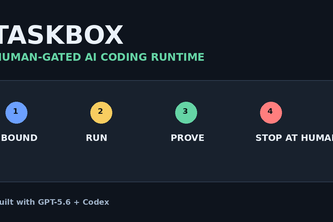
TaskBox is a self-reported developer tool that implements a bounded, auditable AI coding runtime. It is described as a deterministic execution environment for AI-generated code changes, designed to enforce one allowlisted change per task and produce machine-readable proof of execution.
What changed
The project was submitted to the OpenAI 2026 hackathon by a single founder (kiencuongnguyen88 Nguyen). It is described as a prototype or demo built in one primary session, with no evidence of prior development or product iteration.
Single most important open question
Is there any evidence that TaskBox has been used beyond the hackathon context, or that it has moved beyond a proof-of-concept stage?
What The Product Actually Is
The description states that TaskBox is a bounded, auditable runtime for AI coding. It is described as:
- A deterministic execution flow for one narrowly scoped coding request.
- A tool that reads and hashes the source tree.
- A system that creates a disposable working copy.
- A system that reproduces a failing baseline.
- A system that applies exactly one allowlisted change.
- A system that rejects changes outside the approved path.
- A system that reruns validation.
- A system that writes machine-readable JSON proof.
- A system that stops at a Human Gate.
It is built using Python, JavaScript, Node.js, HTML, CSS, JSON, Git, and GitHub. It requires no database, API key, or third-party runtime service.
Evidence
- The author's own description of the product’s behavior.
- Technology stack listed (Python, JavaScript, Node.js, Git, GitHub).
Inference
- The system is designed to be deterministic and reproducible.
- It enforces a strict change path and human control over execution.
Positioning & Claim Evolution
The author states that TaskBox was built to address the need for clear answers to basic operational questions in AI coding tools, such as:
- What source was read?
- What was allowed to change?
- Which commands actually ran?
- What remains under human control?
It is positioned as a tool that makes one AI coding task bounded, reproducible, and auditable, with a focus on governance and trust.
Evidence
- The author’s own write-up of the inspiration.
- The stated goal: to make AI coding tasks bounded, reproducible, and auditable.
Inference
- The product is positioned as a solution to governance challenges in AI-assisted development.
- It aims to reduce risk by constraining AI behavior and ensuring human control.
Target Customer & ICP
The description does not state the target customer or ideal customer profile (ICP). It is unclear whether TaskBox is intended for individual developers, teams, or enterprises.
Evidence
- No mention of specific user personas or organizational use cases.
- The product is described as a developer tool but no further segmentation is given.
Inference
- Likely aimed at developers or development teams using AI coding tools.
- Possibly targeted at organizations concerned with governance and auditability in AI-assisted workflows.
Business Model & Pricing Evidence
There is no evidence of any business model or pricing structure. The project is described as a hackathon submission, not a commercial product.
Evidence
- No mention of revenue, pricing, monetization, or customer acquisition.
- The project is described as a demo and prototype.
Inference
- Not yet in a commercial or monetized state.
- Likely not generating revenue at this stage.
Technical & Delivery Signals
The description states that TaskBox was built using:
- GPT-5.6 (for scoping and definition)
- Codex with GPT-5.6 Terra High (for implementation)
- Python, JavaScript, Node.js, HTML, CSS, JSON, Git, GitHub
- Built in one primary build session
It includes features such as:
- Deterministic task runner.
- Synthetic Node.js fixture.
- File allowlist enforcement.
- Source and tree hashing.
- Machine-readable proof.
- Local web interface and API.
- Human Gate state.
- Automated tests.
- Judge instructions.
Evidence
- The author’s own technical description of the build process and features.
Inference
- The tool is built with a focus on reproducibility, security, and auditability.
- It is designed to run locally without external dependencies.
Traction & Maturity Signals
There is no evidence of traction or maturity beyond the hackathon submission. The project is described as a single prototype built in one session.
Evidence
- No mention of users, customers, or adoption.
- No data on usage, retention, or product iteration.
- The project is described as a demo and not a commercial product.
Inference
- Not yet mature or in production use.
- Likely in early-stage development or proof-of-concept phase.
Competitive Context
The description does not provide any information about the competitive landscape. No competitors are mentioned, nor is there evidence of market positioning or differentiation from other AI coding tools.
Evidence
- No mention of existing products or competitors.
- No analysis of how TaskBox compares to similar tools.
Inference
- The product’s competitive context is unknown.
- It may be a novel approach, but this cannot be confirmed without additional data.
Open Questions & Risks
- No traction or commercial use: The project is described as a hackathon demo with no evidence of adoption.
- Single founder: The team size is listed as 1, which raises questions about scalability and execution capability.
- Unproven market demand: No evidence that there is a market need for this specific type of bounded AI coding runtime.
- Limited scope: The tool is described as a prototype with no indication of broader applicability or extensibility.
Evidence
- The project is described as a single-person hackathon submission.
- No mention of users, customers, or revenue.
Questions the description leaves open
- What specific problem are you solving, and how does TaskBox differ from existing tools?
- Have you tested TaskBox in real-world development workflows beyond the demo?
- Are there any plans to expand beyond the current prototype into a commercial product?
- How do you plan to scale beyond a single developer tool or hackathon project?
- What is your roadmap for product development and market entry?
Overall Assessment
Not evidenced.
There is no evidence of revenue, customers, traction, or any commercial viability beyond the hackathon submission. The project is described as a prototype with no indication of market readiness or scalability.
The single-founder team, lack of product-market fit evidence, and absence of any business model or pricing structure make it difficult to assess investment or partnership potential at this stage.
Confidence Low. This analysis is based entirely on the self-reported description provided by the author. No external validation or evidence of traction exists.
User Stories BotA demo video on every pull request
Get a demo video on every new feature
GitHub App that watches your pull requests and records a narrated, captioned demo.
Save time on demo prep and make informed decisions faster with a video walkthrough of every new feature.
Source
Submitted to the OpenAI 2026 hackathon on Devpost. Project home on Devpost. Back to the full gallery on Devpost.
This competitive analysis was produced by top-founders.com (opens in a new tab)
Generated by a language model from this project's public Devpost page — its tagline, the author's own write-up and any built-with tags listed there — as captured in August 2026. Short quotations are the author's words. It is an opinion on the idea as a business, not on the people behind it, and it reflects the description as published then. If the project has moved on, request a correction below. The analysis is not independent research and contains no verified traction, revenue or customer data.
An independent guide by KFG International LLC — not affiliated with, endorsed by, or connected to Devpost or OpenAI.