

Archive position — measured, not model output
0 likes on Devpost
2,263 of the 7,850 archived projects have more likes, and 5,587 share exactly 0 — so this project's #7,142 place in the like-ranked listing is a tie-break inside that group, not a ranking.
Projects (log scale)
Likes on Devpost. ▲ marks this project's group.
Show the figures
| Likes | Projects | Share of archive |
|---|---|---|
| 0 | 5,587 | 71.2% |
| 1 | 1,758 | 22.4% |
| 2 | 284 | 3.6% |
| 3–4 | 132 | 1.7% |
| 5–9 | 75 | 1.0% |
| 10+ | 14 | 0.2% |
 User Stories BotA demo video on every pull request
Get a demo video on every new feature
GitHub App that watches your pull requests and records a narrated, captioned demo.
Save time on demo prep and make informed decisions faster with a video walkthrough of every new feature.
Executive Summary
What the company appears to be
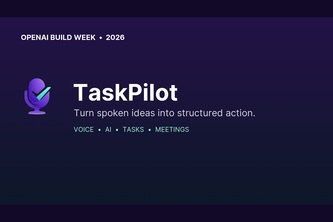
TaskPilot is a voice-first productivity app built as a personal project by one developer (Khalid Hajeer). The app aims to capture unstructured information from voice, text, and images and convert it into structured, actionable tasks using AI. It is designed for individuals managing multiple projects and contractors, with an emphasis on reducing the mental burden of task capture.
What changed
The project was submitted to the OpenAI 2026 hackathon, indicating a transition from a personal prototype to a public-facing product idea. The author describes building it as a solution to their own workflow problem, not as a commercial venture.
Single most important open question — the commercial due-diligence read
Is there evidence of user demand or traction beyond the single developer’s personal use case? There is no indication of customers, revenue, usage metrics, or market validation in the description.
What The Product Actually Is
The description states that TaskPilot is a voice-first productivity app that converts spoken thoughts, meeting conversations, typed notes, and images into structured tasks using AI. It supports:
- Voice input (English, Arabic, mixed-language)
- Meeting transcription and summarization
- Image-based task creation from screenshots or documents
- Local storage with optional AI processing
- Android, iOS, web, and desktop support via Flutter
It uses OpenAI APIs, Whisper, and multimodal models for processing. The app is built using Flutter/Dart, Firebase, SQLite, and native Android integrations.
Claim
TaskPilot transforms unstructured input into editable, structured tasks.
Evidence The author describes how voice or image inputs are processed through AI to generate tasks with titles, descriptions, due dates, reminders, priority, subtasks, etc. Every generated task must be reviewed before saving.
Positioning & Claim Evolution
The app is positioned as a simpler alternative to traditional to-do apps, focusing on capturing tasks at the moment they arise rather than completing them later. It emphasizes:
- Speed and convenience
- Reducing mental load
- Not replacing user judgment, but helping organize it
It does not claim to be a full-fledged productivity platform or enterprise tool.
Claim
TaskPilot reduces the pressure of remembering everything without adding complexity.
Evidence The author says: “I wanted something in the middle: simple and fast, but still powerful enough to organize real work.”
Inference (not fact) The positioning suggests a niche for personal productivity tools that prioritize ease-of-use over feature overload.
Target Customer & ICP
The description does not name specific customer segments or personas. However, it implies the app targets:
- Individuals managing multiple projects
- People who receive frequent phone calls, emails, and updates
- Users who want to avoid interrupting their workflow to log tasks manually
It is described as a personal project, not a commercial product aimed at a broad market.
Claim
TaskPilot serves users who struggle with task capture.
Evidence The author says: “I was managing several projects, contractors, and subcontractors while receiving a constant flow of phone calls, emails, requests, updates, and commitments.”
Inference (not fact) Based on the personal problem described, the ICP likely includes freelancers, project managers, or knowledge workers with fragmented workflows.
Business Model & Pricing Evidence
There is no evidence of pricing, monetization strategy, or business model in the description. The app appears to be a personal prototype, not a commercial offering.
Claim
TaskPilot has no stated pricing or revenue model.
Evidence No mention of subscriptions, freemium tiers, or paid features.
Technical & Delivery Signals
The app is built using modern cross-platform tools:
- Framework: Flutter/Dart
- Backend: Firebase, SQLite
- AI/ML: OpenAI APIs, Whisper, multimodal models
- Features include:
- Local-first storage
- Android home-screen widgets
- Foreground recording and notifications
- Meeting transcription with structured output
Claim
TaskPilot is technically robust, using best practices for AI integration and mobile delivery.
Evidence The author mentions:
- JSON schema validation
- Prompt engineering
- Low-temperature model settings
- Handling of long recordings via segmentation
- Native Android integrations
Traction & Maturity Signals
There is no evidence of traction, customers, or adoption beyond the single developer’s personal use. The project was submitted to a hackathon and has no published metrics.
Claim
TaskPilot lacks measurable traction.
Evidence No data on users, downloads, usage frequency, retention, or revenue.
Competitive Context
The author does not reference competitors directly. However, the app’s functionality overlaps with:
- Voice-based task capture tools
- Meeting transcription and summarization apps (e.g., Otter.ai, Notion)
- AI-powered note-taking and task management platforms
It is positioned as a simpler, more focused alternative to these.
Claim
TaskPilot competes in the personal productivity space.
Evidence The author contrasts it with “traditional to-do apps” that are either too basic or too complex.
Inference (not fact) It likely competes with tools like Notion, Todoist, or Google Tasks, but without market positioning or competitive analysis.
Open Questions & Risks
- No commercial traction or user base: The app is a personal prototype.
- Single developer team: No indication of scaling or support infrastructure.
- Unverified AI performance claims: Reliability of task generation and transcription is self-reported.
- Limited market validation: No evidence of demand beyond the author’s own use case.
Claim
Lack of commercial traction raises concerns about viability.
Evidence The project is described as a hackathon submission, not a product in development or launch.
Questions the description leaves open
- What specific problem are you solving for users beyond your own?
- Have you tested the AI output with real users or external feedback?
- How do you plan to monetize this tool if it remains a personal project?
- Are there any plans to expand beyond voice and image inputs?
- What is your roadmap for user onboarding, retention, and support?
Overall Assessment
Not evidenced.
There is no evidence of commercial traction, revenue, or customer validation. The app is described as a personal prototype built by one developer, submitted to a hackathon.
Claim
No investment or partnership opportunity is evident.
Evidence No financials, customers, or market data are provided.
Inference (not fact) If the author intends to build this into a product, it may be worth exploring further once traction or a clear go-to-market strategy emerges.
User Stories BotA demo video on every pull request
Get a demo video on every new feature
GitHub App that watches your pull requests and records a narrated, captioned demo.
Save time on demo prep and make informed decisions faster with a video walkthrough of every new feature.
Source
Submitted to the OpenAI 2026 hackathon on Devpost. Project home on Devpost. Back to the full gallery on Devpost.
This competitive analysis was produced by top-founders.com (opens in a new tab)
Generated by a language model from this project's public Devpost page — its tagline, the author's own write-up and any built-with tags listed there — as captured in August 2026. Short quotations are the author's words. It is an opinion on the idea as a business, not on the people behind it, and it reflects the description as published then. If the project has moved on, request a correction below. The analysis is not independent research and contains no verified traction, revenue or customer data.
An independent guide by KFG International LLC — not affiliated with, endorsed by, or connected to Devpost or OpenAI.