

Archive position — measured, not model output
0 likes on Devpost
2,263 of the 7,850 archived projects have more likes, and 5,587 share exactly 0 — so this project's #7,144 place in the like-ranked listing is a tie-break inside that group, not a ranking.
Projects (log scale)
Likes on Devpost. ▲ marks this project's group.
Show the figures
| Likes | Projects | Share of archive |
|---|---|---|
| 0 | 5,587 | 71.2% |
| 1 | 1,758 | 22.4% |
| 2 | 284 | 3.6% |
| 3–4 | 132 | 1.7% |
| 5–9 | 75 | 1.0% |
| 10+ | 14 | 0.2% |
 User Stories BotA demo video on every pull request
Get a demo video on every new feature
GitHub App that watches your pull requests and records a narrated, captioned demo.
Save time on demo prep and make informed decisions faster with a video walkthrough of every new feature.
Executive Summary
What the company appears to be
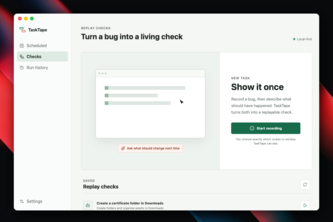
Tasktape is a self-reported macOS desktop application built as a hackathon project that aims to automate bug reproduction and regression testing by leveraging AI agents (Claude Code, Codex) and tools like Playwright, GPT-5.6, and Electron. It allows an AI agent to reproduce a browser bug, capture evidence during the process, and generate a replayable test case or ticket-ready report.
What changed
The project is described as a hackathon submission with no prior traction, revenue, or customer data. It was built in a short timeframe using self-declared technologies and tools, including GPT-5.6, Electron, React, Playwright, and OpenAI API. The author states that the core idea emerged from a desire to turn temporary bug reports into reusable regression checks.
The single most important open question
Is there any evidence of product-market fit or early user feedback beyond the hackathon submission? The description does not indicate whether the tool has been tested in real-world engineering workflows, nor if it has moved beyond prototype stage.
What The Product Actually Is
- The description states that Tasktape is a macOS desktop app.
- It uses Electron, React, TypeScript, and Playwright for implementation.
- It integrates with Claude Code, Codex, and GPT-5.6 to reproduce bugs and evaluate outcomes.
- The tool captures actions, screenshots, DOM snapshots, console logs, network failures, and trace evidence during a bug reproduction session.
- It generates a replayable regression check that can be scheduled, exported as Playwright code, or turned into a ticket-ready report.
Note
This is a self-reported product description. No independent verification or demonstration of functionality exists beyond the author’s account.
Positioning & Claim Evolution
- The project's tagline: “Turn an agent-reproduced bug into a replayable regression check with local evidence.” — this is a claim about the tool’s purpose.
- The author states that Tasktape started from the question: “what if a bug recording could become a reusable regression check?”
- The product is positioned as a way to automate and improve bug reporting, turning temporary debugging into persistent, actionable artifacts.
Inference The positioning suggests an intent to solve inefficiencies in current bug-reporting workflows, but the description does not confirm adoption or feedback from users.
Target Customer & ICP
- The description states that Tasktape is intended for use by engineers who are debugging browser-based issues.
- It targets a developer workflow where AI agents (e.g., Claude Code, Codex) are used to reproduce bugs.
- The tool is designed to generate actionable regression checks, which implies it’s aimed at teams or individuals working on software quality assurance.
Not evidenced No explicit customer segment or persona is defined. No evidence of early adopters or user interviews.
Business Model & Pricing Evidence
- The description does not mention any pricing, monetization strategy, or business model.
- It is described as a hackathon project, with no indication of commercial intent or revenue streams.
Not evidenced No information on how the product would be sold, licensed, or used in a commercial context.
Technical & Delivery Signals
- Built using: Electron, React, TypeScript, Playwright, MCP, OpenAI API.
- Uses GPT-5.6 for structured workflow understanding and outcome evaluation.
- Integrates with Codex for development and research.
- The app is designed to capture evidence during agent workflows, including screenshots, DOM snapshots, logs, and network traces.
- It supports exporting tests as Playwright code and scheduling checks.
Inference The technical stack suggests a desktop application focused on automation and AI integration. However, no evidence of deployment, scalability, or performance data is provided.
Traction & Maturity Signals
- This is described as a hackathon submission, not a product in production.
- No mention of users, customers, or usage metrics.
- The team size is listed as 1 (Rohit Purkait).
- The project was submitted to the OpenAI 2026 hackathon.
Not evidenced No evidence of traction, revenue, or adoption beyond the author’s own account. No data on user feedback or product iteration.
Competitive Context
- The description does not mention competitors.
- It is implied that Tasktape addresses a gap in current bug reporting and regression testing tools, especially those involving AI agents.
- Tools like Playwright, Selenium, or Bugsnag may be relevant, but no comparison or competitive analysis is provided.
Not evidenced No information on existing tools or how Tasktape differentiates from them.
Open Questions & Risks
- The project is a hackathon submission, not a product in development.
- It has no evidence of traction, revenue, or user feedback.
- The use of GPT-5.6 (not GPT-4) and Codex implies reliance on proprietary AI tools that may not be scalable or available to all users.
- The team is 1 person, which raises questions about execution capability and scalability.
- No mention of security, privacy, or data handling practices.
Inference The lack of commercialization, user testing, and scalability planning are key concerns for a potential investment or partnership.
Questions the description leaves open
- What was the actual user feedback from the hackathon or any early adopters?
- How does Tasktape handle data privacy and local evidence storage?
- Is there a plan to expand beyond macOS or support other platforms?
- What is the intended monetization model for this tool?
- Are there any technical limitations in scaling the AI agent workflows or capturing evidence reliably?
- How does Tasktape compare to existing tools like Playwright, Selenium, or Bugsnag?
Overall Assessment
- Not evidenced No data on product-market fit, revenue, or user traction.
- The project is described as a hackathon submission with no commercialization or customer feedback.
- It has no verified evidence of adoption, scalability, or business model.
- The tool’s positioning suggests a potential market need, but the description does not confirm that need is being met.
Assessment This is an early-stage idea with no demonstrated traction. It requires further due diligence to assess whether it has evolved into a viable product or if it remains a prototype.
User Stories BotA demo video on every pull request
Get a demo video on every new feature
GitHub App that watches your pull requests and records a narrated, captioned demo.
Save time on demo prep and make informed decisions faster with a video walkthrough of every new feature.
Source
Submitted to the OpenAI 2026 hackathon on Devpost. Project home on Devpost. Back to the full gallery on Devpost.
This competitive analysis was produced by top-founders.com (opens in a new tab)
Generated by a language model from this project's public Devpost page — its tagline, the author's own write-up and any built-with tags listed there — as captured in August 2026. Short quotations are the author's words. It is an opinion on the idea as a business, not on the people behind it, and it reflects the description as published then. If the project has moved on, request a correction below. The analysis is not independent research and contains no verified traction, revenue or customer data.
An independent guide by KFG International LLC — not affiliated with, endorsed by, or connected to Devpost or OpenAI.