

Archive position — measured, not model output
1 like on Devpost
505 of the 7,850 archived projects have more likes, and 1,758 share exactly 1 — so this project's #1,257 place in the like-ranked listing is a tie-break inside that group, not a ranking.
Projects (log scale)
Likes on Devpost. ▲ marks this project's group.
Show the figures
| Likes | Projects | Share of archive |
|---|---|---|
| 0 | 5,587 | 71.2% |
| 1 | 1,758 | 22.4% |
| 2 | 284 | 3.6% |
| 3–4 | 132 | 1.7% |
| 5–9 | 75 | 1.0% |
| 10+ | 14 | 0.2% |
 User Stories BotA demo video on every pull request
Get a demo video on every new feature
GitHub App that watches your pull requests and records a narrated, captioned demo.
Save time on demo prep and make informed decisions faster with a video walkthrough of every new feature.
Executive Summary
What the company appears to be
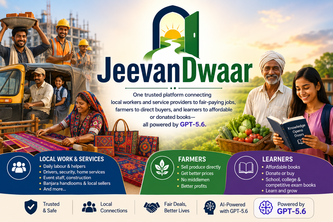
JeevanDwaar is a self-reported, multilingual platform built for local communities in India. The author describes it as one trusted platform connecting local workers and service providers to fair-paying jobs, farmers to direct buyers, and learners to affordable or donated books—all powered by GPT-5.6.
What changed
The project was submitted to the OpenAI 2026 hackathon. It is a self-contained prototype built with Next.js, React, Supabase, and GPT-5.6, designed for demonstration purposes using browser-persisted data and fallbacks.
Single most important open question
Is there any evidence of real-world usage or traction beyond the author’s own development and demo?
What The Product Actually Is
The description states that JeevanDwaar is a multilingual platform with three connected marketplaces:
- Local Work and Services
- Employers post roles (e.g., event helpers, construction workers, drivers).
- Workers can review transparent information about payment, location, schedule, required skills, and number of workers needed.
- Skill-match scores are calculated deterministically using a formula based on matching skills vs. job requirements.
- Farmer Direct Market
- Farmers list produce and compare buyer offers.
- Offers include unit price, requested quantity, total offer value, pickup date, loading conditions, and transportation details.
- Total offer value is computed in application code.
- Used Books and Donations
- People can sell or donate books directly to learners or community groups.
- Book owners review requests, select recipients, and complete handovers.
- The platform distinguishes between paid sales and free donations.
GPT-5.6 is used as an assistance layer:
- Converts natural language into editable listings
- Explains match scores and tradeoffs
- Presents complex information in simpler terms
All AI suggestions must be manually reviewed and confirmed by users before publication. If GPT-5.6 or credentials are unavailable, a clearly labeled Safe fallback is displayed.
The product was built using:
- Next.js 16, React 19, TypeScript, Tailwind CSS
- Supabase Auth, PostgreSQL, Row Level Security
- OpenAI Responses API with GPT-5.6
- Zod for structured validation
- Vitest and Playwright for testing
A browser-persisted demo allows judges to test workflows without account creation or database setup.
Positioning & Claim Evolution
The author claims JeevanDwaar is:
- A trusted platform connecting people to local work, direct agricultural markets, and affordable books.
- Powered by GPT-5.6, though the model acts as an assistant, not a decision-maker.
- Designed for local communities in India, supporting multilingual use (specifically Telugu and English).
Positioning evolution:
- The project starts with a broad claim: “a doorway to life and opportunity.”
- It narrows down to three specific marketplaces addressing real needs: labor, agriculture, education.
- It emphasizes trustworthiness through transparency, deterministic calculations, and human control over key decisions.
This positioning reflects an intent to build a community-focused, trust-based marketplace rather than a traditional e-commerce or gig economy platform.
Target Customer & ICP
The description states that JeevanDwaar targets:
- Local workers and service providers
- Farmers seeking direct buyers
- Learners and community groups needing books
These users are described as operating within local, informal economies where discovery and trust are barriers.
ICP (Ideal Customer Profile) is not explicitly defined. However, the author implies that:
- Users are primarily in rural or semi-urban India
- They value transparency, fairness, and local connection
- They may lack access to formal job platforms or marketplaces
No evidence of segmentation beyond these user types.
Business Model & Pricing Evidence
The description does not provide any information about:
- Revenue streams
- Pricing models
- Monetization strategy
- Fees or commissions
It only mentions that the platform supports:
- Paid book sales
- Donation-based book transfers
- Transparent listings for jobs and produce
There is no indication of how the platform intends to generate income, nor whether it plans to charge fees.
Technical & Delivery Signals
The author reports:
- Built with Next.js 16, React 19, TypeScript, Tailwind CSS
- Uses Supabase Auth, PostgreSQL, Row Level Security, and guarded database functions
- Implements Zod structured validation for AI outputs
- Integrates OpenAI Responses API with GPT-5.6
- Supports browser-persisted demo mode using localStorage
- Includes unit tests (Vitest) and end-to-end tests (Playwright)
- Uses GitHub Actions for CI
The architecture supports both:
- Browser-based demo (for judging)
- Production-ready Supabase persistence
No evidence of scalability, performance metrics, or production deployment.
Traction & Maturity Signals
There is no evidence of:
- Revenue
- Customers
- Users
- Adoption
- Product usage data
- Market traction
The project is described as a hackathon submission, built for demonstration purposes. It includes a browser-persisted demo and does not appear to have launched in production.
Competitive Context
The description does not mention:
- Competitors
- Existing platforms in similar domains
- Market size or competitive landscape
It only states that the author identified a need for direct, understandable, and trustworthy connections between people and opportunities.
No evidence of market analysis or competitive positioning beyond the claim of being a new kind of platform.
Open Questions & Risks
Inferences based on self-reported claims:
- Over-reliance on AI as an assistant without clear value-add: The use of GPT-5.6 is limited to explanation and conversion, not decision-making. This may reduce perceived utility unless the AI significantly improves user experience.
- No monetization strategy: Without a defined business model or pricing structure, it’s unclear how the platform will be sustainable.
- Demo-only architecture: The project appears to exist only in demo form, with no indication of production readiness or scalability.
- Unverified claims about GPT-5.6: The author refers to GPT-5.6, which is not a real model; this may indicate confusion or misrepresentation.
- No evidence of real-world testing or feedback: The platform has not been tested in actual use cases beyond the developer’s own prototype.
Questions the description leaves open
- What are the specific user needs that JeevanDwaar aims to solve, and how were they identified?
- How does the team plan to scale beyond a single-person hackathon project?
- Are there any existing partnerships or pilot programs with local organizations?
- What is the long-term vision for monetization and sustainability?
- Can you clarify the role of GPT-5.6 in practice? Is it truly integrated, or just simulated?
- How will the platform handle disputes or safety concerns in real-world use?
- Has there been any feedback from potential users or community members?
Overall Assessment
Not evidenced.
The project is described as a hackathon submission with no evidence of traction, revenue, customers, or operational history. While the concept and execution show some thoughtfulness around trust, transparency, and accessibility, there is no indication that it has moved beyond prototype stage.
There is insufficient evidence to assess whether this represents a viable business opportunity or strategic fit for investment or partnership. The lack of real-world usage data, clear monetization strategy, or competitive differentiation makes any commercial due-diligence judgment premature.
User Stories BotA demo video on every pull request
Get a demo video on every new feature
GitHub App that watches your pull requests and records a narrated, captioned demo.
Save time on demo prep and make informed decisions faster with a video walkthrough of every new feature.
Source
Submitted to the OpenAI 2026 hackathon on Devpost. Project home on Devpost. Back to the full gallery on Devpost.
This competitive analysis was produced by top-founders.com (opens in a new tab)
Generated by a language model from this project's public Devpost page — its tagline, the author's own write-up and any built-with tags listed there — as captured in August 2026. Short quotations are the author's words. It is an opinion on the idea as a business, not on the people behind it, and it reflects the description as published then. If the project has moved on, request a correction below. The analysis is not independent research and contains no verified traction, revenue or customer data.
An independent guide by KFG International LLC — not affiliated with, endorsed by, or connected to Devpost or OpenAI.