

Archive position — measured, not model output
1 like on Devpost
505 of the 7,850 archived projects have more likes, and 1,758 share exactly 1 — so this project's #1,259 place in the like-ranked listing is a tie-break inside that group, not a ranking.
Projects (log scale)
Likes on Devpost. ▲ marks this project's group.
Show the figures
| Likes | Projects | Share of archive |
|---|---|---|
| 0 | 5,587 | 71.2% |
| 1 | 1,758 | 22.4% |
| 2 | 284 | 3.6% |
| 3–4 | 132 | 1.7% |
| 5–9 | 75 | 1.0% |
| 10+ | 14 | 0.2% |
 User Stories BotA demo video on every pull request
Get a demo video on every new feature
GitHub App that watches your pull requests and records a narrated, captioned demo.
Save time on demo prep and make informed decisions faster with a video walkthrough of every new feature.
Executive Summary
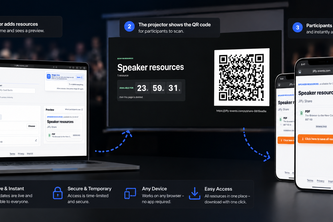
Jiffy share is a self-reported tool designed to help speakers distribute content (slides, links, PDFs) to attendees via a QR code. The author states it was built as part of an OpenAI 2026 hackathon submission and describes the product as solving a "real problem" around post-presentation content sharing. It is described as a temporary sharing page that allows speakers to upload materials which are then automatically delivered to users’ devices.
The project is currently in early-stage development, with no evidence of revenue, customers or traction beyond author claims. The tool appears to be built using open-source and low-code tools (e.g., Codex for UI/UX iteration), and the author reports that it was made open source due to positive feedback. There is no indication of a formal business model, pricing strategy, or target customer segmentation.
The single most important open question
Is there any evidence of actual usage or adoption by speakers or presenters beyond the author’s own experience?
What The Product Actually Is
The description states that Jiffy share provides a "temporary sharing page" accessible via a QR code. Speakers can upload content such as slides, links, and PDFs, which are then automatically delivered to attendees’ devices.
- The product is described as allowing users to “receive them automatically on their device and can save them.”
- It is built using Bootstrap, Cloudflare, DigitalOcean, JavaScript, Python, and SQLite.
- The author reports that the tool was prototyped with GPT 5.6 and Codex, suggesting a significant role for AI in UI/UX design and development.
Inference: Based on the description, it appears to be a lightweight, temporary content-sharing platform aimed at speakers or presenters who want to distribute materials after talks or presentations.
Positioning & Claim Evolution
The author claims that Jiffy share addresses a real problem: “after attending talks and presentations, there was no easy way to get the slides or links from the presenter.”
- The tool is positioned as solving a gap in post-presentation content delivery.
- It is described as a "tiny tool" that is "super focused" and solves a niche need.
- The author notes that it was made open source due to positive feedback, suggesting an early-stage attempt at validation or distribution.
Inference: The positioning evolved from a hackathon prototype into a potential product idea with open-source traction, but there is no evidence of a formal positioning strategy or brand development beyond the author’s own claims.
Target Customer & ICP
The author states that Jiffy share is intended for:
- Speakers
- Presenters
- Developers
- Schools and Universities
- The tool is described as useful for “anyone who gives talks or presentations.”
- It is not clear whether the tool targets a specific vertical or segment beyond general presenters.
Inference: The target customer appears to be broad — anyone giving presentations — but there is no evidence of segmentation, buyer personas, or specific customer validation.
Business Model & Pricing Evidence
There is no evidence in the description of:
- A pricing model
- Revenue streams
- Monetization strategy
- Customer acquisition costs
- Any business model beyond the author’s own use case
The author mentions that they are considering turning it into a startup, but no business plan or monetization details are provided.
Inference: The business model is not evidenced. It may be early-stage and unformed.
Technical & Delivery Signals
- Built with Bootstrap, Cloudflare, DigitalOcean, JavaScript, Python, and SQLite
- Development was aided by GPT 5.6 and Codex, which were used for UI/UX iteration
- The author states that they “just said, now give me a prd for codex as .md” and then implemented it
- The tool is described as being built quickly and iteratively
Inference: The technical stack suggests a simple, lightweight web-based solution. The use of AI tools in development indicates rapid prototyping but does not imply scalability or robustness.
Traction & Maturity Signals
The author states:
- They got “so much feedback” that they made it open source
- They are considering turning the tool into a startup
- It was submitted to a hackathon (OpenAI 2026)
There is no evidence of:
- Revenue or monetization
- Customers or user base
- Product-market fit validation
- Any measurable traction beyond feedback and open-source release
Inference: The product has no demonstrated traction. It remains in early-stage development with no data on adoption or usage.
Competitive Context
There is no evidence of:
- Competitors
- Market analysis
- Competitive positioning
- Prior art or similar tools
The author does not reference any existing solutions for sharing presentation materials, nor do they describe how their tool compares to others in the space.
Inference: No competitive context is evident. The product appears to be a novel idea within the author’s own experience, but no external validation or comparison exists.
Open Questions & Risks
- No revenue or customer data: The project has no evidence of monetization or adoption.
- Unproven market need: While the author claims it solves a real problem, there is no third-party validation or user data to support this.
- Early-stage prototype: Built in a hackathon, with no indication of product maturity or scalability.
- No pricing or business model: The idea is not yet monetized or structured for growth.
- Self-reported only: All claims are from the author and unverified.
Inference: The project is at a very early stage and lacks any commercial validation. It may be an idea in need of further development, but no evidence supports its viability as a business.
Questions the description leaves open
- What specific feedback did you receive from users that led to making it open source?
- Have you conducted any user interviews or surveys to validate the problem you’re solving?
- How do you plan to monetize this tool if you intend to turn it into a startup?
- What is your go-to-market strategy for reaching speakers, presenters, and educational institutions?
- Are there any competitors in this space, and how does Jiffy share differentiate itself?
Overall Assessment
The author states that Jiffy share was built as a hackathon project and is now being considered for turning into a startup.
- There is no evidence of traction, revenue, or customer validation.
- The tool is described as solving a real problem, but no data supports this claim.
- It is currently in early development with no business model or pricing strategy evident.
Assessment: Not evidenced. This is an idea in its earliest form, with no commercial due-diligence signals to support investment or partnership interest. The project lacks any measurable progress beyond the author’s own claims and prototype.
User Stories BotA demo video on every pull request
Get a demo video on every new feature
GitHub App that watches your pull requests and records a narrated, captioned demo.
Save time on demo prep and make informed decisions faster with a video walkthrough of every new feature.
Source
Submitted to the OpenAI 2026 hackathon on Devpost. Project home on Devpost. Back to the full gallery on Devpost.
This competitive analysis was produced by top-founders.com (opens in a new tab)
Generated by a language model from this project's public Devpost page — its tagline, the author's own write-up and any built-with tags listed there — as captured in August 2026. Short quotations are the author's words. It is an opinion on the idea as a business, not on the people behind it, and it reflects the description as published then. If the project has moved on, request a correction below. The analysis is not independent research and contains no verified traction, revenue or customer data.
An independent guide by KFG International LLC — not affiliated with, endorsed by, or connected to Devpost or OpenAI.