

Archive position — measured, not model output
1 like on Devpost
505 of the 7,850 archived projects have more likes, and 1,758 share exactly 1 — so this project's #1,260 place in the like-ranked listing is a tie-break inside that group, not a ranking.
Projects (log scale)
Likes on Devpost. ▲ marks this project's group.
Show the figures
| Likes | Projects | Share of archive |
|---|---|---|
| 0 | 5,587 | 71.2% |
| 1 | 1,758 | 22.4% |
| 2 | 284 | 3.6% |
| 3–4 | 132 | 1.7% |
| 5–9 | 75 | 1.0% |
| 10+ | 14 | 0.2% |
 User Stories BotA demo video on every pull request
Get a demo video on every new feature
GitHub App that watches your pull requests and records a narrated, captioned demo.
Save time on demo prep and make informed decisions faster with a video walkthrough of every new feature.
Executive Summary
What the company appears to be
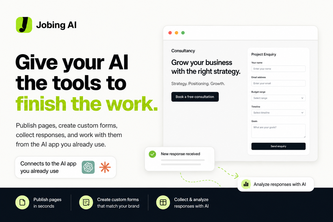
Jobing AI is a self-reported tool that integrates with ChatGPT via the Model Context Protocol (MCP) to enable users to ask AI to perform actions like creating and publishing web pages, forms, and collecting submissions — all within a single conversation. It allows for permission-controlled access to generated content and dashboards.
What changed
The author states they built this tool because ChatGPT can generate code but not complete workflows such as hosting, form backend setup, or submission handling. They aim to bridge that gap by enabling AI to finish tasks end-to-end using existing infrastructure.
Single most important open question
Is there any evidence of actual usage, revenue, or customer traction beyond the author’s own description? The self-reported nature of the project means no third-party validation exists for its commercial viability or adoption.
What The Product Actually Is
The description states that Jobing AI is a system that connects ChatGPT to web infrastructure through the Model Context Protocol (MCP). It allows users to ask ChatGPT to create, publish, and manage forms and pages. The tool supports actions such as:
- Publishing and updating web pages
- Creating and publishing custom forms
- Adding native branded forms to websites
- Collecting and organizing submissions
- Searching and summarizing responses
- Managing inbox, spam, and archived responses
It also provides a dashboard for users who are not inside an AI conversation.
Inference The product appears to be an integration layer between AI (specifically ChatGPT) and backend services like databases, authentication systems, and hosting platforms. It is built using technologies such as Next.js, Supabase, Clerk, Neon Postgres, and Vercel.
Not evidenced No information on actual user base, revenue, or customer data.
Positioning & Claim Evolution
The author claims that Jobing AI solves the problem of “the next part” — where ChatGPT generates code but leaves users to manually deploy or configure systems. The positioning is:
- To make AI actions complete workflows
- To allow users to stay within ChatGPT while getting real results
- To provide control over permissions, drafts, and access
The evolution of the claim seems to be from a simple idea (AI generates code, but doesn’t finish it) to a more nuanced one (AI should safely complete tasks with user control).
Inference The positioning reflects an attempt to address a gap in AI tooling — not just generating content, but enabling execution and management.
Not evidenced No evidence of prior versions or iterations, nor any external feedback on positioning.
Target Customer & ICP
The description implies that the target customer is someone who uses ChatGPT for creative or development tasks and wants to turn those ideas into functional web assets. These users likely include:
- Developers or designers using AI tools
- Small business owners or consultants with limited technical resources
- Users building new types of ChatGPT apps or sites
The ICP appears to be individuals or teams who want to use AI for rapid prototyping and deployment without needing full-stack engineering knowledge.
Inference The product targets users who are comfortable with AI but lack the infrastructure or time to implement generated outputs.
Not evidenced No explicit customer personas, segmentation data, or user interviews.
Business Model & Pricing Evidence
The description does not state anything about pricing, monetization, or business model. It only describes how the tool works and what it enables.
Inference Since no revenue streams are mentioned, it is unclear whether this is a freemium, SaaS, or one-time-use product.
Not evidenced No information on pricing tiers, subscriptions, or monetization strategy.
Technical & Delivery Signals
The author reports that Jobing AI was built using:
- Frameworks: Next.js, TypeScript, React
- Hosting: Vercel
- Databases: Supabase, Neon Postgres
- Authentication: Clerk
- Tools: Codex, GPT-5.6, MCP (Model Context Protocol), OpenAI
It uses the Model Context Protocol to expose tools for pages, forms, publishing, responses, and feedback.
Inference The technical stack suggests a modern full-stack web application with strong integration capabilities and modular design.
Not evidenced No details on scalability, performance metrics, or deployment architecture beyond what’s listed in the tech stack.
Traction & Maturity Signals
There is no evidence of traction or maturity beyond the author's own account. The project was submitted to a hackathon (OpenAI 2026), and there is no mention of:
- Customers
- Revenue
- User growth
- Product usage statistics
The team size is listed as one person, indicating early-stage development.
Inference This is likely an MVP or prototype with limited real-world testing or adoption.
Not evidenced No data on user engagement, retention, or product adoption.
Competitive Context
The author mentions competitors like Lovable, Bolt, and Google Forms. They argue that:
- Lovable and Bolt are good for larger applications but not for simple campaigns
- Google Forms lacks branding and integration with websites
However, no competitive analysis is provided beyond these comparisons.
Inference Jobing AI positions itself as a middle-ground solution between generic tools like Google Forms and full-stack platforms like Lovable or Bolt.
Not evidenced No market sizing, competitive pricing, or differentiation strategies.
Open Questions & Risks
Key risks and open questions include:
- Single-person team: Indicates limited resources for scaling or support
- No revenue or traction data: Suggests no proven commercial viability
- Self-reported only: No independent verification of claims or functionality
- Unproven market demand: No evidence of user interest beyond the author’s own use case
- Security complexity: The need to balance AI access with user control raises potential implementation challenges
Inference The lack of traction and commercial validation makes this a high-risk, early-stage idea.
Not evidenced No risk assessments, failure rates, or mitigation plans.
Questions the description leaves open
- What specific use cases have you identified for Jobing AI beyond the examples in your write-up?
- Have you tested the product with real users? If so, what feedback did they give?
- How do you plan to scale from a single developer to a larger team or customer base?
- Is there any existing market research or competitive analysis that supports your positioning?
- What are the key assumptions behind your product design and feature set?
Overall Assessment
Assessment Early-stage prototype with no demonstrated traction, revenue, or user validation.
Confidence Level Low — based entirely on self-reported information.
Reasoning
The project is described as a hackathon submission by one individual. There is no evidence of product-market fit, customer adoption, or monetization strategy. While the concept has potential, it lacks any commercial due-diligence signals.
Inference This could be an interesting idea with room for development, but it currently offers no clear path to profitability or scalability.
Not evidenced No financials, user data, or strategic partnerships.
User Stories BotA demo video on every pull request
Get a demo video on every new feature
GitHub App that watches your pull requests and records a narrated, captioned demo.
Save time on demo prep and make informed decisions faster with a video walkthrough of every new feature.
Source
Submitted to the OpenAI 2026 hackathon on Devpost. Project home on Devpost. Back to the full gallery on Devpost.
This competitive analysis was produced by top-founders.com (opens in a new tab)
Generated by a language model from this project's public Devpost page — its tagline, the author's own write-up and any built-with tags listed there — as captured in August 2026. Short quotations are the author's words. It is an opinion on the idea as a business, not on the people behind it, and it reflects the description as published then. If the project has moved on, request a correction below. The analysis is not independent research and contains no verified traction, revenue or customer data.
An independent guide by KFG International LLC — not affiliated with, endorsed by, or connected to Devpost or OpenAI.